


A dog drinking more than about 100 mL per kilogram of body weight per day, over roughly 1,000 mL for a 10 kg dog, is past the common cutoff and warrants a veterinary conversation. Healthy dogs generally sit nearer 50 to 60 mL per kilogram, so the gap between ordinary thirst and a problem is wider than a half-empty bowl suggests.
Most owners judge thirst by how often the bowl looks empty. That habit misses the key question. Is your dog drinking more water than its weight, diet, and day would predict, or are you noticing normal refills after a warm walk?
Thirst is a measurement, not a feeling. Log intake against body weight for three to five days before you decide it is a problem. A single busy afternoon at the bowl tells you almost nothing. A repeated total, written down, tells your veterinarian where to start.
Table of Contents
- How Much Water Is Too Much for Your Dog
- How to Measure Your Dog's Water Intake at Home
- Common Causes Behind Increased Thirst
- Diagnostic Tests Your Vet May Recommend
- Interim Care and When to Call Your Vet Right Away
- Work With Your Vet to Choose the Right Treatment
How Much Water Is Too Much for Your Dog
How can you tell whether your dog's thirst is unusually high? Veterinary references commonly use consumption above approximately 100 milliliters per kilogram of body weight per day as a screening guideline for excessive drinking, or polydipsia. The Veterinary Information Network conference proceedings also recommend recording daily water intake at home for 3 to 5 consecutive days. Healthy dogs generally drink about 50 to 60 mL/kg/day, though diet moisture, temperature, humidity, activity, and health can shift their usual intake.
For a 10-kilogram dog, 50 to 60 mL/kg works out to roughly 500 to 600 mL a day; the screening line is above 1,000 mL. For a 20-kilogram dog, that is about 1.0 to 1.2 liters typically, with the screening line above 2.0 liters. The math scales with body weight, like adjusting a recipe for a larger serving.
A weight table you can check tonight
Multiply your dog's weight in kilograms by 50 to 60 for a typical daily estimate, or by 100 for the screening line.
| Dog weight | Typical daily water intake | Polydipsia threshold (more than) |
|---|---|---|
| 5 kg (about 11 lb) | 250 to 300 mL | 500 mL |
| 10 kg (about 22 lb) | 500 to 600 mL | 1,000 mL |
| 20 kg (about 44 lb) | 1.0 to 1.2 L | 2.0 L |
A 5 kg dog drinking 500 mL reaches twice the upper end of the typical estimate. A 20 kg dog drinking 2.0 L reaches the same weight-based screening line. These comparisons help put a measured amount in context; bowl visits alone cannot show how much water your dog consumed.
What pushes a normal dog higher
Heat, humidity, hard exercise, salty treats, vomiting, and diarrhea can all affect thirst. Diet matters, too. In a 2025 canine feeding study indexed by the NIH, dogs fed fresh food consumed water equal to 141% of their calculated minimum requirement, compared with 102% for dogs fed dry food. Fresh food already contains water, yet the dogs fed it still drank more relative to that calculated minimum. Palatability and formulation can change intake without, by themselves, identifying a health problem.
Medication can also increase thirst and urine output. Corticosteroids and diuretics are among the medications associated with these changes. Note the medication name and when it was started, then share that information with your veterinarian.
Practical rule: A change that lasts several days, appears without an obvious trigger, or continues after a trigger stops deserves a call. Increased drinking together with increased urination is more concerning than thirst alone.
A single high-intake day may follow heat or activity. A sustained change alongside weight loss, lethargy, appetite changes, or frequent urination deserves closer attention.
Book this week or watch a few more days
- Book this week: Daily totals repeatedly exceed the weight-based screening line, urination has increased, or you notice weight loss, lethargy, or an appetite change.
- Watch a few more calm days: Extra drinking follows a hot or active day, your dog otherwise seems like itself, and intake returns toward its usual range on quieter days.
- Do not wait through red flags: Collapse, repeated vomiting, or an inability to keep water down calls for prompt veterinary attention.
If you are unsure which category fits, finish the multi-day log and call your veterinarian. The number cannot diagnose a disease, but it gives the clinic a clearer starting point than a guess.
How to Measure Your Dog's Water Intake at Home
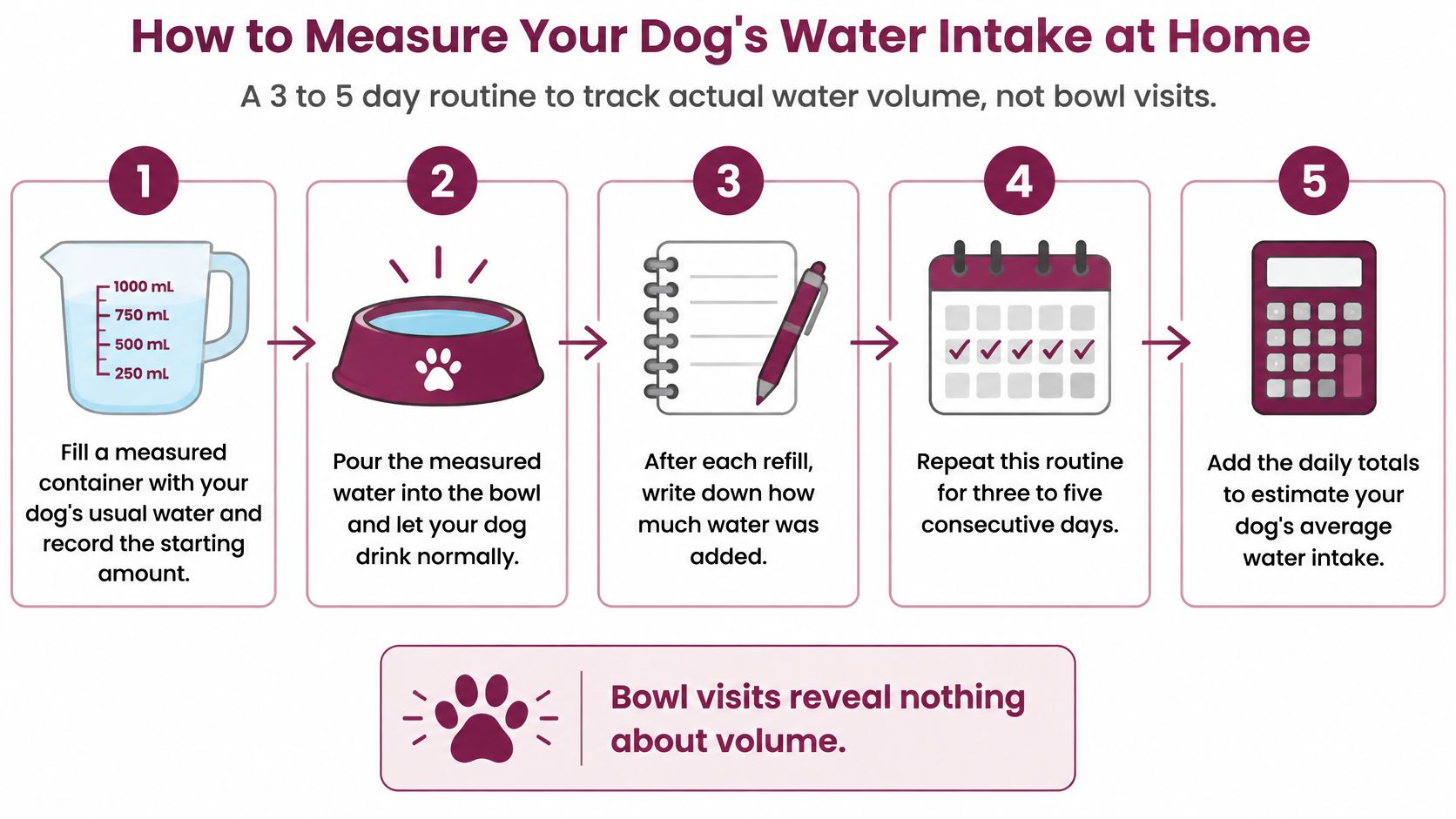
Bowl visits reveal nothing about volume. A dog can lap twenty times and still drink less than a dog that empties the bowl twice. You need milliliters, the same container, and several full days.
A controlled study found that healthy dogs' total water intake averaged about 71 mL/kg/day at baseline, rose to at least 92 mL/kg/day with a palatable nutrient-enriched drink, and reached approximately 156 mL/kg/day at the highest tested formulation, according to a Frontiers in Veterinary Science study. Increased drinking is not automatically a disease, especially when food or water becomes more appealing. That spread is also why the 50 to 60 mL/kg range is a typical guide, not a fixed law. Your dog's own baseline is the comparison that matters.
A measuring routine you can repeat
- Fill one measured pitcher with your dog's usual water and write the starting volume in milliliters. A marked jug beats guessing "about half a bowl."
- Refill the bowl only from that pitcher, at set times you will remember, and record what is left each evening. Subtracting leftovers is the only way the total is real.
- Add every other fluid source: water in wet food, ice cubes, broth on kibble, and water used to give a pill. Skipping those sources makes a dry-food dog look thirstier than it is.
- Log the date, body weight, heat, exercise, and any medication change beside that day's total. Context stops a hot walk from looking like a new illness.
- Note how often your dog urinates and whether the puddles look larger. Bigger, more frequent urine plus a high total is a different story from thirst alone, and leaking while asleep is a separate problem described in this guide to urinary incontinence support.
- Compare each day with the weight-based screening line. One high day can be weather or play. The same high reading on repeated days is the pattern to show your veterinarian.
- Bring the whole log to the visit. Your veterinarian should read it next to body weight, a urinalysis, urine specific gravity, blood glucose, kidney values, and how your dog looks, not against a single internet cutoff.
Never withhold water at home to "see what happens." Extra urine can mean your dog is replacing water it cannot hold, including with diabetes insipidus or kidney disease. Restricting the bowl can dehydrate a dog that is already losing fluid.
What the log should look like
Use one row per day. A scrap of paper works if the columns stay the same.
| Date | Weight | Water added (mL) | Left at night (mL) | Other fluids | Day's total | Heat, exercise, meds | Urine notes |
|---|---|---|---|---|---|---|---|
| Day 1 | 10 kg | 900 | 150 | Wet food, about 50 mL | 800 | Mild walk, no new meds | 4 trips, larger puddles |
If several pets share a bowl, the number is only an estimate. Separate the bowls for the measuring days, or the log will describe the household, not your dog.
Common Causes Behind Increased Thirst
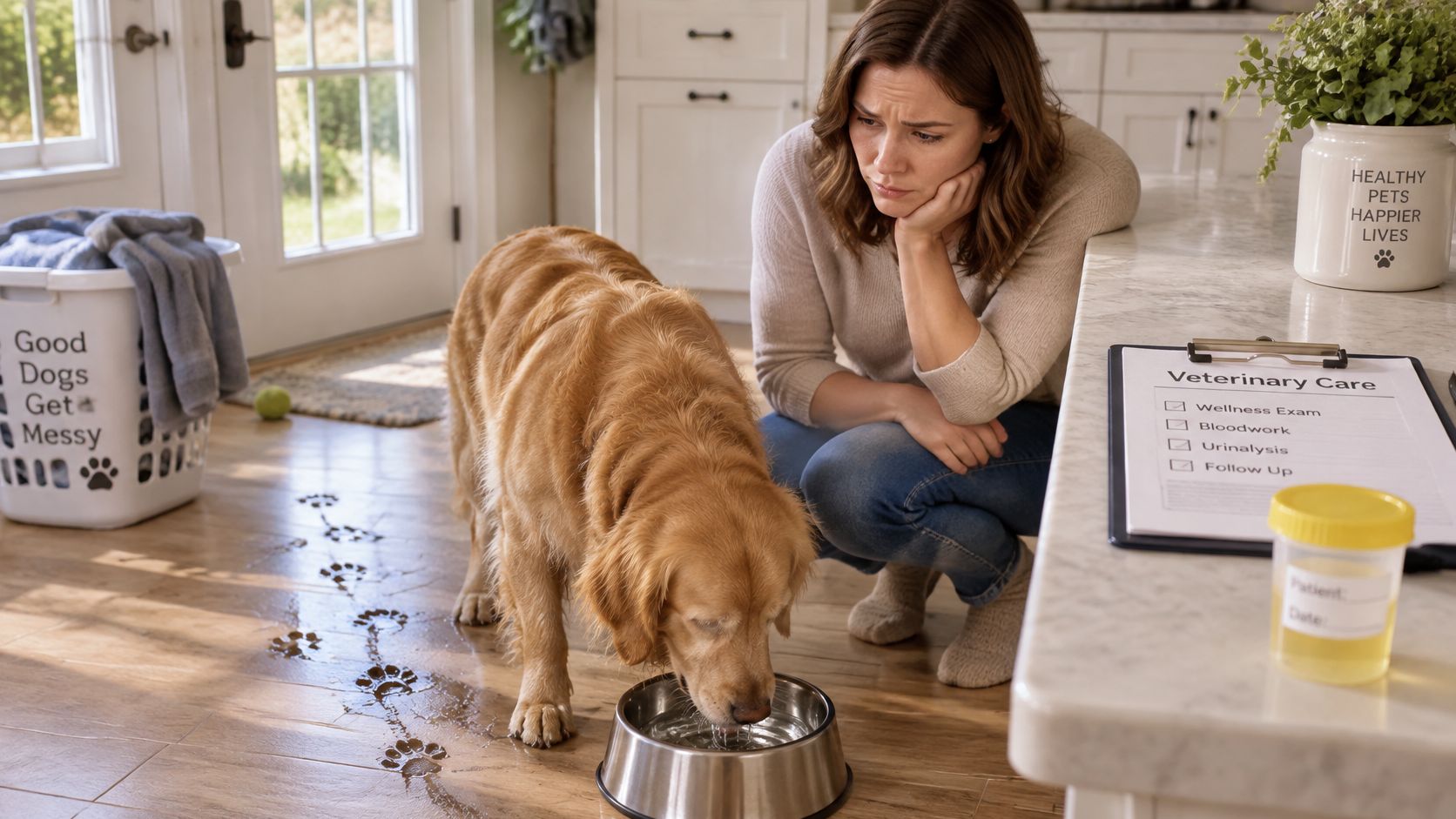
Think of thirst as a dashboard warning light. The light does not tell you which part failed. It tells you the water system needs a look. Extra drinking is usually the response. The cause sits upstream, either as water leaving the body too fast or as thirst and water handling that no longer match need.
Two ways water balance breaks
In the first pattern, the body makes more urine, then the dog drinks to replace it. In diabetes mellitus, excess glucose stays in the urine and osmotically pulls water with it, which raises urine volume and drives compensatory thirst, as described in the VCA overview of diabetes mellitus in dogs. Kidney disease can look similar because the kidneys lose the ability to concentrate urine, so dilute urine and ongoing water loss follow. Diabetes insipidus is sharper still. Inadequate vasopressin signaling, or a kidney that does not respond to it, blocks normal water conservation. Enormous volumes of extremely dilute urine follow, and a dog can still dehydrate despite heavy drinking.
Hormone disease sits in the same family. Hyperadrenocorticism (Cushing's disease) and hypoadrenocorticism (Addison's disease) are recognized causes of polydipsia. So are liver disease, high blood calcium, certain cancers, uterine infection in an intact female, electrolyte disturbances, and medication effects from corticosteroids and diuretics.
The second pattern is abnormal thirst itself. Psychogenic polydipsia, compulsive drinking tied to behavior, neurologic, or environmental factors, is considered most often in young, otherwise healthy, anxious, stereotypic, or hyperactive dogs. It is a diagnosis of exclusion. No single test confirms it. Veterinarians first rule out diabetes mellitus, kidney disease, hyperadrenocorticism, urinary infection, liver disease, and medication effects before anyone treats the drinking as a habit.
Why the warning light is not the diagnosis
| Cause | Often seen alongside | Why thirst rises |
|---|---|---|
| Diabetes mellitus | Weight loss, increased appetite, frequent urination | Excess glucose pulls water into urine |
| Kidney disease | Dilute urine, weight loss, poor appetite | Kidneys lose the ability to concentrate urine |
| Diabetes insipidus | Very large volumes of dilute urine | The body cannot conserve water normally |
| Cushing's disease (hyperadrenocorticism) | Pot-bellied appearance, increased appetite, thinning coat | Excess hormone changes water balance |
| Addison's disease (hypoadrenocorticism) | Weakness, vomiting, poor appetite | Hormone deficiency disrupts fluid and electrolyte balance |
| Liver disease | Vomiting, poor appetite, jaundice in some dogs | Liver dysfunction alters how fluids and hormones are handled |
| High blood calcium | Constipation, weakness, vomiting | Excess calcium interferes with kidney water handling |
| Uterine infection (intact female) | Vaginal discharge, lethargy, fever in some dogs | Infection and inflammation affect kidney water handling |
| Electrolyte disturbances | Weakness, muscle change, or appetite shift tied to the imbalance | Imbalances alter thirst signals and urine output |
| Medication effects | Recent corticosteroid or diuretic use | Drugs increase urine output or thirst |
| Psychogenic polydipsia | Normal urine concentration and no other disease found | Compulsive drinking, diagnosed only after exclusions |
Extra drinking usually arrives with extra urination, clinically polyuria with polydipsia. The pair still does not name the disease. Treatment follows the underlying condition, not the thirst. Owners sometimes meet metformin in human diabetes articles and wonder if it fits a dog. Canine diabetes mellitus is managed under veterinary direction, commonly with insulin and a consistent diet, not with a drug chosen from a search. Read the context in this article on metformin for dogs before you assume a human diabetes drug belongs in the plan.
Before the appointment, write down thirst, urine frequency and volume, appetite, body weight, every medication including corticosteroids and diuretics, and whether a female dog is spayed. New thirst with lethargy, repeated vomiting, inability to keep water down, collapse, severe weakness, or suspected toxin exposure is urgent. It is not something to manage with an over-the-counter product.
Diagnostic Tests Your Vet May Recommend
A dog that is drinking more water than usual can have several unrelated conditions, so the symptom alone does not identify a diagnosis. VCA's guide to testing for increased thirst and urination lists kidney failure or infection, diabetes mellitus, diabetes insipidus, Cushing's disease, Addison's disease, liver disease, high blood calcium, some cancers, electrolyte disturbances, certain medications, and, less commonly, primary or psychogenic polydipsia. A veterinarian generally starts with a complete history and physical exam, then screening tests. Treatment depends on the cause, not on thirst itself.
The first pass, then the tests that answer a question
The physical exam covers body condition, hydration, the abdomen, and reproductive status. An intact female with discharge and lethargy raises a different concern than a senior dog with a thinning coat and a pot belly. History narrows the list before a single tube of blood is drawn.
| Test | What it measures | What it helps the vet decide |
|---|---|---|
| History and physical exam | Body condition, hydration, abdomen, reproductive status | Narrows the list of likely causes |
| Complete blood count | Red and white blood cells, signs of infection or anemia | Identifies infection and other blood changes |
| Serum biochemistry profile | Glucose, kidney and liver values, electrolytes, calcium | Points toward diabetes, kidney, liver, or calcium disorders |
| Urinalysis | Urine concentration, glucose, ketones, bacteria | Checks for diabetes mellitus and urinary infection |
| Urine specific gravity or osmolality | How concentrated the urine is | Separates excess water loss from normal water conservation |
| Hormone-specific tests | Adrenal or thyroid function, as indicated | Confirms or rules out endocrine disease |
| Supervised water deprivation or desmopressin test | Response to controlled water restriction or a vasopressin analog | Helps distinguish diabetes insipidus from other causes; vet-supervised only |
Not every dog needs every row. The vet adds tests when the first results point somewhere. A urinalysis that shows bacteria, for example, raises urinary infection, which is a different plan from hormone disease. This overview of kidney and urinary tract infection is a useful companion when infection is the question on the table, not a reason to start an antibiotic at home.
Diabetes mellitus is not called from one thirsty afternoon or one glucose reading. Veterinary diabetes guidance treats the disease as definite only when glucose is present in the urine and blood glucose stays persistently high, as explained in VCA's canine diabetes service page. Kidney, liver, electrolyte, and medication-related problems can raise thirst too, so the lab pattern has to fit the dog in front of the clinician.
A modified water-deprivation test, or a carefully supervised desmopressin trial, is a later step for suspected diabetes insipidus. It is done in clinic because withholding water can dangerously dehydrate a dog that cannot conserve fluid. That test is never a home experiment.
What you bring to the visit
- The measurement log: Daily totals, body weight, and notes on heat, exercise, and diet.
- A full medication and supplement list: Include corticosteroids, diuretics, flea products, and anything bought without a prescription.
- Diet details: Dry, fresh, or wet food, treats, and any recent switch.
- A symptom timeline: When thirst changed, whether urine volume rose with it, and any vomiting, appetite shift, or weight change.
That packet lets the veterinarian choose the smallest set of tests that can change the plan.
Interim Care and When to Call Your Vet Right Away
Could your dog's increased thirst be urgent, or can it wait for a scheduled visit? Thirst is a measurement, not a diagnosis. Compare water intake with body weight over three to five days, while keeping water available, and share the log with your veterinarian.
Veterinary references describe urine output above 50 mL/kg/day together with water intake above 100 mL/kg/day as an abnormal pattern to investigate, according to the Merck Veterinary Manual chapter on diabetes insipidus. A reading of 110 mL/kg/day is well above the commonly cited healthy range of 50 to 60 mL/kg/day. These numbers are clues, not a diagnosis: your veterinarian interprets the log alongside urine concentration, kidney function, blood glucose, electrolytes, medications, and the physical exam.
Interim care while you wait for the visit
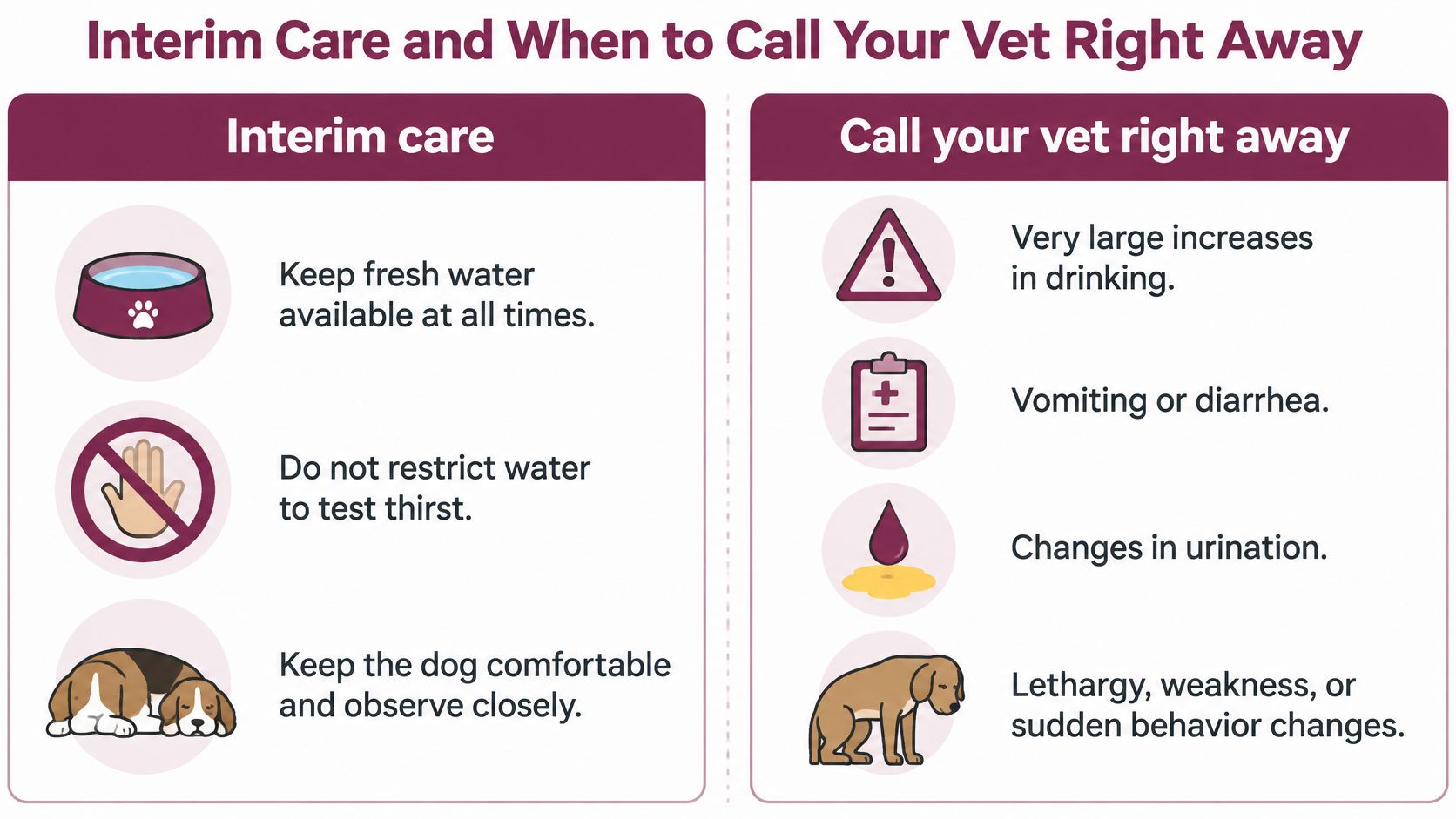
- Keep fresh water available at all times. If your dog is losing more water through urine, drinking helps replace it.
- Do not restrict water to test thirst. Water restriction for testing is performed by a veterinarian under close monitoring. A home experiment can put your dog at risk.
- Keep the log going. Record daily water totals and body weight, along with changes in heat, exercise, or diet.
- Do not give leftover medication or an over-the-counter product for thirst, kidneys, or “urinary health” unless your veterinarian advises it. Do not change a prescribed dose or schedule on your own. Steroids, including Depo-Medrol for dogs, can affect thirst, and stopping them suddenly can be harmful.
If your dog is otherwise bright and able to drink, contact your veterinary clinic for guidance and keep the appointment. Call the same day if any of these signs appear.
Call your vet the same day
- Lethargy, collapse, or severe weakness. These may accompany dehydration or a serious metabolic problem.
- Repeated vomiting or inability to keep water down. Your dog may be losing fluid faster than they can replace it.
- Pale or tacky gums, or sunken eyes. These can be visible signs of dehydration.
- Known or suspected toxin exposure. Contact a veterinarian promptly rather than waiting to see whether the thirst settles.
Keep your clinic's daytime hours and the after-hours emergency clinic address where you can find them quickly. If a same-day warning sign appears, seek veterinary care right away.
Work With Your Vet to Choose the Right Treatment
What treatment makes sense depends on what is causing the thirst. Your veterinarian uses the exam and test results to choose a plan, then checks whether it is working at follow-up visits. Routine veterinary visits help keep that plan on track even after your dog's water intake starts to look normal.
Diabetes insipidus shows why diagnosis comes first. It causes large volumes of dilute urine, so a dog drinks more to replace the fluid lost. As VCA explains in its overview of diabetes insipidus in dogs, veterinarians first check for more common causes with a complete blood count, blood chemistry that includes glucose, liver and kidney values, and a urinalysis. A modified water-deprivation test may be considered later under close veterinary supervision. Withholding water can be dangerous for a dehydrated dog, so this is never a home test or treatment.
Match the plan to the cause
Treatment differs by diagnosis, and doses must be set for the individual dog. Kidney disease may be managed with fluids, a veterinary diet, and monitoring of kidney values, blood pressure, and hydration. Confirmed diabetes mellitus is treated with insulin and a consistent feeding schedule under veterinary direction; home logs of appetite, water intake, and urination can help track changes.
Cushing's or Addison's disease may call for prescription hormone therapy chosen for that diagnosis. Confirmed diabetes insipidus may be treated with a prescription such as desmopressin, at the dose and schedule your veterinarian sets. Psychogenic polydipsia, considered after medical causes are excluded, is first addressed through environmental and behavioral changes. Medication is reserved for selected cases. Taking away the water bowl is not a treatment.
These treatments are not interchangeable. Your veterinarian chooses the medication, dose, and follow-up for your dog's diagnosis. Do not start, stop, combine, or switch medications on your own.
What you do after the diagnosis
Bring your water-intake log to the appointment and ask which tests are needed and what the results mean for treatment. If your dog needs ongoing prescription medication, a licensed pharmacy can coordinate refills after your veterinarian authorizes them. Bandana Rx offers prescription medications for dogs, with prescription orders processed after veterinary authorization. Subscriptions with scheduled deliveries may be available for some products, so check the product information or contact customer support.
Bandana Rx is a licensed U.S. veterinary pharmacy that fills authorized prescriptions for dogs, including medications used in diabetes, kidney, and endocrine care. Once your veterinarian has approved a prescription, review the available options with your clinic and Bandana Rx.