


Depo-Medrol is a prescription-only, long-acting steroid injection for dogs, and its labeled average intramuscular dose is 20 mg, with approximately 2 mg for miniature breeds, 40 mg for medium-sized dogs, and up to 120 mg for extremely large dogs or severe cases. It can provide prolonged anti-inflammatory relief, but veterinary supervision is essential because one dose may suppress adrenal function for up to 7 weeks and glucocorticoids can increase diabetes risk.
Your dog may have received an injection after a painful flare-up, an allergic reaction, or inflammation that made normal movement difficult. You may now be watching the water bowl more closely, wondering whether extra thirst is expected, or asking whether another injection would help when symptoms return. Those questions are important because Depo-Medrol is a depot medication. Once administered, it cannot be removed or quickly withdrawn like a daily tablet.
Table of Contents
- What Is Depo-Medrol and How It Works
- Approved Uses and Administration Routes
- Clinical Benefits and Research Evidence
- Serious Risks and Safety Warnings
- Diabetes Risk and Special Population Considerations
- Home Monitoring and When to Seek Care
What Is Depo-Medrol and How It Works
A dog with inflamed skin, painful joints, or an immune-mediated condition may improve after a veterinarian recommends Depo-Medrol. The medication is a brand formulation of methylprednisolone acetate, a long-acting corticosteroid suspension used in veterinary medicine for inflammatory and immune-mediated conditions. It reduces inflammatory and immune activity, which can help ease swelling, irritation, and discomfort when the underlying diagnosis makes steroid treatment appropriate.
The word depot describes the key difference. After injection, the suspension acts as a reservoir that releases corticosteroid gradually rather than delivering the entire effect at once. A daily oral steroid can be adjusted, reduced, or stopped under veterinary direction. A depot injection remains in the body after administration, so its benefits and adverse effects may continue after the appointment.
Why the depot matters
The U.S. product labeling identifies Depo-Medrol as a prescription animal drug under NADA 012-204, not an over-the-counter product for unsupervised use. The label also provides an average intramuscular dose for dogs of 20 mg, while emphasizing that body size and disease severity require individualized dosing. The broader parenteral range is 4 to 120 mg, which shows why an online fixed-dose chart can't safely replace an examination and prescription decision. The official DailyMed product information explains these dose and safety considerations.
Owners sometimes compare the injection with an oral steroid course because both are corticosteroids. That comparison can be misleading. The depot form is designed for prolonged exposure, while a veterinarian can usually adjust an oral schedule more directly if a dog develops an adverse effect or no longer needs treatment.
Practical rule: Never assume that a recurring symptom means your dog needs another injection. A return of symptoms can indicate infection, diabetes, endocrine disease, or an incorrect original diagnosis.
Managing prescription records, refill questions, and follow-up communication can also create administrative work for veterinary practices. For general background on clinic support roles, you can compare virtual assistant costs, but medication decisions still belong with your dog's veterinarian. A different corticosteroid formulation, such as dexamethasone tablets, isn't automatically interchangeable with Depo-Medrol.
Approved Uses and Administration Routes
Depo-Medrol may be used when a veterinarian determines that corticosteroid treatment is suitable for an inflammatory or immune-mediated problem. The correct route depends on the tissue involved, the diagnosis, the desired distribution of medication, and the dog's health history. The labeled administration routes include intramuscular, intra-articular, soft-tissue, and intralesional injection. The product is not for intravenous use. FDA product information identifies these permitted routes and the prescription status of the medication.
An intramuscular injection distributes the drug through the body. An intra-articular injection places medication into a joint, while soft-tissue and intralesional routes target specific areas. These routes aren't interchangeable, and an injection site doesn't determine whether the medication is safe by itself. Infection, tissue damage, wound healing, and systemic absorption all matter.
Concentration is not the same as volume
The labeled product is supplied in 40 mg/mL and 80 mg/mL concentrations. The same volume therefore doesn't necessarily represent the same dose. One milliliter of the 80 mg/mL product contains twice as much methylprednisolone acetate as one milliliter of the 40 mg/mL product. The FDA label identifies both concentrations and emphasizes that the product is supplied as a single-dose vial and isn't intended for intravenous administration.
| Concentration | Implication for dosing | Common use context |
|---|---|---|
| 40 mg/mL | The prescribed milligram amount must be converted into the correct volume | Route and volume selected by the veterinarian |
| 80 mg/mL | The same volume contains twice the medication found in the 40 mg/mL product | Requires careful label and prescription verification |
The labeled average intramuscular dose for dogs is 20 mg, but the label gives approximately 2 mg for miniature breeds, 40 mg for medium-sized dogs, and up to 120 mg for extremely large dogs or severe cases. These figures illustrate variation, not a home dosing guide. The veterinarian must calculate the amount and choose the route based on the individual dog.
Clinical Benefits and Research Evidence
The evidence for methylprednisolone acetate in dogs is more specific than many online discussions suggest. A systematic review identified 14 studies involving more than 200 dogs, including one blinded randomized controlled trial, two clinical cohort studies, one case series, and ten pharmacokinetic, physiologic, safety, or experimental investigations. The systematic review in PMC describes a research base that includes different routes, conditions, and study designs, so the findings shouldn't be treated as proof that every dog with inflammation will benefit in the same way.
The clearest randomized result involved a narrow surgical situation. Forty-one dogs with non-ambulatory thoracolumbar intervertebral disc disease underwent surgery and were assigned to epidural methylprednisolone acetate or control. Eighteen dogs received 1 mg/kg, while 23 served as controls. Median time to ambulation was 3 days in the methylprednisolone group and 7 days among controls, a difference of approximately 4 days reported as statistically significant with p = 0.01.
That result is clinically interesting, but it doesn't establish that an intramuscular Depo-Medrol injection will produce the same outcome for allergies, arthritis, or another inflammatory disorder. The study used epidural, intraoperative administration in a surgical neurologic population. It also had a small sample, and discospondylitis and abscess formation occurred in 1 of 18 treated dogs, while other complications were monitored.
Matching treatment to the diagnosis
A veterinarian may consider corticosteroid treatment when inflammation or abnormal immune activity is contributing to a dog's illness. The route then follows the problem:
- Systemic disease: An intramuscular route may be considered when the veterinarian needs a body-wide corticosteroid effect.
- Joint disease: An intra-articular injection may be considered for a specific joint, but infection must be excluded before local steroid administration.
- Localized lesions: Soft-tissue or intralesional administration may be selected when the target is limited and the veterinarian believes the benefits justify local and systemic risks.
Owners researching related corticosteroid questions can also review veterinary information about triamcinolone acetonide for dogs. It shouldn't be treated as a recommendation to switch medications. Different steroids and formulations have different properties, and only the prescribing veterinarian can decide whether an alternative fits the diagnosis.
Serious Risks and Safety Warnings
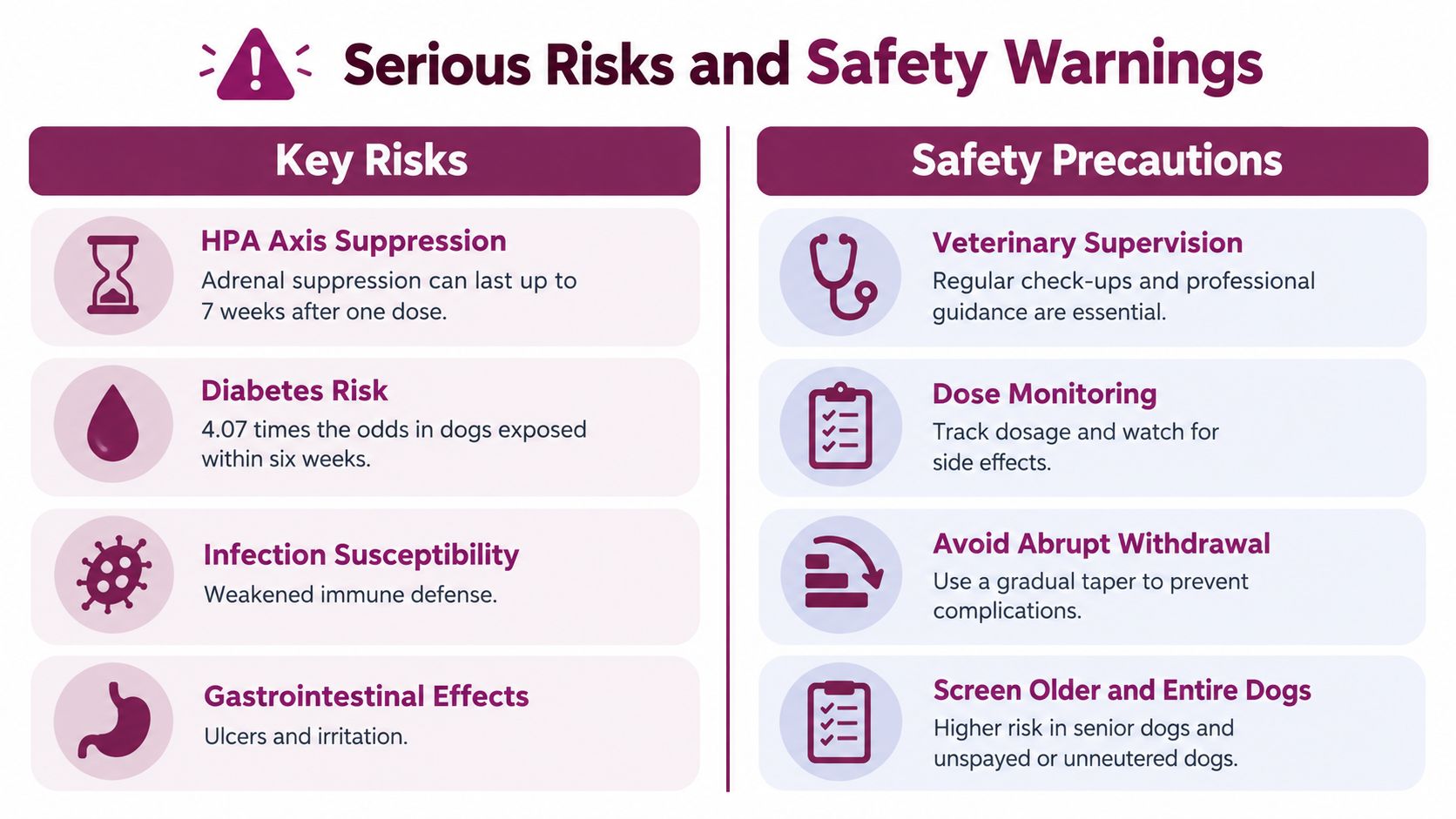
The most important safety issue is not just where the injection is given. Risk depends on glucocorticoid exposure, dose, duration, formulation, and the individual dog's susceptibility. Depo-Medrol's depot design can prolong exposure, which means a dog may continue to experience hormonal and immune effects after the visible inflammation improves.
A single 2.5 mg/kg intramuscular dose of methylprednisolone acetate has been reported to suppress the hypothalamic-pituitary-adrenal axis for up to 7 weeks in dogs. The hypothalamic-pituitary-adrenal axis helps the body respond to stress. Suppression can matter if a dog later needs surgery, develops an infection, or receives additional corticosteroids. The DailyMed label provides the product's warnings and precautions.
Effects owners may notice
Common or clinically important corticosteroid effects can include:
- Increased thirst and urination: These changes may appear after treatment and should be reported if marked, persistent, or accompanied by weakness or weight loss.
- Increased appetite and weight gain: Appetite stimulation can be prominent, but it doesn't prove that the underlying disease has resolved.
- Hyperglycemia: Higher blood glucose may be temporary or may contribute to persistent diabetes in a susceptible dog.
- Reduced immune defense: Steroids can mask infection and may allow an infectious organism to spread.
- Gastrointestinal injury: Ulceration and pancreatitis are serious concerns, especially when other risk factors are present.
- Muscle, bone, and skin effects: Prolonged exposure can contribute to steroid myopathy, osteoporosis, and calcinosis cutis.
The label contraindicates systemic use in dogs with Cushing's syndrome, peptic ulcer, or arrested tuberculosis. It calls for tightly controlled use in dogs with diabetes mellitus, renal insufficiency, hypertension, congestive heart failure, osteoporosis, or thromboembolic risk. Local corticosteroid injection is contraindicated when an acute infection is present.
Pregnancy requires special caution. Corticosteroid exposure in dogs has been associated with cleft palate and other congenital abnormalities, and late-gestation exposure may contribute to premature parturition and dystocia. Tell the veterinarian if pregnancy is possible before any injection.
For general context on a different corticosteroid prescription, prednisolone information for pets may be useful, but it doesn't replace the Depo-Medrol label or an individualized veterinary assessment.
Diabetes Risk and Special Population Considerations
Steroids can raise blood glucose by changing how the body uses and produces glucose. That effect may be temporary, but a depot injection can make observation more important because the exposure continues after the appointment. A dog that drinks more for a short period isn't automatically diabetic, yet persistent thirst, urination, hunger, weight loss, weakness, or recurrent infections deserve veterinary attention.
A large primary-care case-control analysis found that dogs exposed to glucocorticoids during the preceding six weeks had 4.07 times the odds of diabetes mellitus compared with unexposed dogs. The authors identified older dogs and entire females in the studied breeds as groups requiring particular caution. The finding concerns glucocorticoids generally, not Depo-Medrol alone, so it doesn't mean every injection causes diabetes. The study in PMC supports individualized screening and monitoring rather than a universal prediction.

A practical monitoring conversation
Before treatment, ask the veterinarian how the dog's age, sex, reproductive status, body condition, and medical history change the plan. A dog with borderline glucose regulation, prior pancreatitis, endocrine disease, or recurrent infections may need a different risk discussion from a young dog without those concerns.
Medication reconciliation is equally important. Provide a complete list of current and recent medicines, including NSAIDs, insulin, immunosuppressants, and treatments given around surgery. Don't start, stop, combine, or substitute prescription medicines without veterinary instructions. If your dog uses insulin or requires glucose supplies, ask whether testing is needed and how results should be interpreted. Guidance about insulin syringes for dogs can help with equipment questions, but it isn't a substitute for a veterinarian's dosing plan.
A transient steroid-related rise in glucose may improve as exposure declines. Persistent diabetes requires diagnosis and treatment, not just waiting for thirst or urination to settle. The distinction depends on clinical signs and veterinary testing.
Home Monitoring and When to Seek Care
After an injection, write down the date, product concentration, amount, route, and the veterinarian's follow-up instructions. Keep that information available for any emergency clinic, especially if your dog becomes ill or needs surgery while the depot medication may still be active. A medication record can prevent another clinician from assuming that no recent corticosteroid exposure occurred.
What to watch at home
During the early period after treatment, observe water intake, urination, appetite, sleep, activity, and comfort. Mild changes may be expected with corticosteroid exposure, but the pattern matters more than one isolated observation.
- Thirst and urination: Contact the veterinarian if your dog is drinking or urinating much more than usual, particularly with weakness, weight loss, or accidents.
- Appetite and weight: Increased hunger can occur, but refusal to eat, rapid weight change, or profound weakness is more concerning.
- Digestive signs: Vomiting, abdominal discomfort, or black, tarry stool requires prompt veterinary advice because gastrointestinal injury can be serious.
- Infection signs: Fever, lethargy, worsening pain, discharge, coughing, or a new wound problem should not be dismissed as a normal steroid response.
- Joint or injection-site changes: Increasing pain, reduced joint motion, fever, and malaise after an injection may indicate a septic process, particularly after intra-articular treatment.
The FDA-derived product information warns that worsening pain, reduced joint motion, fever, and malaise can signal a septic process rather than a temporary reaction. Contact your veterinarian promptly when these signs occur. Seek urgent care for severe weakness, collapse, breathing difficulty, repeated vomiting, black stool, or rapidly worsening condition.
A depot injection isn't a treatment you can “undo” at home. The safest response to a concerning change is a call to the prescribing veterinary team, not an extra dose or an unapproved antidote.
Why repeat dosing needs a fresh evaluation
When symptoms return, owners may reasonably assume that the medication has worn off and another injection is needed. That assumption can delay diagnosis of infection, diabetes, an endocrine disorder, or a condition that was never steroid-responsive. Because the medication may suppress adrenal function for up to 7 weeks after a single reported intramuscular dose, the timing of a repeat injection can affect stress response, immune defense, glucose control, and wound healing.
Don't repeat a dose because an old syringe label, online chart, or previous appointment suggests a familiar volume. The product comes in 40 mg/mL and 80 mg/mL strengths, and volume alone doesn't establish the milligram amount. Bring the medication record to the veterinarian and ask whether an examination, blood glucose assessment, urine testing, or another diagnostic check is appropriate.
Use the pet medication label and dosage guide to improve your understanding of prescription labels, warnings, and storage information. It can't authorize a dose or replace the prescriber. Your dog needs a new veterinary decision whenever symptoms change, a new medicine is added, or a procedure is planned.
Bandana Rx offers prescription and over-the-counter pet medications, preventive products, and health supplies for dogs and cats, with prescription orders processed after veterinary authorization. Visit Bandana Rx to explore available pet-care options and coordinate medication fulfillment with your veterinarian.