


Is the longest-lasting flea medicine the right one for your pet? Duration matters, but it doesn't answer the questions that decide eligibility: whether the product is labeled for your dog or cat, whether your pet meets its age and weight limits, and whether their medical history changes the risk.
Prescription flea meds should be selected for the patient, not just the calendar. A veterinarian makes the final treatment decision. Your role is to bring accurate information, understand the label, and choose a plan you can administer reliably.
Table of Contents
- Prescription Flea Medication Options Compared
- How Prescription Flea Products Are Regulated and Labeled
- Species, Age and Weight Limits That Decide Eligibility
- Neurologic Risk Screening Before a First Dose
- Matching Your Pet's Situation and Confirming With Your Veterinarian
- Why Fleas Persist After a Correct Dose
- Ordering Prescription Flea Meds Through Bandana Rx
Prescription Flea Medication Options Compared
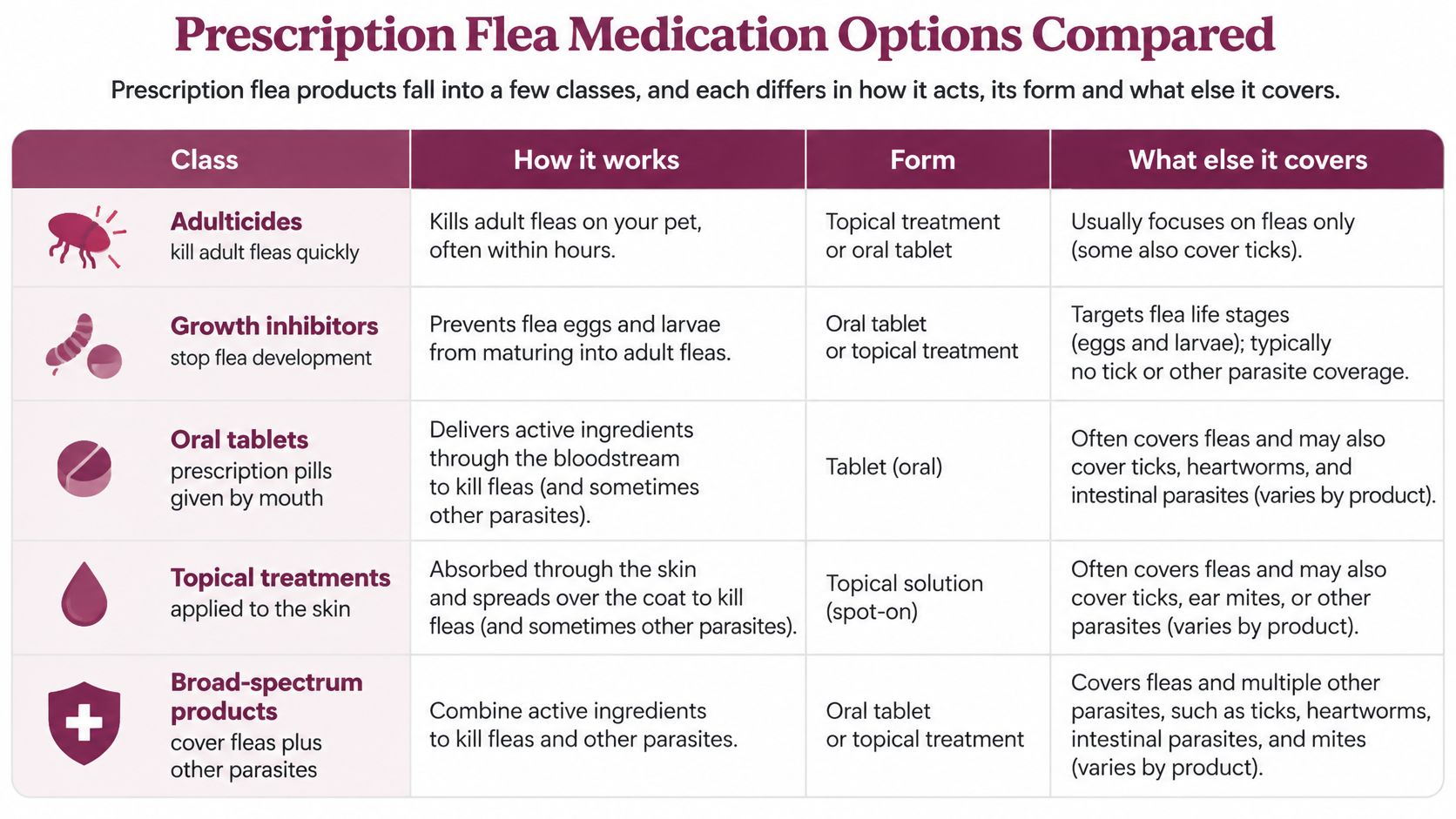
Prescription flea products fall into several classes, each differing in how it acts, its form, and what else it covers. The comparison below also includes fipronil with (S)-methoprene as a relevant topical comparator, not as a claim that every listed formulation requires a prescription.
Prescription flea medication classes compared
| Class | Example active ingredients | Form | Flea action | Heartworm and tick notes |
|---|---|---|---|---|
| Isoxazolines | Fluralaner, afoxolaner, sarolaner, lotilaner, esafoxolaner | Oral chew or topical, by product | Kills adult fleas | Tick coverage is product-specific; heartworm coverage requires an appropriately labeled combination |
| Fipronil with (S)-methoprene | Fipronil, (S)-methoprene | Topical spot-on | Fipronil kills adult fleas; methoprene interrupts immature stages | Check the exact label for tick claims; don't assume heartworm coverage |
| Spinosad | Spinosad | Oral tablet | Kills adult fleas | Check the complete formulation for any additional parasite claims |
| Selamectin | Selamectin | Topical spot-on | Kills adult fleas | Labeled for heartworm and certain other parasites in specified species |
| Lufenuron | Lufenuron | Prescription oral or injectable, by product | Prevents flea eggs from developing; doesn't kill adult fleas | Lufenuron alone has no tick or heartworm claim |
Isoxazolines provide adult-flea control, with route and additional coverage determined by the formulation. Fipronil with (S)-methoprene combines adult-flea killing with interruption of immature development.
Spinosad offers an oral adulticide option for labeled species. Selamectin offers topical flea control with other labeled parasite indications, while lufenuron targets egg development rather than existing adult fleas.
What an efficacy comparison can tell you
In a randomized European field study of client-owned cats, oral lotilaner achieved a 98.1% geometric-mean live-flea reduction on day 28, while topical fipronil/(S)-methoprene achieved 48.3% on day 14, according to the study abstract indexed by EPA. Those measurements come from different assessment days, so they aren't a same-day comparison.
The findings support discussing an oral option when topical administration is unreliable. They don't establish that every oral medication outperforms every topical, or that the studied treatment suits another species or formulation.
Practical rule: Choose the flea action your pet needs, then check whether the specific product is appropriate and manageable.
If you're also considering a collar, our guide to whether flea and tick collars work explains that separate delivery approach. No medication class suits every pet.
How Prescription Flea Products Are Regulated and Labeled
Two flea products can follow different regulatory pathways even when they sit beside each other on a shelf. The EPA's explanation of flea and tick product regulation describes the historical distinction between products remaining on the skin and those absorbed systemically, and notes that a 1975 statutory amendment excluded new animal drugs from the pesticide definition.
That historical boundary isn't absolute: regulators acknowledge that some EPA-regulated products can enter the bloodstream. Topical doesn't automatically mean non-systemic, and prescription status doesn't establish suitability for every pet.
Read the identity and directions together
Use this checklist before comparing packages:
- Regulatory identity: Look for animal-drug approval information or EPA pesticide registration information. Use the FDA Center for Veterinary Medicine or EPA's official resources when verification is needed.
- Species: Find the animal named on the label, not just the animal pictured on the carton.
- Eligibility: Locate minimum age, minimum weight, and the applicable weight band.
- Administration: Identify the route, dosing interval, and handling directions.
- Ingredients: Read every active ingredient in combination products.
- Prescription status: Confirm whether veterinary authorization is required.
A familiar brand name isn't enough. Products within a brand family can differ in ingredients, route, species, or instructions, so match the full name rather than relying on package color.
Our guide to reading pet medication labels, dosage warnings, and storage instructions can help you organize those details.
Keep the carton, package insert, pharmacy label, and veterinarian's instructions together. If the directions don't agree, ask the veterinarian or dispensing pharmacy to resolve the discrepancy before administering the medication.
Species, Age and Weight Limits That Decide Eligibility
Labeled species, age and weight minimums for example products
The following named-product examples accompany the safety principles in EPA's guidance on controlling fleas and ticks on your pet; their minimums are NexGard COMBO, 8 weeks and 1.8 pounds; Bravecto's 12-week dog formulation, 6 months and 4.4 pounds; and Comfortis for cats, 14 weeks and 4.1 pounds.
| Product (FDA label example) | Labeled species | Minimum age | Minimum weight |
|---|---|---|---|
| NexGard COMBO | Cats and kittens | 8 weeks | 1.8 lb |
| Bravecto 12-week formulation | Dogs and puppies | 6 months | 4.4 lb |
| Comfortis | Cats and kittens | 14 weeks | 4.1 lb |
Verify each example against the current product label before use. These are product-specific minimums, not interchangeable rules for every medication containing a related ingredient.
EPA instructs owners to use flea products only on the labeled species and size or weight. Don't apply dog products to cats or cat products to dogs, and don't treat puppies or kittens unless the label specifically permits it.
Check eligibility before choosing a package
- Find the species on the exact label. A related brand name doesn't authorize use in another animal.
- Weigh your pet using a suitable home scale or ask the clinic for a current weight. An old chart entry may no longer reflect a growing kitten or a dog whose weight has changed.
- Compare both the minimum and the weight band. Meeting the minimum doesn't mean every strength in that product line fits.
- Check age using the unit printed on the label. If a rescue animal's age is uncertain, let the veterinarian assess eligibility rather than estimating to make a product fit.
- Ask about borderline measurements. If your pet is near a cutoff or between weight bands, have the veterinarian select the product and strength before any dose.
Younger animals can respond differently, which is why minimum-age directions matter. Don't buy based on the size of a previous pet, and don't divide a larger animal's medication to create an assumed smaller dose.
For a kitten that resists handling, separate medication administration from optional grooming so you can concentrate on the prescribed technique. A resource on fuss-free ear cleaning for cats addresses routine handling, but ear care doesn't determine flea-medication eligibility.
Our discussion of oral flea and tick options for cats can help you prepare route-specific questions. The veterinarian still needs to confirm the exact feline product rather than adapting a dog treatment.
Neurologic Risk Screening Before a First Dose
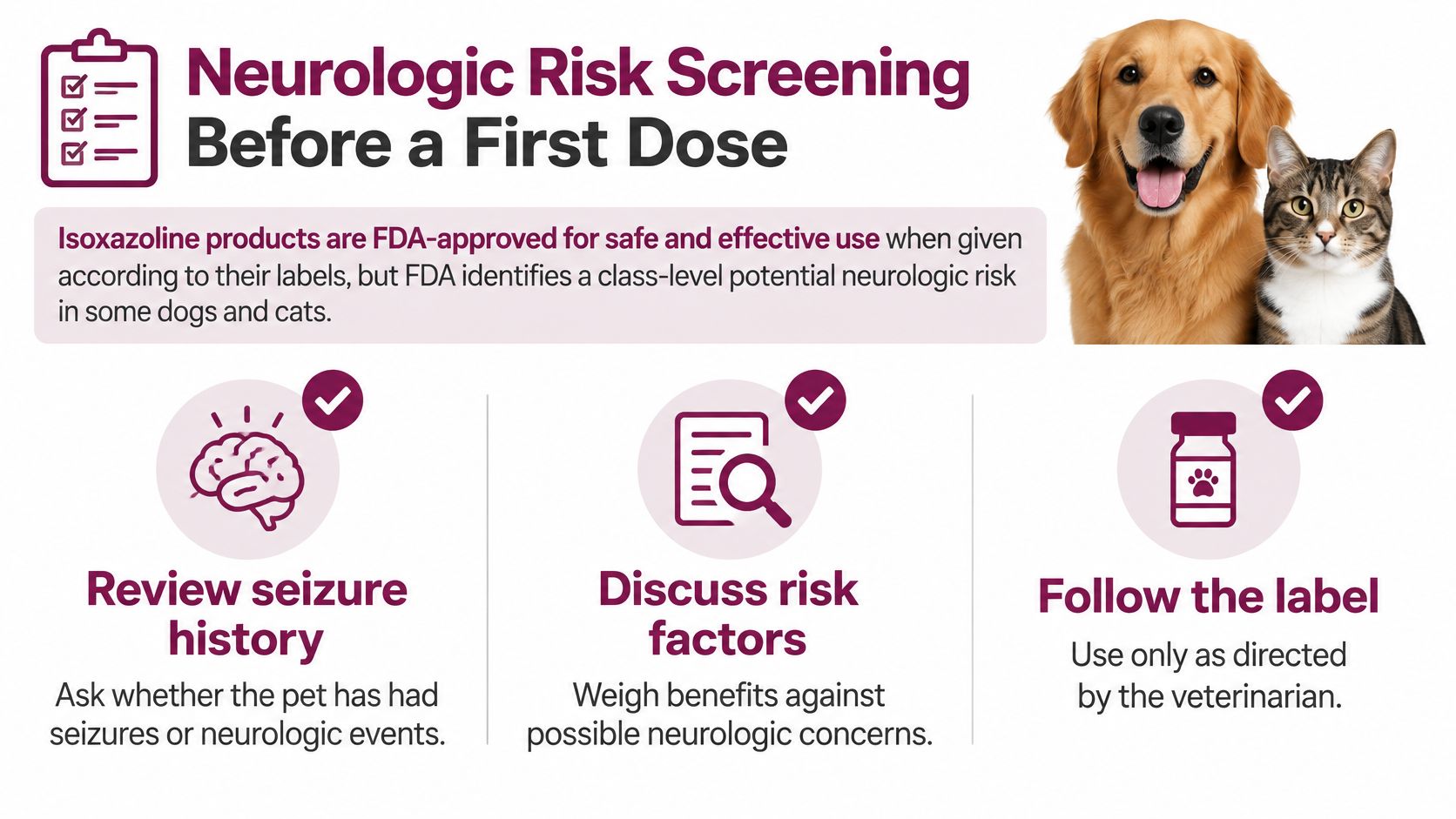
Prescription doesn't mean risk-free. The FDA's isoxazoline safety fact sheet identifies potential neurologic reactions, including tremors, ataxia, and seizures, in some dogs and cats, while stating that these products are safe and effective for the majority of treated animals.
The class includes formulations containing fluralaner, lotilaner, afoxolaner, sarolaner, and esafoxolaner. Neurologic events have been reported in animals with and without previous neurologic disorders, so an uneventful medical history doesn't eliminate the need for counseling.
This is a benefit-risk discussion, not a verdict against an entire class. The veterinarian must consider the pet's parasite-control needs alongside the product's warnings and the individual medical history.
Bring a usable medical history
Give the veterinarian specific observations rather than describing your pet as generally sensitive.
- Seizures or epilepsy: Include diagnosed seizures and unexplained episodes that haven't been evaluated.
- Tremors or abnormal movement: Describe shaking, stumbling, weakness, or unusual behavior, including when it happened.
- Previous medication reactions: Bring the product name, approximate timing, and signs you noticed.
- Current treatments: List prescriptions, supplements, over-the-counter products, and existing parasite preventives.
- Other neurologic conditions: Identify established diagnoses or ongoing investigations.
- Patient details: Provide your pet's species, current weight, and age.
Cats with neurologic disease warrant particular caution and a product-specific discussion. Don't assume that selecting a topical formulation removes an ingredient's neurologic warning.
Understand the language on the label
A contraindication identifies a circumstance in which the product shouldn't be used. A precaution calls for additional care and a veterinarian's assessment; it isn't automatically a prohibition.
A side effect is an unwanted reaction to treatment. Some labeled reactions may be mild, but the phrase doesn't mean that every reaction is expected, harmless, or safe to watch without advice.
A warning is information for a treatment decision, not a reason to make that decision without your veterinarian.
Make a post-dose plan
Write down the product, strength, administration date, and any unusual signs. Ask how closely to monitor your pet afterward and which clinic to contact outside normal hours.
Contact a veterinarian promptly for tremors, incoordination such as wobbling or stumbling, or seizures. A seizure or severe loss of coordination warrants urgent veterinary attention rather than waiting for a routine appointment.
Keep the packaging available so the veterinary team can identify the formulation. Don't independently split, combine, substitute, or repeat flea medications to manage a suspected reaction or compensate for concern about effectiveness.
Matching Your Pet's Situation and Confirming With Your Veterinarian
A medication can meet basic label requirements and still be a poor practical fit. Your veterinarian needs to know whether you can reliably give an oral dose, whether your pet swims or needs frequent bathing, and which other parasites require coverage.
Situations that change the prescription flea choice
| Situation | Why it changes the choice | Question for your veterinarian |
|---|---|---|
| Pet has seizures or other neurologic disease | Medical history affects the benefit-risk assessment | Is this product class appropriate given my pet's history? |
| Cat or kitten near a labeled age or weight limit | Eligibility is specific to the named formulation | Which product matches my cat's exact age and weight? |
| Pet resists pills or oral dosing | Route affects whether administration is reliable | Which route can we use consistently? |
| Multiple pets in the household | The household needs a coordinated control plan | Should every pet be treated during the same period? |
| Outdoor access or wildlife exposure | Exposure affects reinfestation and tick-control needs | Which relevant ticks are covered by the label? |
| Heartworm risk in my area | Flea-only treatment may not address the full prevention plan | Which product covers both fleas and heartworm for my pet? |
Choose a route you can actually administer
An oral medication can be practical for a pet that accepts it reliably. But buying a chew doesn't solve the problem if your dog spits it out or your cat refuses it.
Tell the veterinarian what administration looks like at home. Ask what to do if a dose is partly eaten, vomited, or otherwise uncertain, rather than deciding yourself that another dose is needed.
A topical may be more workable for some pets, but application requires attention to the specific directions. Ask where it goes, how to prevent licking, and whether bathing, swimming, or contact with other pets must be restricted.
A route is useful only if you can use it correctly. Don't select oral medication solely to avoid application instructions, or select a topical on the assumption that it carries fewer systemic concerns.
Make the schedule realistic
Choose a prescribed interval that fits a routine you can maintain. Put administration dates in a calendar, retain the medication record, and identify who in the household is responsible for giving it.
A missed or late dose needs product-specific advice. Don't shorten the next interval or give extra medication to make the calendar look right.
For households with several animals, keep records under each pet's name. A coordinated plan doesn't mean sharing medication, using identical products, or assuming all animals qualify for the same formulation.
Confirm the decision before shopping
Bring your pet's weight, age, medication list, relevant medical history, and exposure details to the appointment. Include information about other household animals and where your pet spends time outdoors.
Ask the veterinarian to document:
- Exact product and strength: Include the complete combination-product name.
- Route and interval: Confirm how to give it and when the next dose is due.
- Coverage: Identify which flea, tick, heartworm, or intestinal-parasite indications apply.
- Reassessment: Agree on when eligibility or treatment response should be reviewed.
- Contingency instructions: Know whom to call for an uncertain dose, persistent fleas, or a suspected reaction.
Say a cat resists tablets but tolerates brief handling. That's a reason to discuss a labeled topical, not permission to substitute one independently.
The final choice should account for medical suitability, reliable administration, and the household's prevention needs. Once the veterinarian confirms the prescription, compare the exact authorized formulation rather than searching for a similar-looking substitute.
Why Fleas Persist After a Correct Dose
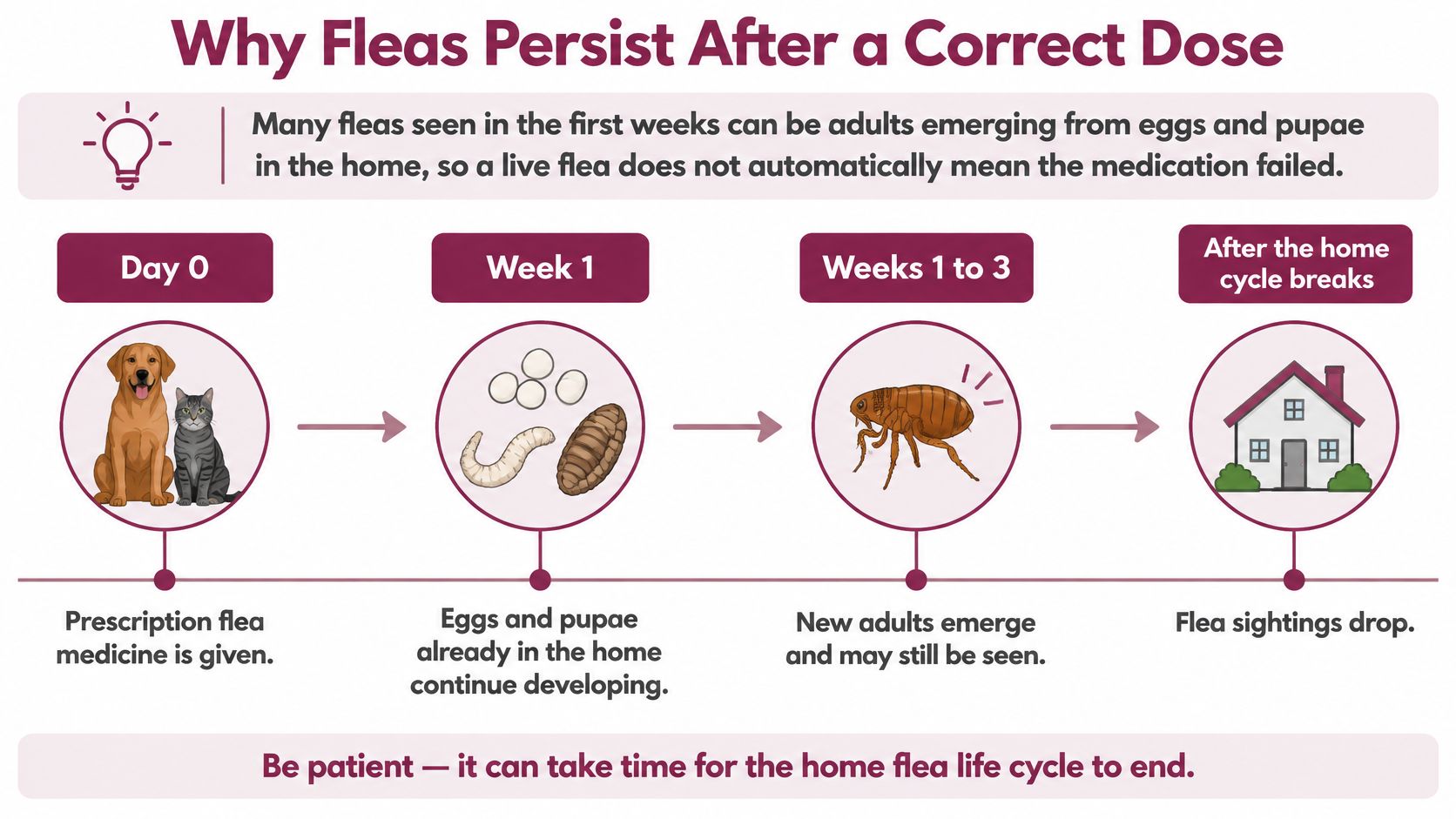
A live flea after treatment doesn't automatically mean the medicine failed. Adults can continue emerging from immature stages already present in the home, while untreated animals or outdoor exposure can introduce more fleas.
The next step is investigation, not automatic redosing. Keep a record of what you're seeing so the veterinarian can distinguish ongoing environmental emergence, administration problems, reinfestation, and possible product failure.
Persistent flea symptoms, likely causes and next steps
| What you notice | Likely cause or possibility | Next step |
|---|---|---|
| Live fleas in the first weeks after treating all pets | Adults emerging from the home environment | Continue the prescribed plan and clean bedding and carpets |
| Fleas return before the labeled interval ends | Reinfestation from outdoors or other animals | Review exposure and tell your veterinarian |
| Fleas persist late in the labeled interval | Product performance or continuing exposure needs review | Ask your veterinarian to reassess |
| Fleas persist after verified correct use | Administration issues, reinfestation, or possible resistance | Request review of diagnosis, dosing, and product selection |
| A dose was missed, given late, or doubled | Schedule or dosing error | Call your veterinarian before the next dose |
Work through the home and treatment record
Coordinate labeled treatment for household pets with the veterinarian. Wash pet bedding according to its care instructions, vacuum carpets and upholstered resting areas, and empty the vacuum where pets won't contact the collected debris.
Record medication names, administration dates, and flea sightings. Include whether an oral dose was fully consumed or a topical was applied as directed.
Our explanation of whether Capstar kills flea eggs helps clarify why adult-flea killing and immature-stage control aren't the same task. It isn't a recommendation to add another medication to the prescription.
Troubleshooting priority: Verify the dose, administration, household plan, and exposure before assuming resistance.
Resistance is one possibility for a veterinarian to investigate, not something a flea sighting can diagnose. Don't stack insecticides, switch products, or shorten dosing intervals without professional guidance.
Ordering Prescription Flea Meds Through Bandana Rx
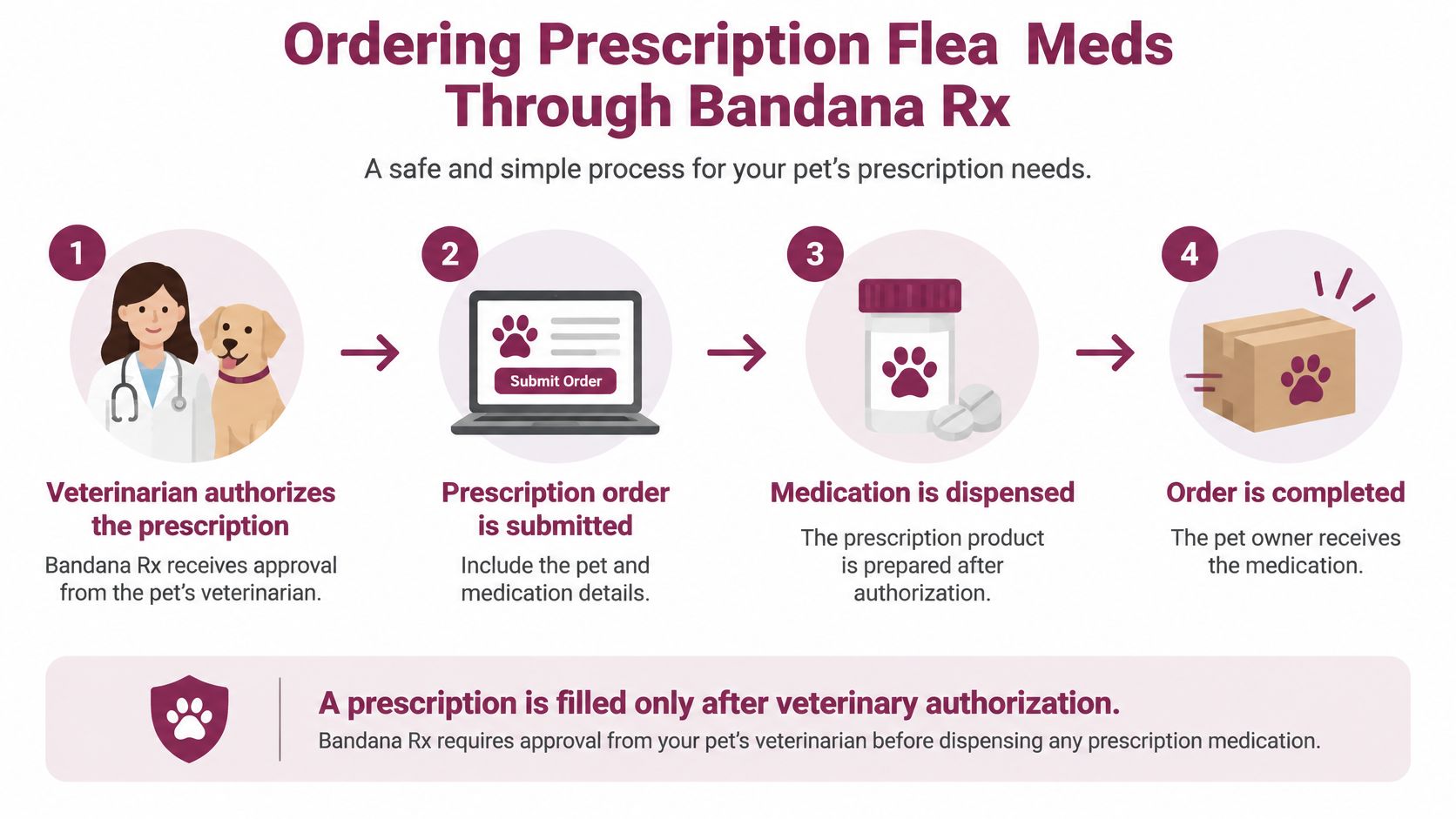
A prescription animal drug may be dispensed only by or on the lawful written order of a licensed veterinarian, according to the FDA's explanation of animal-drug regulation. That authorization supports patient-specific selection, dosing, and monitoring.
We dispense prescription medications only after receiving authorization from your pet's veterinarian. A refill should match the veterinarian's current directions for that pet, not repeat an outdated purchase.
Follow the prescription through checkout
- Confirm the prescription. Match the full product name, strength, route, and interval with your veterinarian.
- Enter your shipping address, your pet's details, and the veterinarian's details for each medication ordered.
- Complete verification. We can contact the veterinary office to seek authorization and prefer receiving it directly from the office. If your veterinarian doesn't work with online pharmacies, you must use the mailed prescription method.
- Track your order and check the medication against the prescription when it arrives.
- Review before refilling. Tell the veterinary team about weight changes, new medications, or health developments that may affect the plan.
Our explanation of why routine veterinary visits still matter when using online pharmacies describes how examinations and pharmacy fulfillment serve different roles.
Buy Once and AutoShip purchasing options may be offered on individual product pages. AutoShip can simplify regular reordering where available, but check the specific page rather than assuming every medication qualifies.
Delivery timing doesn't determine dosing timing. Keep the prescribed schedule separately, and contact the veterinarian if a supply issue could interrupt treatment.
Bandana Rx offers veterinary medications with prescription verification to support your veterinarian's flea-control plan. Visit Bandana Rx to explore available options and match your order to the exact product, strength, and formulation your veterinarian has authorized.