

You're sitting with your cat when you notice a round patch of thin fur near an ear. There's an antifungal cream in the bathroom cabinet, and it's tempting to apply a little tonight. But a bald patch isn't a diagnosis, and treating the visible spot may leave the bigger problem untouched.
Ringworm treatment for cats at home works best as a veterinarian-directed plan, not a cabinet-cream experiment. Your veterinarian identifies the infection and chooses treatment. Your part is to give that treatment correctly, protect the household, and remove contaminated hair without turning your home into a bleach project.
Table of Contents
- What Home Treatment Can and Cannot Do
- Isolate the Cat and Protect Your Household
- How to Carry Out the Treatment Plan
- Clean the Home Without Overdoing Bleach
- Know When the Infection Is Actually Gone
- Get Prescribed Products Through Bandana Rx
What Home Treatment Can and Cannot Do
Ringworm is a contagious fungal infection called feline dermatophytosis, not an infection caused by worms. Several skin problems can resemble it, so a photograph or circular patch can't reliably tell you which treatment your cat needs.
True dermatophytosis accounts for less than 4% of feline skin disorders, and infection generally takes about 6–12 weeks to resolve, according to the Merck Veterinary Manual's dermatophytosis guidance. That makes veterinary confirmation important before you commit to a lengthy home routine.
Match the plan to the cat
A healthy adult with a small, localized infection may be a candidate for a veterinarian-selected topical product. Widespread disease, particularly in a long coat, often needs prescription oral medication as well as whole-body topical care. A kitten or a household with several pets deserves an individualized assessment rather than an automatic cream-only approach.
Home role versus veterinary ringworm therapy
| Situation | Typical veterinary plan | What the owner does | Do not assume |
|---|---|---|---|
| Suspected patch, no test yet | Examination plus fungal culture or PCR when appropriate | Limit contact gently and book the veterinarian | A round bald spot is ringworm |
| One or few small lesions, healthy adult | Topical antifungal the veterinarian selects | Wear gloves, prevent licking, follow clinic directions | Any over-the-counter cream is enough |
| Most confirmed cases | Whole-body topical therapy on a set schedule | Apply only as directed and protect the eyes | A stronger product works faster |
| Widespread disease, long coat, kitten, or multi-cat home | Assessment for prescription oral antifungal plus topical care | Give the prescribed dose and schedule only | Fur regrowth means the cat is cured |
| Persistent infection | Recheck, culture, and possible clipping by the clinic | Report missed doses and new spots | Switching products on your own is safe |
A spot treatment and a whole-coat treatment aren't interchangeable. The veterinarian may need to address infected hairs beyond the obvious bald area, while oral medication may be necessary for disease that topical treatment alone won't adequately manage.
Keep prescription decisions with the veterinarian
Product choice, strength, dilution, and application schedule belong to the clinic. Concentrating a rinse, spreading cream over a larger area, or substituting a human product can expose your cat to harm through grooming, ingestion, or eye contact.
If getting to the clinic feels unnecessary because the lesion looks minor, our explanation of why veterinary visits still matter when using an online pharmacy explains the distinction between obtaining medicine and choosing appropriate care.
Practical rule: Your home jobs are to protect people, treat your cat as prescribed, and remove spore-carrying hair. Diagnosing the patch and selecting medication remain veterinary jobs.
Isolate the Cat and Protect Your Household
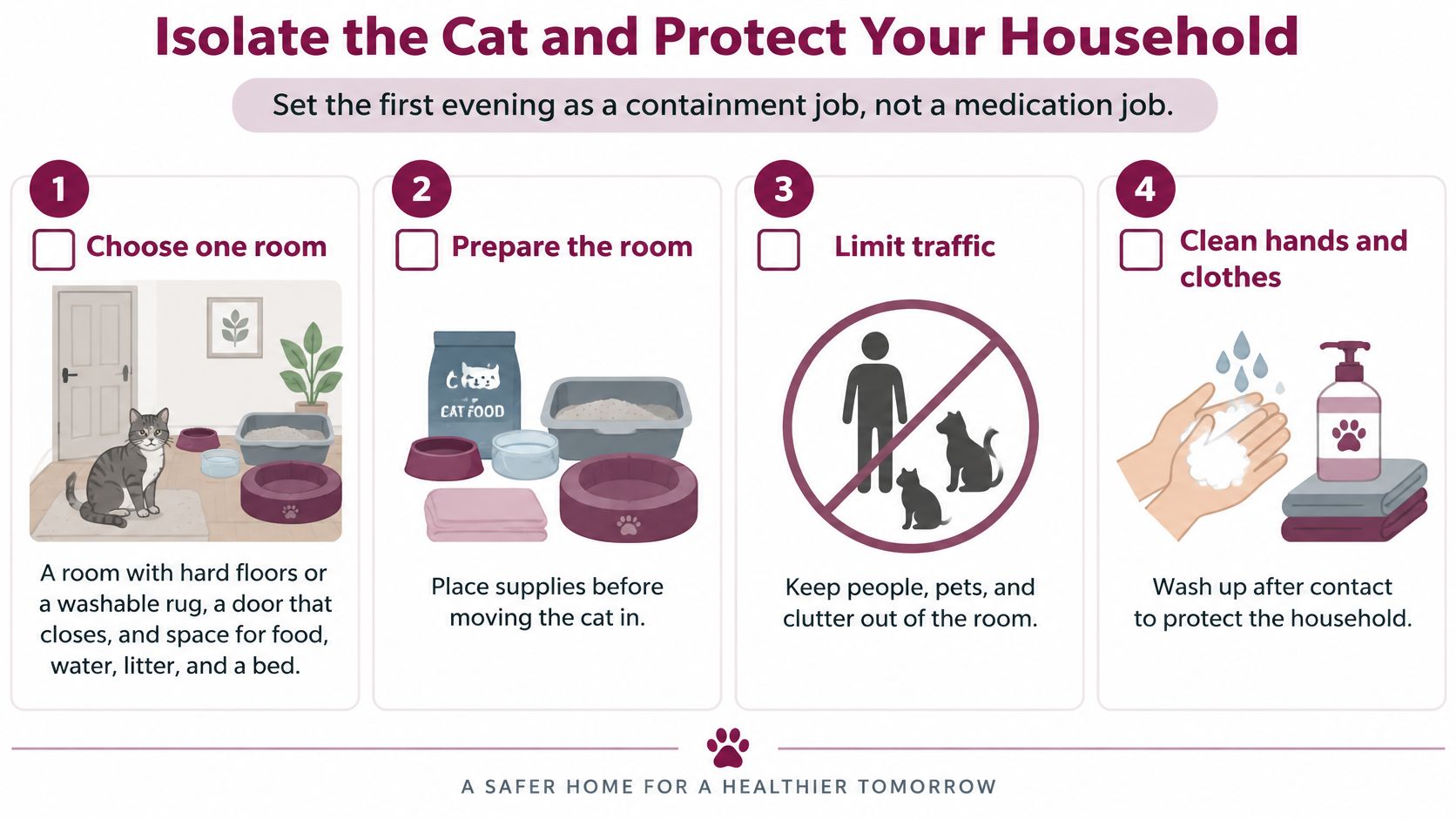
Make the first evening a containment job, not an improvised medication job. Set up a comfortable area that lets you care for your cat while reducing unnecessary contact with other animals and household surfaces.
Ringworm can spread through infected skin and hair, as well as contaminated belongings. The Centers for Disease Control and Prevention advises prompt veterinary care, checking household pets, wearing gloves and long sleeves when handling an infected animal, and washing hands with soap and running water afterward.
Set up a humane recovery room
Choose an easy-clean room. A closing door, hard flooring or a washable rug, and adequate space make daily care more manageable. Provide food, water, litter, bedding, and comfortable resting space, with food separated from the litter area.
Prepare supplies before moving your cat. Use washable bedding and dedicated bowls, towels, and toys. Remove unnecessary cushions and clutter rather than trying to disinfect around them every day.
Keep the arrangement comfortable. Visit for necessary care and calm interaction, but avoid close face-to-coat contact. Offer washable enrichment and talk to your cat so separation doesn't become abandonment.
Dress for handling and cleaning. Wear gloves and long sleeves for treatment, handling contaminated bedding, and litter-area care. Keep clean supplies separate from used towels and cleaning equipment.
Wash afterward. Use soap and running water even after wearing gloves. Change clothing if it has collected hair before handling another pet or sitting on shared furniture.
Keep equipment separate. Don't share brushes, beds, towels, or toys with other pets. Wash your hands between animals and keep other pets out of the recovery space.
Cornell's Feline Health Center recommends confining an infected cat to a room until the infection has cleared, together with household cleaning and disinfection. In a small apartment, a suitable bathroom may work if it's safe, ventilated, and large enough for normal activities. A transport carrier isn't an appropriate substitute for a living space during a prolonged course of care.
Isolation reduces spread. It doesn't replace treatment.
Protect people and other pets
Anyone who develops a suspicious rash after exposure should seek medical advice and mention the cat's infection. Be particularly cautious about direct contact involving children, older adults, and people with weakened immune systems. Don't put your cat's medication on a person's rash.
Ask the clinic to evaluate household pets, including those without obvious patches. Don't give another animal leftover oral antifungal medication or assume that a shared home means a shared prescription.
Medication availability also doesn't tell you whether a product fits your cat. Clotrimazole Cream, an antifungal for skin conditions caused by ringworm and other susceptible fungal infections, costs $5.50 through our pharmacy; Miconazole (Conzol) Lotion 1% requires a veterinarian's prescription. Neither should be chosen just because it's accessible or already in the cabinet.
If infection seems to return despite your efforts, our guide to why ringworm keeps coming back can help you organize questions about treatment completion, household exposure, and follow-up testing.
How to Carry Out the Treatment Plan
Once your veterinarian has chosen the products, turn the instructions into a routine you can repeat without guessing. Keep the clinic's written directions beside the medication, especially when topical applications and oral treatment follow different schedules.
Before beginning, make sure you know whether the treatment is a spot application, whole-coat product, or oral medication. A lotion, shampoo, rinse, and cream can have different instructions even when their purposes sound similar.
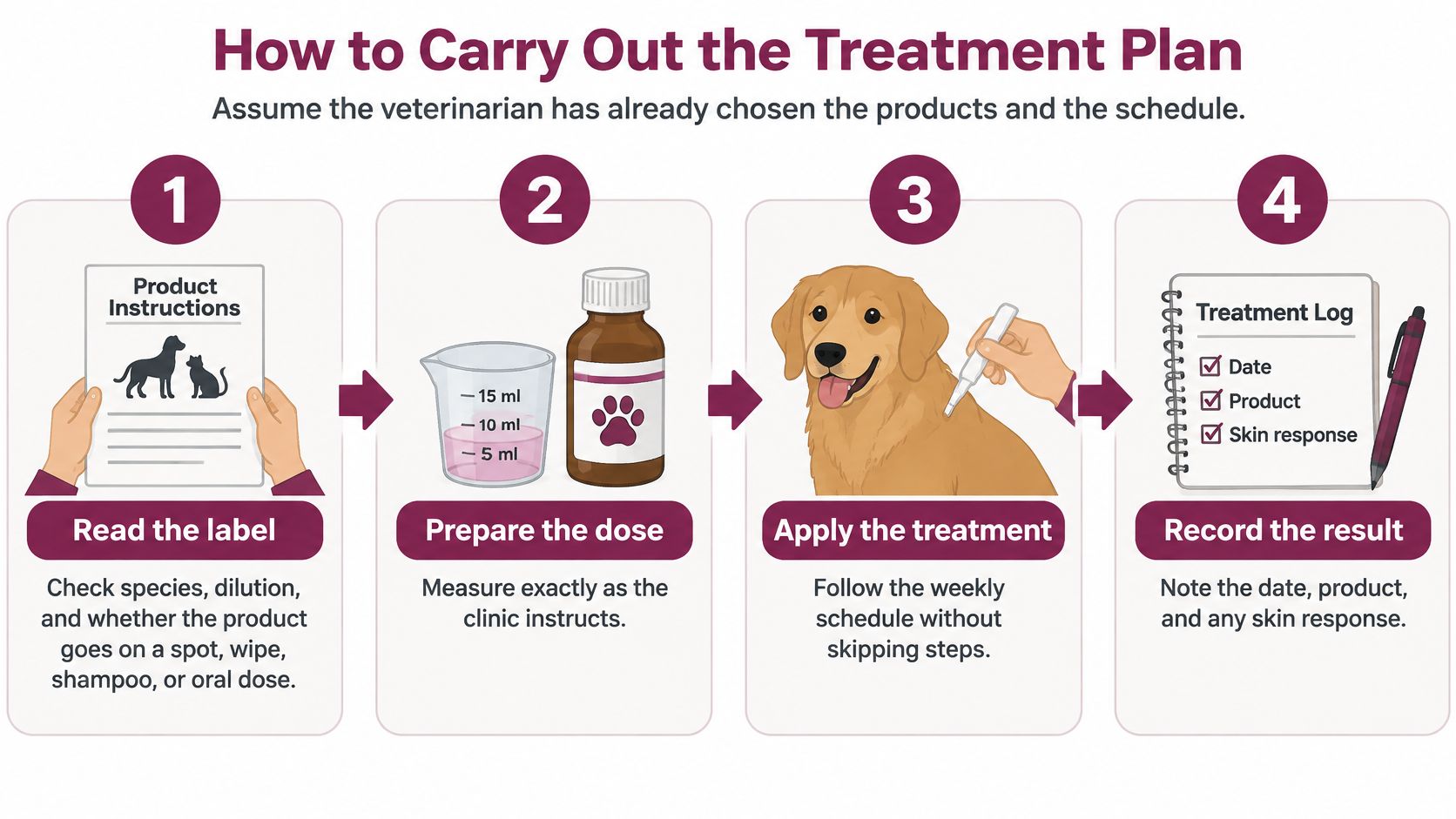
Build a repeatable treatment routine
Read the label and clinic directions together. Check the animal's name, product, application area, dilution if required, and schedule. If the package and clinic directions appear inconsistent, call before using the product.
Gather everything first. Set out gloves, an old towel, the prescribed measuring device, and any grooming-prevention equipment the clinic recommended. A nonslip surface and a quiet room can make handling easier.
Measure exactly. Use the supplied or pharmacist-recommended measuring tool. Don't estimate a liquid dose with a household spoon or make a rinse stronger because the skin looks worse.
Apply topical treatment as directed. Follow the instructions for coat coverage, contact time, rinsing, and drying. Protect the eyes and mouth, and ask for specific directions before treating broken skin or lesions close to sensitive areas.
Prevent grooming for the instructed period. If the clinic recommends a cone, have it ready before application. Don't assume that a product is safe to lick just because it's intended for skin use.
Give oral medication on its exact schedule. Prescription itraconazole is an example of an oral antifungal a veterinarian may choose. Don't double a missed dose, change treatment days, or combine antifungals without advice.
Store and record. Keep medication away from children and other animals. Mark completed applications, oral treatment days, missed doses, and the recheck appointment on a calendar.
A simple record can include the date, product used, whether administration was complete, and any change in appetite or behavior. If several people help, have the person giving treatment mark it immediately so nobody accidentally repeats a dose.
Know when to call instead of continuing by habit
Contact your veterinarian before the next dose if your cat vomits, stops eating, becomes markedly lethargic, develops eye irritation, or has a rapidly spreading rash. These changes don't identify a particular drug reaction by themselves, but they warrant professional assessment.
If a topical product reaches an eye, contact the clinic promptly for immediate instructions rather than waiting for the next scheduled visit. Bring the container or provide its exact name so the veterinarian can advise you based on the actual product.
Clipping is a clinical decision, particularly for heavy or long coats. Don't shave the affected area at home, since struggling or nicking the skin can create additional problems.
If you're comparing nonprescription products, use our guide to over-the-counter antifungals for ringworm as background for a clinic conversation, not permission to substitute products. No cream, shampoo, or oral medication should be treated as a guaranteed cure for every cat.
Clean the Home Without Overdoing Bleach
You don't need to begin by throwing away the sofa or bleaching every wall. Remove hair first, then wash and disinfect suitable surfaces. Spraying disinfectant over dust and shed fur skips the work that makes disinfection more useful.
The feline dermatophytosis guidance available through the National Library of Medicine emphasizes mechanical cleaning and explains that ordinary washable items can be cleaned with detergent without requiring bleach or hot water. Focus your effort on the cat's room and places the cat used, rather than treating every household surface identically.
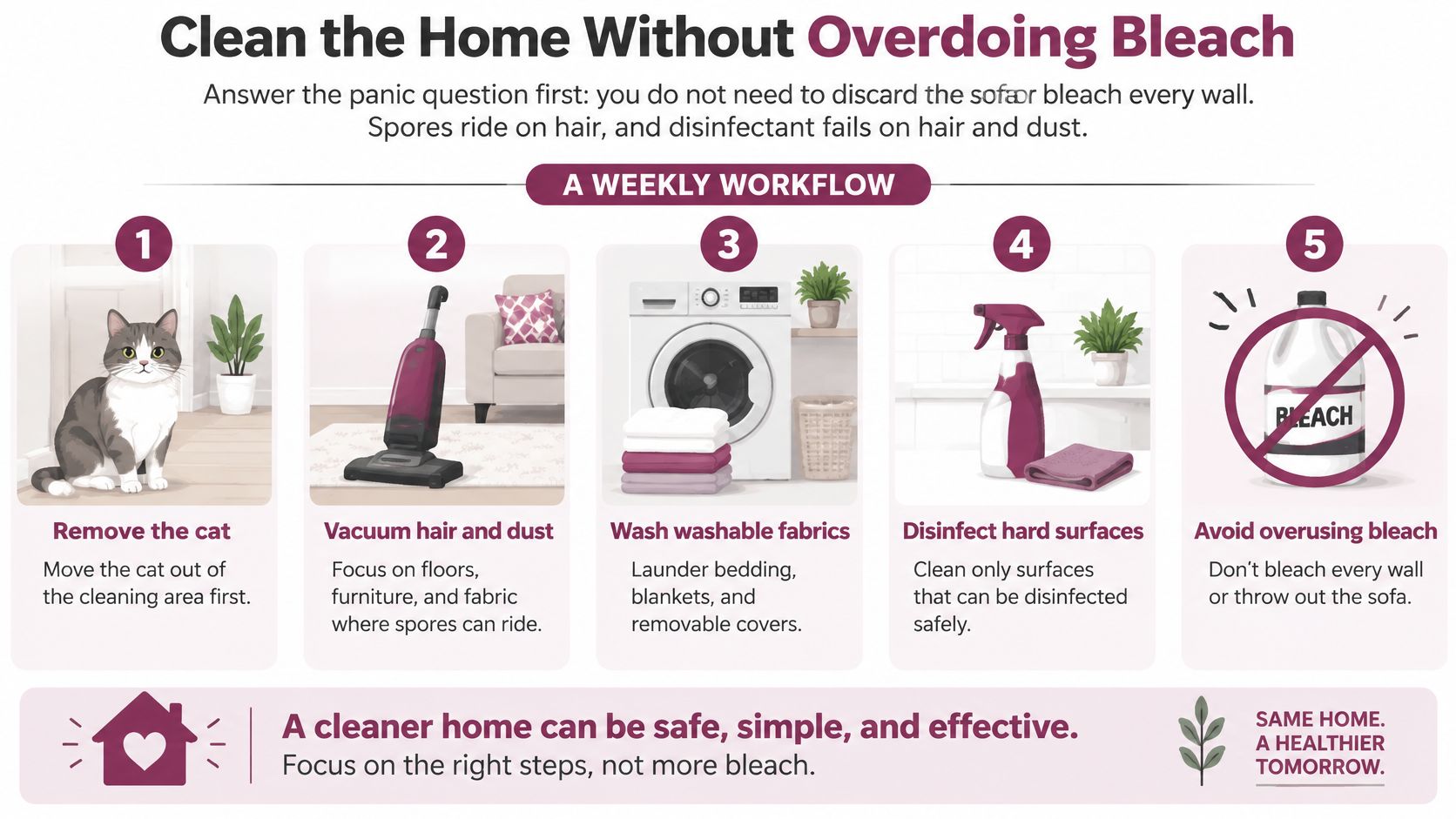
Follow the cleaning order
Move your cat away from the work area. Use another safe, contained space while cleaning. Keep medications, bowls, and clean bedding away from sprays and wet surfaces.
Vacuum hair and debris. Focus on floors, furniture the cat used, edges, and accessible vent covers. Seal and discard collected debris, or empty the canister outside the living space without scattering its contents.
Launder washable fabrics. Wash bedding, towels, and suitable soft toys with ordinary detergent. Avoid overloading the machine, follow fabric-care directions, and dry items before returning them.
Wash hard surfaces. After removing hair, clean floors, the litter area, and other suitable surfaces with detergent. Clean bowls separately from litter equipment.
Disinfect selectively. Use a product appropriate for the cleaned, nonporous surface and the intended fungal-control purpose. Follow its dilution and wet-contact instructions, ventilate, and keep cats away until the surface is dry and safe under the label directions.
Keep household disinfectants off your cat. Don't use surface wipes, floor cleaner, or bleach as a skin treatment. Never mix bleach with other cleaning products.
Match the method to the material
What to clean and whether bleach belongs there
| Item | First step | Disinfectant | Skip this |
|---|---|---|---|
| Bedding and washable toys | Detergent wash | Not required for ordinary laundry | Throwing out every blanket |
| Hard floors and counters | Vacuum or pick up hair, then wash | Dilute bleach only after debris is gone and where suitable | Spraying a dusty floor |
| Carpet and upholstery | Frequent vacuuming and bag disposal | Poor result if hair remains; choose a material-appropriate method | Soaking fabric with bleach |
| Litter box and bowls | Empty debris, wash with detergent | Disinfect hard plastic when appropriate, following rinsing directions | Sharing the box with other cats |
| Brushes and other pets' beds | Keep a separate set | Clean suitable nonporous tools after hair removal | One household grooming kit |
A shelter's environmental treatment protocol isn't a home mixing recipe. Bleach products have different starting concentrations, and surface compatibility matters, so don't translate a published percentage into a guessed household dilution.
If you're wondering whether Clorox wipes kill ringworm, distinguish the brand name from the specific product's label claims. The container's directions, appropriate surface, and required contact time matter more than the word wipes.
In an apartment, frequent hair removal in the confinement room is more manageable than an occasional whole-home cleaning marathon. If a dog shares your home, our guide to ringworm treatment for dogs offers context for discussing that animal's care separately.
Hair removal first, disinfectant second, and only where the surface can actually be wetted and dried safely.
Know When the Infection Is Actually Gone
Your cat's bald patch is filling in, and the coat looks nearly normal. It's tempting to stop treatment. Hair regrowth is not proof that ringworm has cleared. Fur can return while infection remains, so appearance alone cannot tell you whether treatment is finished.
The veterinarian sets the treatment endpoint using follow-up findings, which may include fungal cultures. Cats are typically considered cleared after consecutive negative fungal cultures, as described in the Merck Veterinary Manual's ringworm overview. Your veterinarian will decide which tests apply and how to interpret them. If PCR is proposed, ask what its result can show during follow-up. Different tests do not necessarily answer the same question about whether viable fungus remains.
What a combined treatment protocol tells us
Ringworm care involves more than watching the affected patch. Treatment, follow-up testing, and attention to other animals may all contribute to the veterinarian's decision. A cat with no visible bald spots may still need assessment if there is an ongoing household concern.
Ask the clinic what test will guide the decision and when samples should be collected. Keep following the prescribed plan unless the veterinarian changes it.
Signs during treatment and the next move
| What you notice | What it usually means | Next move |
|---|---|---|
| Bald spots grow hair | Skin is improving, but fungus may remain | Continue until the veterinarian stops treatment |
| Consecutive negative cultures meeting the clinic's endpoint | Evidence supporting clearance, not a home guess | Ask when confinement can end |
| New spots on a person | Possible zoonotic spread | See a physician and update the veterinarian |
| Another pet develops patches | Possible carrier or new infection | Have in-contact animals checked |
| Still affected near the planned endpoint | The plan may need adjustment | Arrange a recheck; don't swap drugs |
| Vomiting or marked lethargy on oral medicine | Possible adverse effect or another illness | Call the veterinarian before the next dose |
Use milestones rather than the mirror
At the start, make sure you understand the diagnosis and medication instructions. During treatment, note changes in your cat's skin and any problems following the plan. A new patch or returning hair is information for the clinic, not a reason to shorten or change treatment yourself.
Keep the scheduled recheck even when the coat looks normal. Stopping too soon can leave infection unresolved, and another affected animal may complicate the picture. Tell the veterinarian about missed doses, incomplete topical applications, and difficulty giving medicine. These details can help the clinic decide whether the plan needs support, more testing, or adjustment.
The veterinarian determines when treatment ends and whether confinement can stop. A home observation is useful, but it is not a substitute for that decision.
Some problems need attention before routine clearance testing. Contact the veterinarian promptly if your cat stops eating, seems painful, or gets a topical product in the eye. A person with a spreading rash should seek medical assessment.
Get Prescribed Products Through Bandana Rx
Once your veterinarian has named the treatment, the pharmacy's role is to supply the correct product, not to replace the examination. Match the medication name, strength, dosage form, and directions to the prescription before giving it to your cat.
We're a licensed pet pharmacy, and we dispense prescription medications only after receiving authorization from your pet's veterinarian. We ask for information including your pet's medical conditions, weight, breed, and age to support appropriate care.
Keep the order tied to the treatment plan
Before ordering, make sure the clinic knows about your cat's other medications, supplements, health conditions, and any previous difficulty taking medicine. Tell the clinic if you can't administer the prescribed formulation reliably. A practical administration problem deserves a professional solution, not an improvised substitution.
Use these checks when reviewing an order:
- Match the prescription. Confirm the exact medication and formulation the veterinarian named.
- Check the quantity. Make sure the supply aligns with the authorized schedule and planned follow-up.
- Resolve discrepancies. Contact the pharmacy or clinic if the received product doesn't match your understanding.
- Keep the recheck appointment. Having medicine left over, or running out, doesn't independently determine whether treatment is finished.
A listing such as our fluconazole product page isn't a recommendation to choose that medication for ringworm. Antifungals aren't interchangeable, and a product page can't determine which prescription is appropriate for your cat.
Refills should also follow the veterinarian's plan rather than an assumed ongoing need. Don't extend treatment, restart leftover medication, or arrange recurring purchases as a substitute for clearance testing.
The next step is a coordinated one: confirm the diagnosis, then keep isolation, prescribed treatment, and cleaning going until the clinic, not the mirror, says to stop.
Bandana Rx offers veterinary prescription fulfillment and pet-care supplies to support a veterinarian-directed treatment plan. After your clinic confirms what your cat needs, visit Bandana Rx to review the prescribed product's available strengths and purchase options, with veterinary authorization required for prescription orders.