


Could an oral tablet be labeled for your cat's fleas but not for your cat's ticks? Yes. Parasite coverage, minimum age, weight limits, and treatment intervals are separate label requirements, even when a product is described as flea and tick medication.
If you're searching for “flea and tick for cats oral,” the useful question isn't which tablet is easiest to give. It's which product matches your cat's current weight, age, medical history, and parasite risks. A little label reading can prevent a convenient choice from becoming an unsuitable one.
Table of Contents
- Oral Flea and Tick Options for Cats at a Glance
- Label Checklist Before You Choose an Oral Product
- Safety Screening and Warning Signs in Cats
- Choosing an Oral Option by Your Cat's Situation
- How Fast Oral Flea Products Work and What to Expect
- Prescription Status, Ordering and Veterinary Oversight
- Confirm the Right Oral Product With Your Veterinarian
Oral Flea and Tick Options for Cats at a Glance
Oral flea and tick options for cats compared
| Product type | Active ingredient | Parasites on label | Minimum age and weight | Duration or interval |
|---|---|---|---|---|
| Nitenpyram oral tablet | Nitenpyram | Fleas, used for fast flea kill | 4 weeks and 2 lb, per the FDA approval record | Follow the specific tablet label for repeat dosing |
| Credelio CAT | Lotilaner | Adult fleas; black-legged ticks | Fleas: 8 weeks and 2 lb. Ticks: 6 months and 2 lb | One month |
| Dog-labeled oral products | Check the dog product's ingredient panel | Only the parasites named on its dog label | Not labeled for cats | Do not give to cats |
The table is a starting point, not a dosing chart. In particular, Credelio CAT has different age requirements for flea and tick indications. Its complete approved label is discussed below.
Rapid flea treatment and ongoing prevention aren't the same job
Nitenpyram tablets and Credelio CAT both address fleas, but they shouldn't be treated as interchangeable tablets. Nitenpyram is used for rapid treatment of existing flea infestations. Credelio CAT is a prescription oral product with a longer treatment interval and a specified tick indication.
That distinction matters when your cat has visible fleas today. Killing the fleas currently feeding on your cat and choosing an ongoing preventive plan are related decisions, but they aren't identical. Don't assume that a fast flea-killing tablet provides the same continuing protection as another medication.
The active ingredient matters more than the fact that both products go into your cat's mouth. Different ingredients have different directions, eligibility requirements, and precautions.
Bring these questions to every product
- Which parasites need coverage? A flea-only treatment doesn't become a tick treatment because it's sold beside flea-and-tick products.
- How old is your cat? Kitten eligibility is product-specific, and an age requirement may also differ by parasite indication.
- What does your cat weigh now? Use a current weight, rather than an estimate from an earlier visit or the appearance of your cat's coat.
For example, a kitten may meet a product's flea eligibility requirements without meeting its tick eligibility requirements. An adult cat may meet both age requirements but still need a different product because of medical history or local tick exposure.
Practical rule: Compare the exact cat label, not just the product name, package color, or convenience of the tablet.
Your veterinarian should make the final selection when a prescription is involved or when your cat's age, size, health, or other medications raise questions.
Label Checklist Before You Choose an Oral Product
The approved label tells you what a medication has been evaluated and authorized to do. A broad description such as flea and tick protection can leave out details that change whether the product fits your cat.
For example, the FDA-approved Credelio CAT label specifies monthly adult flea treatment and prevention for cats at least 8 weeks old and 2 pounds, but black-legged tick treatment and control requires cats to be at least 6 months old and 2 pounds.
Read beyond the front of the package
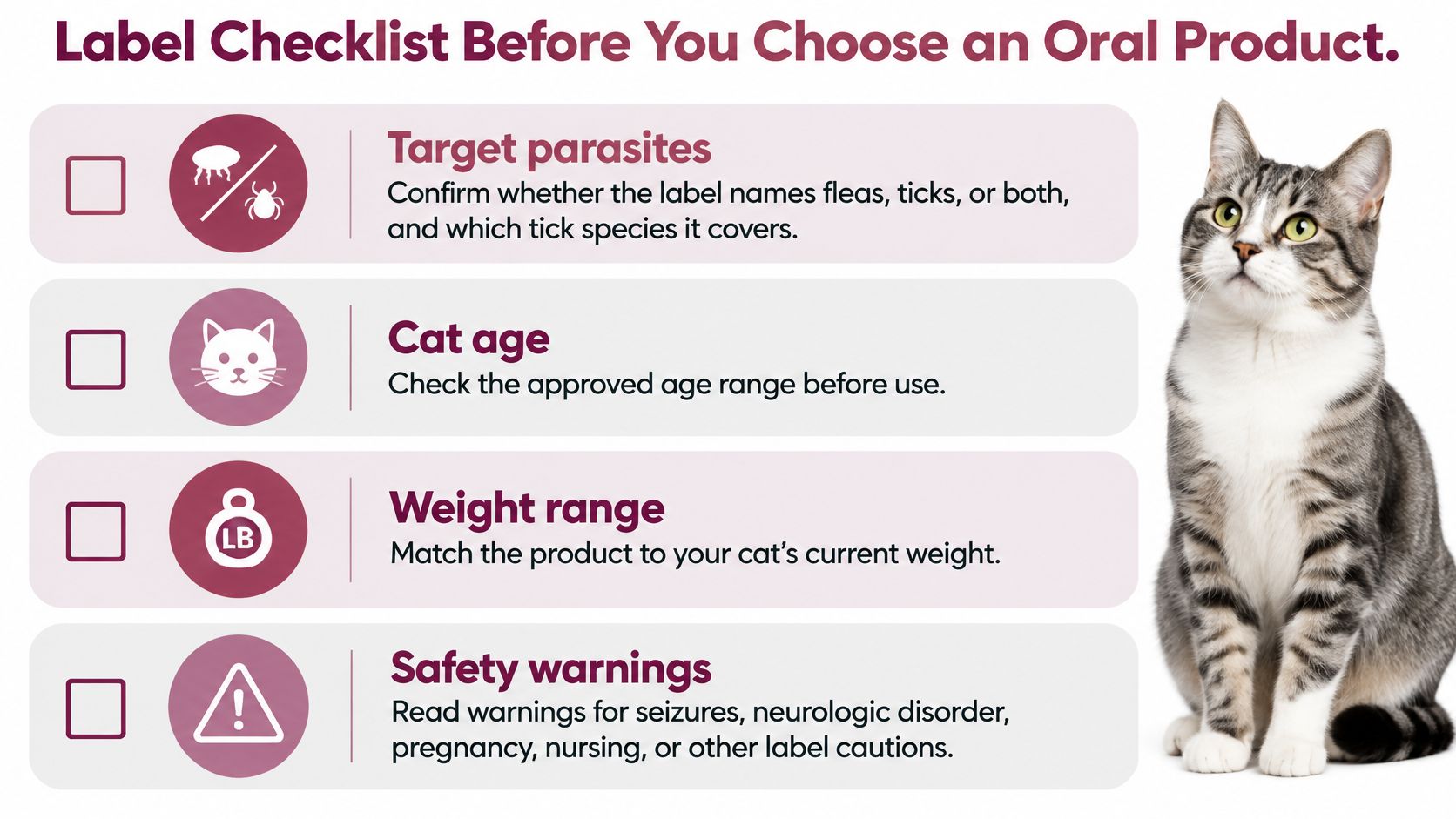
Identify the target parasites. Find the actual indications, including tick species. Black-legged tick coverage isn't a claim to control every tick your cat might encounter.
Confirm the species. The package must identify cats as an approved species. A smaller amount of a dog medication isn't an acceptable substitute for a cat-labeled product.
Check the age requirement for the intended use. Don't stop after finding the word kitten. A kitten's eligibility for flea treatment doesn't automatically establish eligibility for tick treatment.
Match the weight band. Check both the minimum weight and the tablet's labeled weight range. If your cat is near a boundary, ask the clinic to confirm its current weight before selecting the package.
Read the dose and interval together. Note when the next treatment is due and how the tablet must be administered. Don't transfer another medication's schedule to the new product.
Look for food instructions. Credelio CAT must be administered with food. If your cat won't eat, ask your veterinarian how to proceed rather than assuming an empty-stomach dose is equivalent.
Check regional tick coverage. Tell your veterinarian where your cat lives and travels. Ask whether the label covers the tick species relevant to those locations.
Understand what oral coverage means
Oral products work after parasites feed; they don't create a physical barrier that prevents attachment. A tick-killing claim isn't a promise that ticks can't attach or that disease transmission is impossible.
Keep the package insert available, and use our guide to reading pet medication labels, dosage instructions, warnings, and storage when checking unfamiliar terms. If the label doesn't match your cat's needs, ask your veterinarian about a different product or an additional preventive. Don't split, combine, or substitute doses to make the label fit.
Safety Screening and Warning Signs in Cats
An oral medication isn't automatically safer than a topical medication because nothing remains on the coat. The better choice depends on your cat's medical history and whether you can administer the selected treatment correctly.
Before selecting an oral product, give your veterinarian a clear account of your cat's health. Don't leave out an unexplained shaking episode or a reaction to a previous preventive because it happened long ago.
Questions to answer before treatment
- Neurologic history: Has your cat ever had a seizure, tremors, unexplained wobbliness, or a diagnosed neurologic disorder?
- Age and body size: Is your cat's recorded weight current, and does the clinic know its approximate birth date?
- Reproductive status: Is your cat pregnant, nursing, or intended for breeding?
- Other treatment: Which prescription medications, non-prescription products, supplements, and parasite preventives does your cat receive?
- Existing illness: Has your cat recently been unwell, stopped eating normally, or developed a new health problem?
The FDA's isoxazoline safety fact sheet considers these products safe and effective overall while warning about neurologic reactions, including muscle tremors, ataxia, and seizures. Seizures have occurred in animals without a previous seizure history, so a reassuring history doesn't eliminate the need to monitor your cat.
The Credelio CAT prescribing information advises caution in cats with a history of neurologic disorders and states that safety hasn't been established in breeding, pregnant, or lactating cats. Its U.S. field study included 341 cats and reported no serious adverse reactions, but that finding doesn't guarantee that an individual cat won't react.

What deserves veterinary attention after dosing
The FDA's guidance on safe flea-and-tick product use identifies warning signs including wobbliness, incoordination, vomiting, diarrhea, poor appetite, depression, excessive salivation, and seizures. Also watch for tremors, twitching, pronounced lethargy, or behavior that's unusual for your cat.
Contact your veterinarian promptly if these signs develop. A seizure, collapse, or marked difficulty standing warrants urgent veterinary attention. Don't give another dose or try a home remedy while waiting for advice.
Keep the package, record when the dose was given, and describe what happened. If possible, note whether your cat ate with the medication and whether another pet's product could have been involved.
A safety warning is a reason to screen carefully and know what to watch for, not a reason to assume every cat will have a reaction.
Oral treatment can be practical for a cat that won't tolerate topical application, but it still requires accurate dosing and medical review. In mixed-pet households, resources such as our Advantix flea-control guide should be read with species restrictions in mind, never as permission to use a dog product on a cat.
Choosing an Oral Option by Your Cat's Situation
The most useful veterinary conversation starts with your cat's circumstances, not a preferred brand. Bring the package name you're considering, but be prepared for your veterinarian to recommend a different approach.
The FDA's animal-drug safety-related labeling information describes Credelio CAT's adult flea indication as lasting one month in cats at least 8 weeks old and weighing at least 2.0 pounds. Those are product-specific requirements, not general eligibility rules for every oral medication.

Match the question to the situation
Cat situations and the question to ask your veterinarian
| Your cat's situation | Question for your veterinarian | Why it changes the choice |
|---|---|---|
| Kitten under 8 weeks | Is any oral product labeled for this age? | Nitenpyram's FDA record starts at 4 weeks; Credelio CAT's flea label starts at 8 weeks |
| Cat under 2 pounds | Which weight band applies, and how should the dose be confirmed? | Both examples have a 2-pound minimum; a lighter cat needs veterinary direction |
| Seizure history or neurologic disease | Is an oral isoxazoline suitable for this cat? | Medical history matters, and absence of previous seizures doesn't eliminate risk |
| Won't tolerate topical application | Is an oral product practical, and how is dosing checked? | Avoiding topical application doesn't remove the need for weight-based selection |
| Multi-pet home with dogs | How do I keep dog and cat products separate? | Dog-labeled products aren't labeled for cats |
| Other medications or illness | Are there possible interactions with current medicines? | The answer requires the exact product and your cat's full medication list |
| Tick-heavy region | Which tick species does the product cover, and is another preventive needed? | Tick indications can be narrower than a general flea-and-tick description |
Make the plan workable at home
For a young kitten, don't make a buying decision from age alone. Weight, health, and the purpose of treatment still matter. Our guide to flea treatment for kittens aged four weeks can help you prepare questions, but it doesn't replace an examination or a product-specific recommendation.
For a cat that resists handling, tell your veterinarian what really happens during treatment. There's a difference between disliking a topical applicator and refusing all medication. Ask how to confirm that an oral tablet was swallowed, and what to do if part of it is found afterward.
A mixed-pet household needs an administration routine as well as a prescription. Store dog and cat medications separately, check the pet's name before opening a package, and avoid preparing loose tablets together on the same counter.
If your cat takes other medications, bring photographs of their labels or an updated medication list. Include occasional treatments and supplements, not just daily prescriptions. Your veterinarian can then assess the actual combination rather than an incomplete description.
A convenient tablet is useful only when the overall plan fits your cat. Don't adjust a dose at home to solve an age, weight, or coverage mismatch.
How Fast Oral Flea Products Work and What to Expect
Flea kill on your cat and flea control throughout your home follow different timelines. An oral product can affect feeding fleas while immature flea stages remain in bedding, carpets, furniture, and other resting areas.
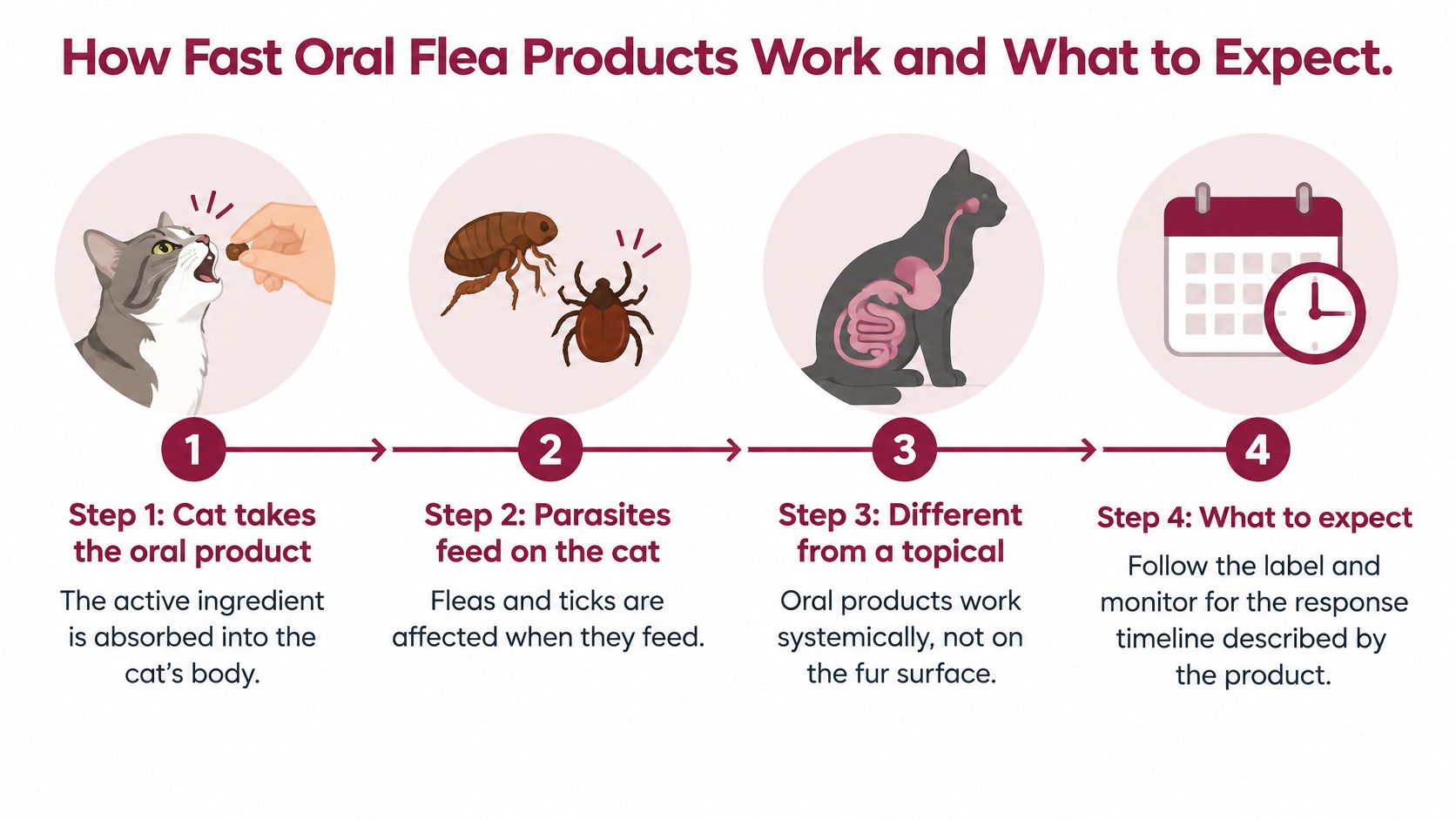
Oral treatments work systemically, meaning the active ingredient is absorbed into your cat's body. The exact onset and duration belong to the individual product's label. Don't apply a rapid-treatment product's expected response time to every monthly preventive.
Follow the cat's response and the household plan
A practical treatment sequence includes:
- At administration: Give the selected medication exactly as directed, including any food requirement. Record the administration date and the next scheduled treatment.
- During monitoring: Use a flea comb to check for visible fleas and note whether the number decreases over time. Don't judge success only by whether your cat scratches.
- During household cleanup: Wash pet bedding as its care instructions allow, vacuum carpets and upholstered resting areas, and dispose of collected debris promptly.
- During follow-up: Continue the veterinarian's plan and report persistent fleas, ongoing skin irritation, or difficulty administering treatment.
Seeing another flea doesn't automatically mean the dose failed. Fleas developing in the environment can continue to emerge, so treating the cat without addressing its surroundings may leave you frustrated. Our explanation of whether Capstar kills flea eggs helps distinguish adult flea treatment from control of the wider flea life cycle.
Look for a downward trend in fleas on your cat, not an instant disappearance of every flea in the home.
Don't improvise after a dosing problem
If your cat vomits after treatment, contact your veterinarian before giving more medication. Tell the clinic when the dose was administered, when vomiting occurred, and whether you could see the tablet.
Use the same caution after a missed dose, an uncertain swallowed amount, or suspected double-dosing. Don't automatically repeat, double, or shorten the interval. Your veterinarian needs the exact product details to advise you safely.
Prescription Status, Ordering and Veterinary Oversight
Prescription status is product-specific. Credelio CAT is a prescription medication, while other oral flea products may be available without a prescription. Check the exact label or listing rather than assuming that every tablet follows the same purchasing rules.
The FDA's guidance on reporting flea-and-tick product problems explains that oral flea-and-tick products are generally regulated as animal drugs by the FDA, while many externally applied pesticide products fall under EPA oversight. Don't use a topical product's regulatory category or claims to judge an oral medication.
Check the order in a clear sequence
- Confirm prescription status. Read the listing and package information for the specific medication you intend to order.
- Arrange veterinary authorization when required. We require a valid prescription before prescription medication can ship.
- Confirm shipping eligibility. We process shipping according to applicable state requirements, so the destination must be eligible.
- Match the medication details. Check the product name, strength, dosage form, and weight band against the prescription and your veterinarian's instructions.
Bandana Rx is a licensed pet pharmacy, and all medications we dispense are intended for veterinary use only. Non-prescription medications don't require veterinarian authorization, but that doesn't make them suitable for every cat.
Keep veterinary care connected to refills
A repeat order shouldn't replace reassessment when your cat's weight, health, or medications change. Our guide to routine veterinary visits when using online pharmacies explains why ongoing clinical care remains important.
After delivery, keep medication in its original package and follow its labeled storage directions. Retain the insert, and keep the package away from pets and children so an accidental extra dose is less likely.
Confirm the Right Oral Product With Your Veterinarian
The best preparation is a short, accurate summary of your cat's needs. You don't need to diagnose the problem or calculate a dose yourself. You need enough information for your veterinarian to select and explain an appropriate plan.
Bring the proposed product name and any questions you couldn't resolve from its label. If different household members give medication, make sure everyone receives the same written directions.
Take a focused checklist to the appointment
- Record your cat's details. Write down age in weeks when relevant, current weight in pounds, medical history, and all current medicines and supplements.
- Describe the parasite concern. Explain whether you're seeing fleas, finding ticks, planning travel, or trying to prevent another infestation.
- Confirm the exact label match. Ask whether the product fits your cat's age and weight band, and whether the tablet must remain whole.
- Agree on monitoring. Ask which symptoms require a call, which require urgent care, and what to do if your cat vomits or doesn't swallow the full dose.
- Verify the order before administration. Check that the package matches the medication and directions your veterinarian selected.
Leave with instructions you can follow
Ask your veterinarian to write down the administration method, treatment interval, and next steps if a dose is missed. A clear plan is especially helpful when more than one person cares for your cat.
The drugs we carry and dispense are the same drugs provided by local veterinarians. Pharmacy access supports the treatment plan, but it doesn't replace your veterinarian's assessment of your cat.
Don't start, stop, combine, or substitute prescription medication without veterinary guidance. Once the product is confirmed, keep the instructions with the package and use a shared reminder so household members don't accidentally duplicate treatment.
Bandana Rx offers veterinary medications and prescription coordination to help you follow your cat's flea-and-tick treatment plan. After your veterinarian confirms the appropriate oral option, visit Bandana Rx to review available medications and ordering details. Prescription items require a valid prescription before shipping.