



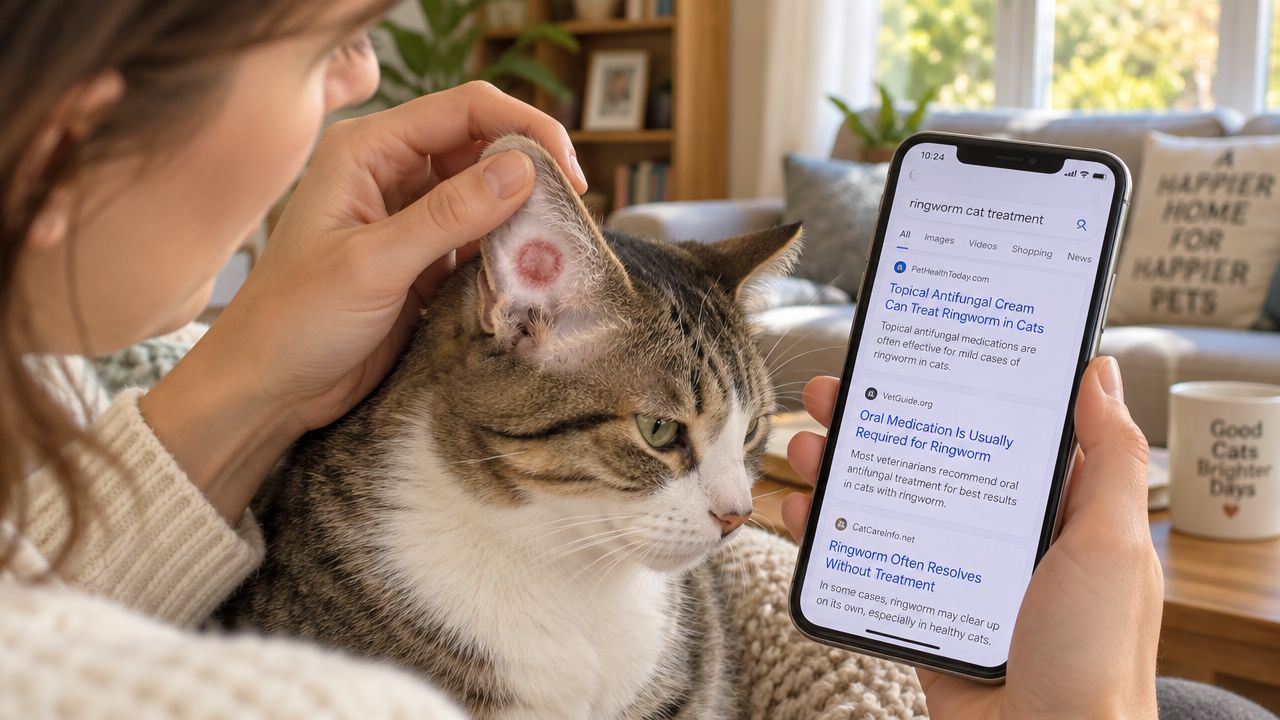
You've just found a coin-shaped bald patch behind your cat's ear or on your dog's muzzle. The internet offers conflicting advice, from human creams to medicated baths, while your main concern is simple: what is the best OTC antifungal for ringworm, and is a cream enough?
For a small, localized lesion on an otherwise healthy adult pet, a topical antifungal may be a reasonable starting point. But pet ringworm, or dermatophytosis, rarely behaves like the neat red ring shown in human health pictures. Broken fur, scaling, mild crusting, and patchy hair loss are common, and cats may carry the infection with few obvious signs.
The most effective plan usually combines the right topical product with whole-coat treatment when needed, household cleaning, and veterinary oversight when the case is widespread or uncertain. Creams treat skin. They don't reliably sterilize a furry coat or control spores throughout a home.
Table of Contents
- Spotting Ringworm and Why OTC Choices Matter
- Active Ingredients in OTC Antifungal Products
- Matching the Product to Your Pet's Situation
- Application Protocols That Actually Work
- Red Flags and When a Vet Visit Is Required
- Environmental Decontamination for the Whole Household
- Putting It All Together for Your Pet
- Questions Pet Owners Ask After Treatment Starts
Spotting Ringworm and Why OTC Choices Matter
Ringworm is a fungal infection, not a worm. On pets, it may begin as a small area of broken hair or baldness with flaky skin. The edge can be scaly or crusted, but a perfect circular border isn't required. Allergies, bacterial infections, mites, and other skin conditions can look similar, so a visual guess isn't a dependable diagnosis.
Start with a calm inspection:
- Check the pattern. Look for broken hairs, scaling, crusting, or expanding hair loss rather than waiting for a textbook ring.
- Note the location. The face, ears, paws, and nail beds deserve more caution because topical home care may be inadequate.
- Count the lesions. One small patch is a different problem from several lesions across the body.
- Check the household. Other pets can be infected without obvious bald spots, and ringworm can spread through contaminated surfaces.
- Protect yourself. Wear gloves and wash your hands after handling a suspicious lesion.
For a healthy adult dog or cat with one small, localized lesion, an OTC antifungal can make sense while you arrange veterinary advice or monitor closely. The limitation is biological, not cosmetic. A cream sits on the skin and may not reach spores associated with hair shafts, while a cat that appears normal may still contribute to household spread.
Practical rule: A tube can be useful for a spot. It isn't a complete ringworm-control plan for a furry animal.
Ringworm is common worldwide in people, and the Cleveland Clinic estimates that it affects about 20% to 25% of the world's population at any given time (Cleveland Clinic guidance). The CDC confirms that some forms respond to non-prescription antifungals, but treatment depends on the infection's location and severity, and steroid creams can make ringworm worse (CDC ringworm treatment guidance).
For a practical overview before choosing a product, review Bandana Rx's ringworm treatment and antifungal information. Treat the lesion as potentially contagious until you know what you're dealing with.
Active Ingredients in OTC Antifungal Products
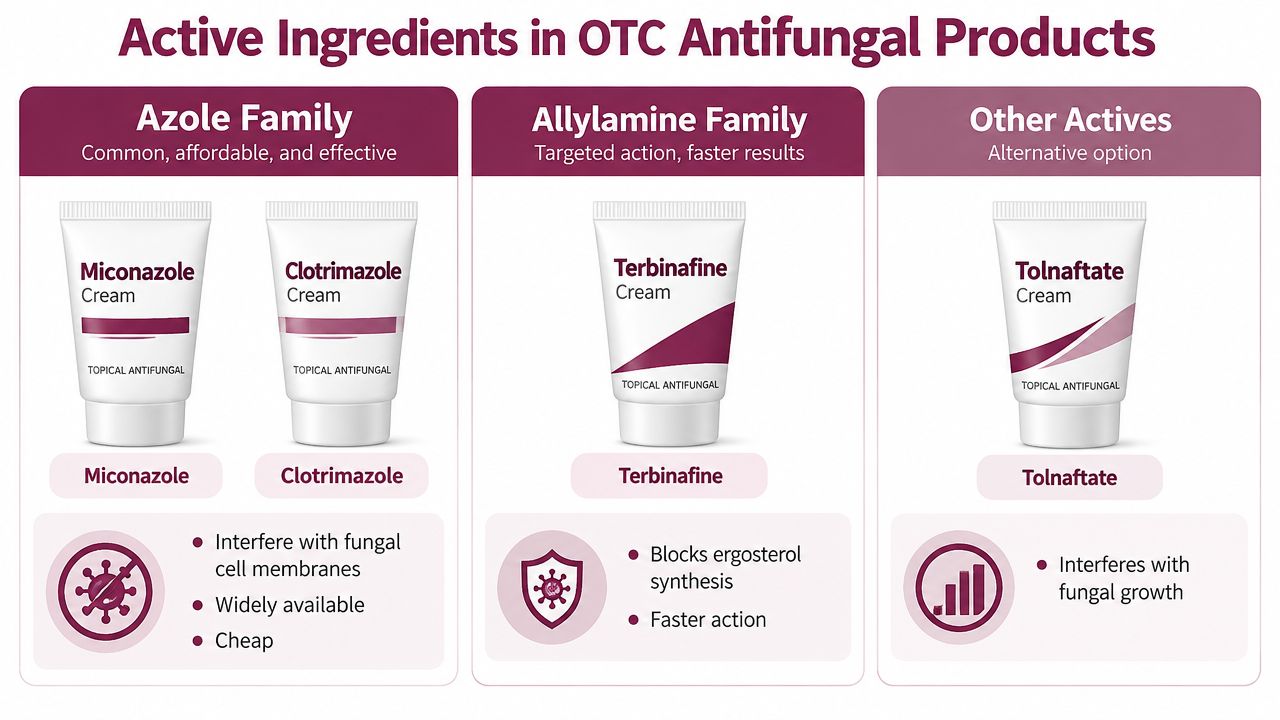
The OTC shelf becomes easier to judge when you sort products into three groups: azoles, allylamines, and whole-coat treatments. Ingredient choice matters, but formulation and the pet's coat matter just as much.
Azoles for localized skin lesions
Miconazole and clotrimazole are azole antifungals. They interfere with fungal cell membranes, making them reasonable options for a small lesion when the product label and your veterinarian support use in that animal. They're widely available and commonly found in creams, lotions, sprays, and some veterinary shampoos.
Think of an azole as a polite bouncer. It disrupts the fungus's ability to maintain its protective barrier, but it still needs repeated, consistent contact with the affected skin. A cream is most practical when you can see the lesion clearly and keep your pet from licking it.
Bandana Rx lists clotrimazole cream for susceptible fungal skin conditions. Don't assume that a human combination cream is interchangeable with a veterinary product, especially if it contains a steroid or other active ingredient.
Terbinafine for a stronger topical option
Terbinafine is an allylamine and one of the CDC's main OTC choices for human ringworm. It blocks an enzyme involved in fungal membrane production. In practical terms, it acts more aggressively against dermatophytes than many owners expect from a basic cream. The CDC says terbinafine appears to be the most effective OTC option for athlete's foot, but that doesn't make it universally best for every pet lesion or every species (CDC clinician guidance).
The locksmith analogy is useful: azoles disrupt the fungal structure, while terbinafine interferes with the process used to build it. Choose based on the actual product label and veterinary advice, not on the assumption that “stronger” automatically means safer or more suitable.
Shampoos and rinses for the coat
Medicated shampoos containing miconazole plus chlorhexidine can reduce surface contamination over the coat. Lime sulfur rinses are particularly important in veterinary ringworm management because guidance describes them as immediately sporicidal, with residual activity on the coat, and effective for reducing environmental contamination. Chlorhexidine alone is a poor choice for dermatophytes.
A cream is a spot treatment. A rinse or shampoo is a coat-management tool. For cats and dogs with multiple lesions, long hair, or household exposure, the second category is usually more relevant.
Matching the Product to Your Pet's Situation
The best OTC antifungal isn't the ingredient with the most impressive marketing. It's the product that matches the lesion, coat, species, household, and ability to apply it correctly.
| Pet Scenario | Best OTC Option | Why It Fits | Escalate to Vet If |
|---|---|---|---|
| One small lesion on a short-haired adult dog | A labeled topical cream containing miconazole, clotrimazole, or terbinafine | You can reach the skin directly and monitor the area | The lesion expands, new spots appear, or the diagnosis is uncertain |
| One localized lesion on a short-haired adult cat | Veterinary-guided topical care, with caution around licking | The area may be accessible, but cats groom topical products | The cat is young, the lesion is on the face or ear, or more lesions develop |
| Several lesions on a long-haired cat | Lime sulfur rinse or an appropriate whole-body medicated shampoo, with veterinary direction | Coat-wide treatment addresses surface spores better than lesion-only cream | Hair clipping, systemic treatment, or diagnostic testing is needed |
| Multiple pets in one home | Whole-body topical treatment for in-contact animals, coordinated with a veterinarian | Treating only the visible patient can leave an unrecognized carrier behind | Any pet develops lesions or household spread continues |
| Lesion near a nail bed, on the paw, face, or ear | Don't rely on OTC cream alone | These locations can be difficult to treat and may indicate a more complicated case | Arrange veterinary examination promptly |
| Kitten, puppy, pregnant pet, or immunocompromised animal | Veterinary assessment before selecting treatment | Age, reproductive status, and illness change the safety calculation | Seek guidance before applying medication |
A single-pet home with one localized lesion and an owner who can apply treatment consistently is the strongest candidate for cautious OTC care. A long-haired cat with several patches is not. Cream can't adequately contact every affected hair shaft, and clipping or whole-body therapy may be necessary.
In pet households, miconazole-chlorhexidine shampoos and lime sulfur rinses are more defensible choices than lesion-only human creams when the goal is reducing contamination across the coat. Veterinary references identify lime sulfur as a leading topical option, while chlorhexidine monotherapy is considered poorly effective against dermatophytes (MSD Veterinary Manual guidance).
Use Bandana Rx's ringworm treatment information for dogs as a pharmacy resource, but don't use an online product listing as a substitute for diagnosis.
Application Protocols That Actually Work
Application errors are a major reason topical treatment appears to fail. Owners often dab a little product onto the center of the bald patch, rinse shampoo off immediately, or stop once the skin looks better.
For cream or lotion
First, separate the fur so you can see the skin. If surrounding hair blocks contact, ask your veterinarian whether careful clipping is appropriate. Avoid creating razor irritation or spreading material from the lesion to other body areas.
Wash the area gently, then dry it thoroughly. Apply a thin layer beginning just outside the visible edge and moving toward the center. Use gloves, avoid the eyes and mouth, and wash your hands after application. MedlinePlus gives similar skin-application mechanics for human ringworm products, including washing and drying first, applying from outside toward the center, and avoiding a bandage over the rash (MedlinePlus ringworm treatment information).
Many OTC creams are labeled for twice-daily use, but your product label and veterinarian's directions control. Don't increase frequency because the lesion looks stubborn, and don't use a human product that contains a steroid unless a veterinarian specifically directs it. The CDC warns that steroid creams can worsen ringworm (CDC information about ringworm).
For medicated shampoo
A shampoo only works while it remains in contact with the coat. Wet the animal thoroughly, work the product through the coat according to its label, and respect the stated dwell time before rinsing. Veterinary review material reports good in vitro efficacy for several antifungal shampoos, including miconazole shampoo, after 10 minutes of contact time, but not after only 3 minutes unless paired with an accelerated hydrogen peroxide rinse (Veterinary Times dermatophytosis review).
Some products call for repeated twice-weekly use. Others differ. Don't treat every medicated bath as interchangeable, and don't confuse a rinse designed to reduce spores with a stand-alone cure for an established infection.
Continue for the full label period and veterinary plan, even after hair begins returning. The skin can look improved before fungal contamination has resolved. If the product irritates the skin, your pet develops swelling, or grooming makes safe application impossible, stop improvising and contact your veterinarian. Bandana Rx's ringworm rash treatment resources can help you identify relevant pharmacy options.
Red Flags and When a Vet Visit Is Required
OTC treatment is the wrong tool when the diagnosis is uncertain, the infection is extensive, or the pet has factors that make treatment more complicated. A lesion that resembles ringworm may instead be bacterial dermatitis, allergy, mites, or another condition requiring a different approach.
Seek veterinary care promptly if you see:
- Sensitive locations: Lesions on the face, around the eyes, inside the ears, on the paws, or near nail beds.
- Rapid spread: Quickly expanding patches, widespread hair loss, marked crusting, pain, discharge, or severe inflammation.
- Multiple animals: More than one pet has lesions, or a cat appears normal but lives with a confirmed case.
- Higher-risk pets: Kittens, puppies, pregnant or lactating animals, pets receiving immunosuppressive medication, or pets with significant underlying illness.
- Household exposure: A child, older adult, or immunocompromised person develops a suspicious skin lesion after contact with the animal.
The age details matter. A kitten under eight weeks should not be managed with casual trial and error. Cats under eight months also warrant a lower threshold for examination, particularly if lesions are facial or widespread.
A veterinarian may use a Wood's lamp, microscopic examination, or fungal culture. A Wood's lamp can provide useful evidence for some infections, but a positive test or culture is more meaningful than a photograph or a guess based on shape. Diagnostic confirmation becomes especially important before treating several pets or exposing a household to repeated cleaning.
Scalp ringworm in people illustrates the same principle. The CDC says scalp infections usually require prescription oral therapy for 1 to 3 months, while skin-limited infections may respond to topical care (CDC clinician guidance). Pets with coat-wide disease have a similar practical problem, topical cream can't reliably manage infection hidden throughout the hair.
Veterinarians may prescribe oral itraconazole or terbinafine when systemic treatment is appropriate. Those are prescription decisions, not DIY substitutions. Don't start, stop, combine, or change prescription antifungals without veterinary direction.
Environmental Decontamination for the Whole Household
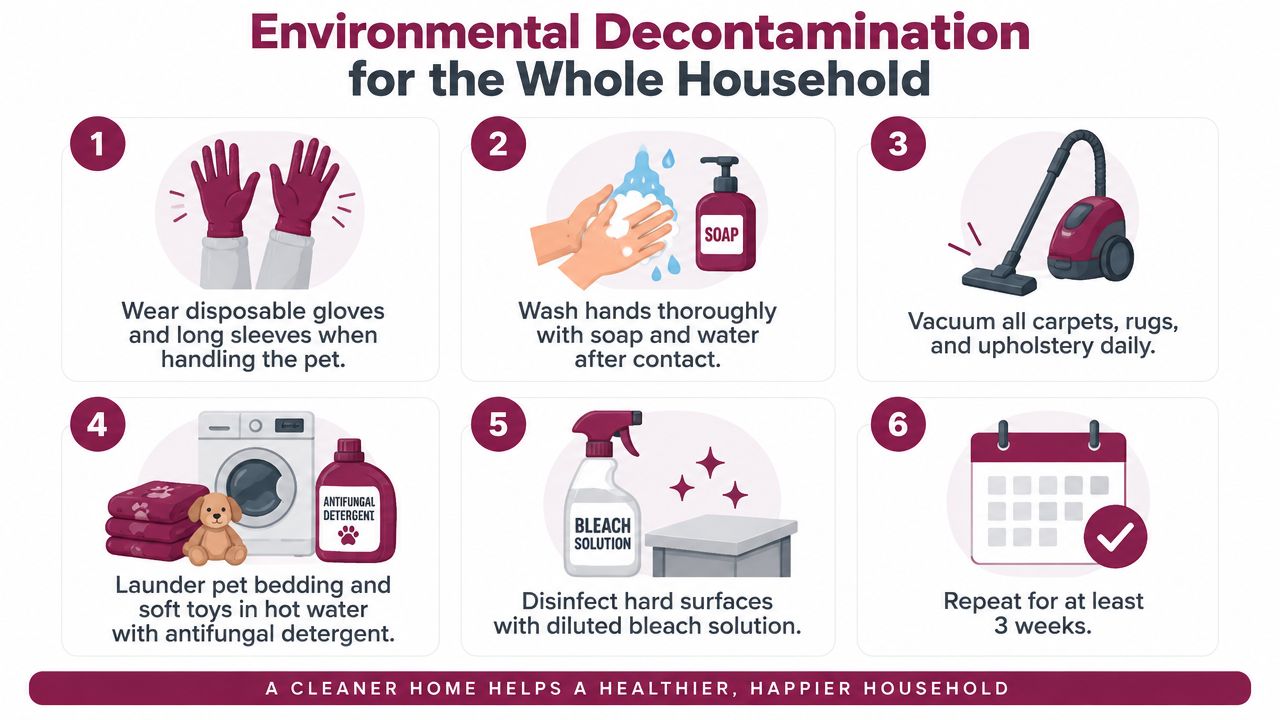
Medication won't solve a contaminated environment by itself. Ringworm spores can move through shed hair, bedding, furniture, brushes, carriers, and flooring. The CDC advises taking an affected pet to a veterinarian promptly, checking every pet in the household, wearing gloves and long sleeves, washing hands after contact, vacuuming common areas, and disinfecting surfaces and bedding appropriately (CDC prevention guidance for pets).
A workable cleaning routine
Keep the affected pet in one room that can be cleaned easily, rather than allowing unrestricted access to beds and upholstered furniture. This isn't punishment. It limits the area you need to manage and makes daily cleaning realistic.
Build a small cleaning kit:
- Protective clothing: Disposable gloves and long sleeves for handling the pet, bedding, and contaminated hair.
- Hair removal tools: A vacuum for carpets, rugs, upholstery, and the pet's usual resting spaces.
- Laundry supplies: A closed bag or container for bedding, blankets, towels, and washable soft toys until laundering.
- Surface disinfectant: Use a product and dilution appropriate for the surface, following its label and safety instructions.
- Handwashing supplies: Soap and running water immediately after handling the animal or cleaning materials.
Remove hair and debris before disinfecting. A disinfectant can't work well through a layer of fur, dirt, or organic material. Launder washable items thoroughly, and keep cleaned items separate from untreated bedding.
A veterinary source identifies lime sulfur rinses used twice weekly as a strong practical topical option for pet ringworm, while miconazole-chlorhexidine shampoos are alternatives that need adequate contact time (MSD Veterinary Manual). Environmental control should run alongside that coat treatment, not after it fails.
If you're researching additional air and surface sanitation approaches for a household cleaning plan, whole-house ozone treatment is a separate environmental resource to evaluate carefully. Don't expose pets or people to ozone, and follow the equipment manufacturer's safety requirements.
For cat-specific handling and treatment considerations, see Bandana Rx's ringworm treatment information for cats. The exact disinfectant, dilution, and contact time must come from the product label or veterinary guidance.
Putting It All Together for Your Pet
A sensible plan starts tonight, but it doesn't start with buying the strongest-looking cream. It starts by deciding whether the case is suitable for limited home care.
Your practical checklist
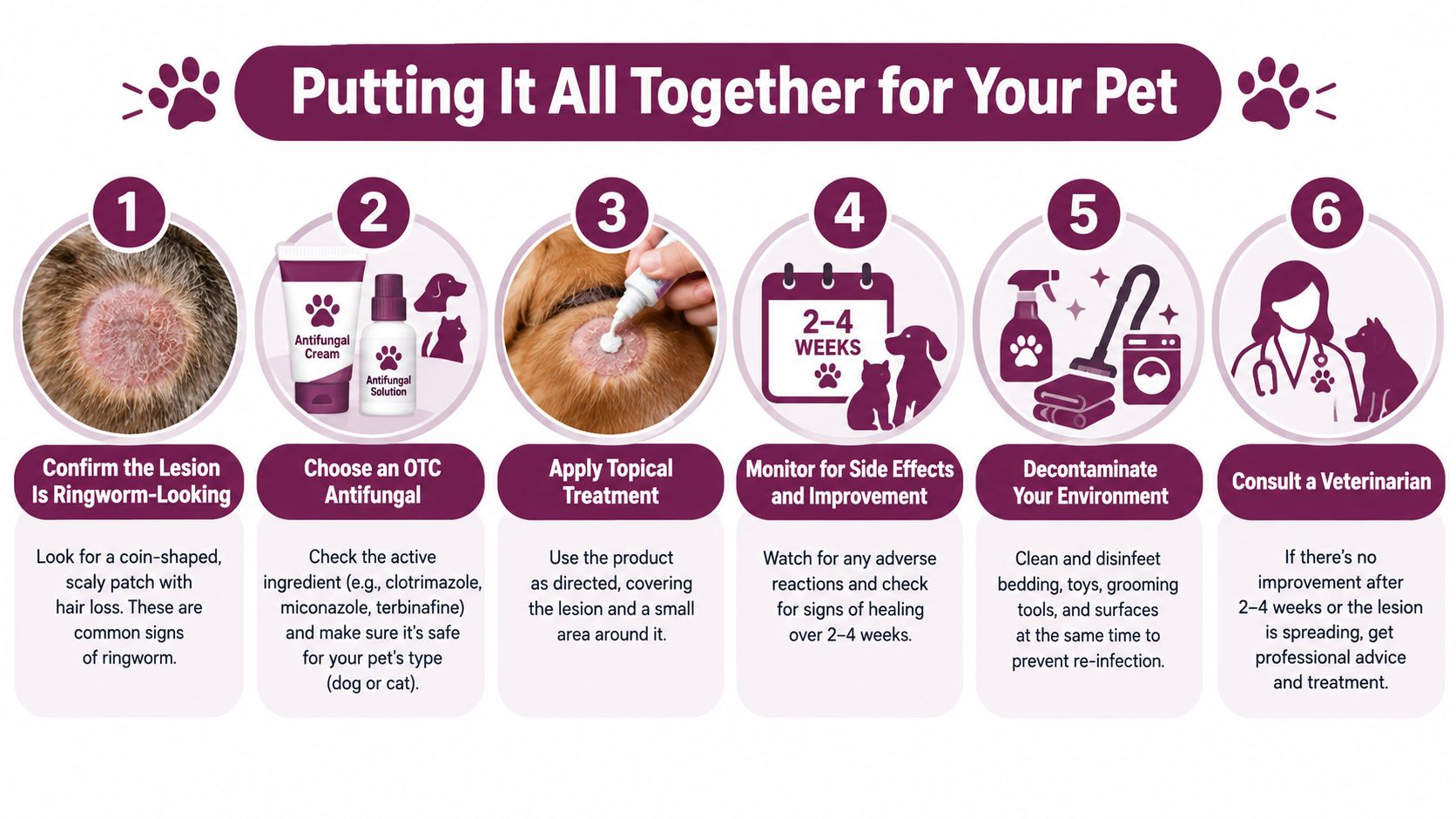
- Assess the lesion. A coin-shaped, scaly patch with hair loss may fit ringworm, but appearance alone doesn't confirm it.
- Choose by situation. A small, accessible lesion on a healthy short-haired adult may suit a topical cream. Multiple lesions or a long coat usually call for whole-body veterinary-guided treatment.
- Read the active ingredient. Miconazole, clotrimazole, and terbinafine are relevant antifungal ingredients. Avoid steroid combinations unless prescribed or specifically directed.
- Set reminders. Put applications and medicated baths on your phone calendar so you don't miss doses or stop when the lesion looks better.
- Prepare the cleaning kit. Keep gloves, laundry bags, a vacuum, and an appropriate disinfectant together.
- Reduce contact. Keep the affected pet away from bedrooms and other animals until your veterinarian advises that normal contact is appropriate.
- Reassess on schedule. Arrange a veterinary check if the area spreads, new lesions appear, or progress isn't clear.
The best OTC antifungal for ringworm is therefore conditional. For a single accessible lesion, a labeled topical azole or terbinafine product may be practical. For coat-wide contamination, lime sulfur or an appropriate medicated shampoo is more logical. For young, pregnant, immunocompromised, or widely affected pets, skip product experimentation and arrange a veterinary plan.
Bandana Rx offers OTC pet-care products and prescription fulfillment for dogs and cats, with prescription orders requiring veterinary authorization. Use its pet pharmacy resources for product information and refills, but keep the veterinarian involved when OTC care isn't clearly working.
Questions Pet Owners Ask After Treatment Starts
How long should treatment continue?
Don't judge success only by the first visual improvement. Human guidance commonly describes OTC skin treatment for 2 to 4 weeks, while jock itch may be treated with products applied twice daily for 10 to 14 days (CDC treatment guidance). Pet cases can take longer, especially when hair, multiple animals, or environmental contamination is involved.
Use the product for the full labeled course and follow the veterinary plan. If the lesion remains active, spreads, or returns, reassessment matters more than extending the same cream indefinitely.
When is my pet no longer contagious?
A pet isn't reliably “clear” just because the bald patch looks smaller. Hair can begin returning while spores remain on the coat or in the environment. Your veterinarian may use examination, testing, and the overall response to decide when normal contact is appropriate.
Until then, keep cleaning, limit shared bedding and grooming tools, and check the other pets in the home.
Is it safe around children or pregnant household members?
Treat ringworm as a household exposure concern. Wear gloves and long sleeves when handling the affected pet, wash hands with soap and running water afterward, and keep children from handling the animal until your veterinarian gives you a safer contact plan. If a pregnant or immunocompromised household member develops a suspicious lesion, that person should contact a healthcare professional.
What if new spots appear after two weeks?
Call your veterinarian rather than adding another cream. New lesions may mean the diagnosis is wrong, the infection is more extensive than it looked, another pet is carrying it, or the environment is repeatedly re-exposing the household. A prescription antifungal, whole-body treatment, diagnostic testing, or coordinated treatment of all pets may be needed.
If your pet has a small, accessible lesion, Bandana Rx offers relevant OTC pet-care products and pharmacy resources for dogs and cats. Visit the site to review available ringworm-related options, and contact your veterinarian before using medication on a young, pregnant, immunocompromised, or widely affected pet.