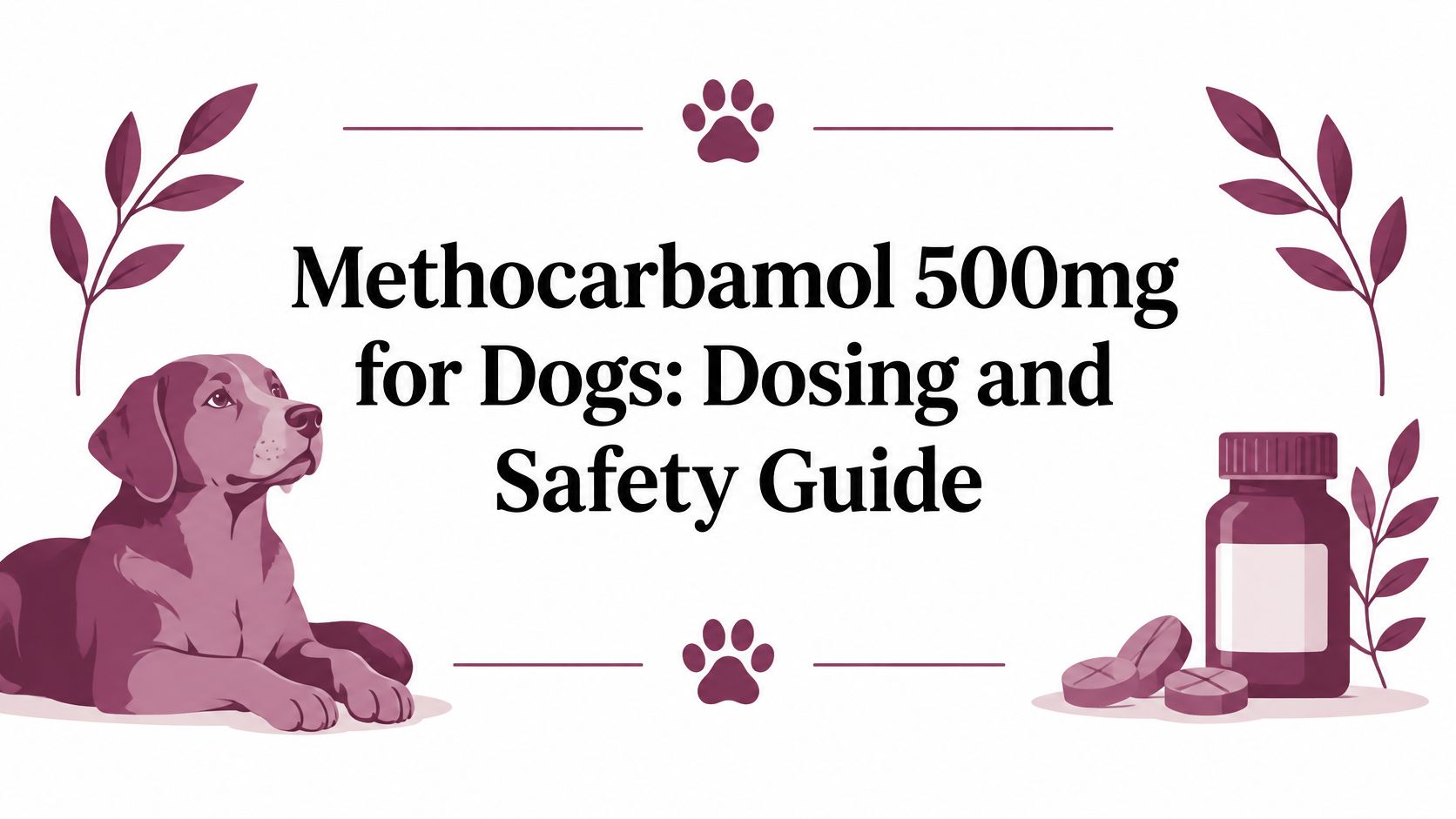



If the bottle says 500 mg, does that tell you how much methocarbamol your dog should receive? Not by itself. That number describes the tablet's strength, while your dog's prescription determines the amount to give and the schedule.
Understanding methocarbamol 500mg for dogs starts with keeping those two ideas separate. Just as important is knowing whether your dog is resting comfortably or becoming excessively sedated, and when that difference calls for veterinary help.
Table of Contents
- Labeled Methocarbamol Dose Ranges by Body Weight
- Why 500 mg Describes the Tablet, Not Your Dog's Dose
- Checking Your Label and Tablet Before Each Dose
- What Methocarbamol Is Used For and Where It Stops
- Expected Side Effects Versus Warning Signs
- Drug Interactions and Conditions to Review With Your Vet
- Steps to Take After an Accidental Overdose
- Confirm Your Prescription Before You Reorder
Labeled Methocarbamol Dose Ranges by Body Weight
The U.S. federal labeling for oral methocarbamol specifies an initial dose of 60 mg per pound of body weight, divided into two or three equal doses, followed on subsequent days by 30–60 mg per pound per day; treatment is usually limited to 14–21 days. These are daily amounts, not amounts to give at every administration.
That distinction matters. Giving a full daily total each time the label calls for a divided dose could result in a serious dosing error.
Labeled Oral Methocarbamol Totals by Body Weight
The figures below are arithmetic from the federal labeling cited above. They're reference totals, not prescribed doses, tablet counts, or instructions to administer medication.
| Body weight | Initial day total (60 mg per lb) | Later days total (30 to 60 mg per lb per day) |
|---|---|---|
| 10 lb | 600 mg | 300–600 mg |
| 20 lb | 1,200 mg | 600–1,200 mg |
| 35 lb | 2,100 mg | 1,050–2,100 mg |
| 50 lb | 3,000 mg | 1,500–3,000 mg |
| 75 lb | 4,500 mg | 2,250–4,500 mg |
| 100 lb | 6,000 mg | 3,000–6,000 mg |
Your veterinarian decides how the daily amount translates into individual doses and tablet portions. Don't round a calculated amount to a convenient tablet count or choose the high end of a range because your dog seems uncomfortable.
The oral tablet labeling restricts use to, or on the order of, a licensed veterinarian. A different regimen or treatment beyond the labeled duration is an extralabel decision that needs veterinary oversight, not an adjustment to make at home.
Check the Prescription Before Doing Arithmetic
A veterinarian may prescribe a schedule that differs from this reference table after considering the condition, formulation, other medicines, and your dog's response. A difference is a reason to ask for clarification, not to replace the prescription with an internet calculation.
- Confirm current weight. Tell the clinic if the weight on the record is outdated or was estimated.
- Match the treatment day. Check whether the veterinarian has written different instructions for starting treatment and continuing it.
- Resolve discrepancies. Call the clinic if the written directions differ from what you expected. Ask the staff to confirm both the amount per dose and how often to give it.
If your dog also has a prescribed anti-inflammatory, carprofen safety advice from Maxijournal can help you prepare questions about that separate medicine. It isn't a reason to add carprofen, substitute it, or change either prescription.
Practical rule: Read the amount per dose and the frequency together. Neither instruction is complete without the other.
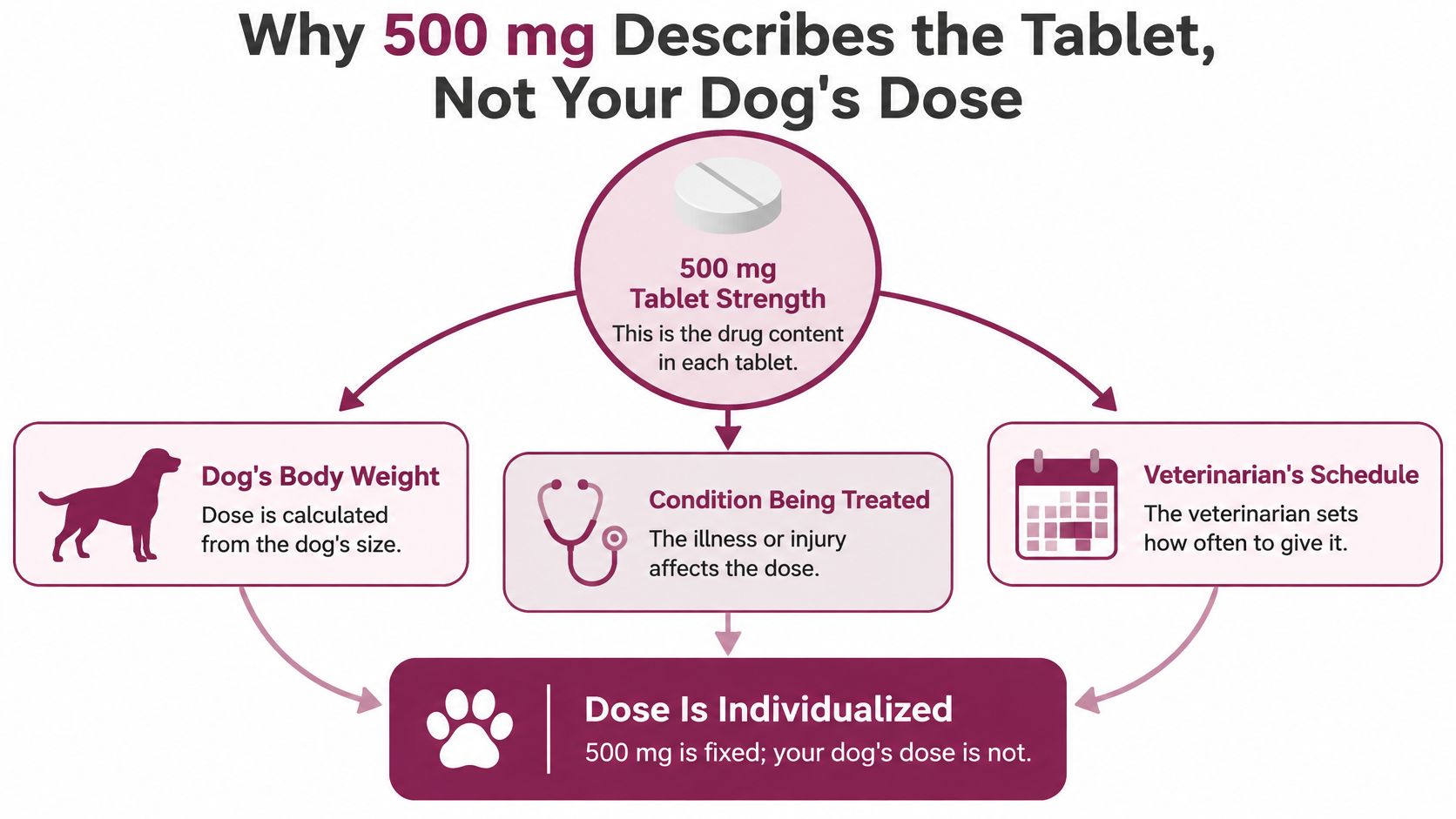
Why 500 mg Describes the Tablet, Not Your Dog's Dose
Could a 500 mg tablet be the right amount for your dog? The number describes the methocarbamol in one tablet, not the dose your veterinarian has prescribed. The dose is the amount to give at each administration.
For example, the labeled arithmetic gives a 20-pound dog an initial-day reference total of 1,200 mg. That is more than the 1,000 mg contained in two 500 mg tablets, but the total alone does not determine how many tablets to give at a time or when to give them.
Keep Formulations Separate
The federal injectable methocarbamol labeling describes a different regimen from the oral product. Injection instructions, including those for emergency poisoning treatment or tetanus management, do not apply to a bottle of tablets.
Tablet splitting also depends on the specific product and prescription. A tablet may crumble or divide unevenly, making it hard to give the intended amount. Ask the veterinarian or pharmacist before splitting it.
- Count against the directions. Check the prescribed amount per administration, not just the daily total.
- Ask before dividing. If the prescribed portion is difficult to measure reliably, ask the pharmacist about a workable option.
- Verify any liquid. A compounded liquid has its own concentration, storage instructions, and measuring directions.
For liquid medication, confirm both the prescribed milligrams and the matching volume with the pharmacy. Use the supplied oral measuring device, not a household spoon. Check the concentration before using volume instructions from an older bottle.
Write down the prescribed milligrams and the tablet count or liquid volume for each dose. Ask the veterinary team to compare your record with the prescription.
Checking Your Label and Tablet Before Each Dose
An FDA-listed methocarbamol tablet product was described in 2025 as light-orange, round, and film-coated, containing 500 mg of methocarbamol and marked B134. That description identifies a particular product, not every methocarbamol tablet.
Manufacturers may supply tablets that look different. If a refill changes appearance unexpectedly, ask the pharmacy to verify it before giving the next dose rather than assuming the new tablet is equivalent.
Compare the Bottle With the Written Plan
Check the container in good lighting before administering medication. A familiar-looking bottle can still belong to another pet or contain an older prescription.
- Patient name. Make sure the label identifies your dog.
- Drug name. Confirm that it says methocarbamol.
- Strength. Check the drug content per tablet against the current prescription.
- Directions. Find the number of tablets or milligrams per dose and how often to give it.
- Prescriber. Confirm the veterinarian's name.
- Dispensing details. Review the quantity and fill date so you don't accidentally use an outdated bottle.
- Contact information. Keep the pharmacy's phone number available for questions.
The guide to reading pet medication labels, dosage warnings, and storage instructions offers additional help interpreting these details.
Store the Medicine With Its Instructions
Keep the bottle closed, in its original container, and stored as its label directs. Place it somewhere pets and children can't reach, including dogs that chew through packaging.
The tablet's color and imprint help identify the product; the prescription label identifies your dog's directions. If either conflicts with what you expected, contact the pharmacy or veterinarian before the next dose. Bring the bottle to your dog's next appointment so the clinic can review exactly what you're administering.
What Methocarbamol Is Used For and Where It Stops
Methocarbamol is a centrally acting skeletal-muscle relaxant. Its labeled veterinary role is to support treatment of acute inflammatory or traumatic skeletal-muscle conditions that cause spasms, such as muscle spasm following an injury.
Consider a dog that becomes stiff and reluctant to move after an injury. After examining the dog, the veterinarian may identify muscle spasm as part of the problem and prescribe methocarbamol alongside other care. The medication supports that plan; it doesn't establish the diagnosis or repair the injury.
Less Movement Doesn't Identify the Cause
Owners can notice a limp, stiffness, or difficulty getting comfortable, but they can't reliably confirm muscle spasm at home. Joint pain, injury, and nervous-system problems can produce overlapping signs while requiring different treatment.
Information about joint pain in dogs may help you describe changes to your veterinarian. It shouldn't be used to decide that a leftover muscle relaxant is appropriate for a new episode.
A quieter dog isn't necessarily a recovering dog. Comfort, responsiveness, and the ability to move safely matter more than simply sleeping longer.
Use Follow-Up to Check Progress
Ask your veterinarian what improvement should look like for your dog. Useful observations include whether your dog can settle comfortably, rise without the same difficulty, and manage the activity the veterinarian has permitted.
Keep notes about discomfort, mobility, appetite, and medication effects. A short video of an unusual movement can help the clinic understand what you're seeing, provided recording it doesn't delay urgent care.
If your dog isn't improving, arrange reassessment rather than extending, pausing, or changing treatment yourself. The veterinarian may need to reconsider the diagnosis or adjust the broader care plan. A clear follow-up plan helps keep your dog comfortable without assuming that every ongoing symptom calls for more methocarbamol.
Expected Side Effects Versus Warning Signs
Reported side effects in dogs include sleepiness or sedation, drooling, vomiting, weakness, and incoordination. Dark or blue-green urine may also occur and is described as not harmful.
Sedation deserves particular attention because it can affect balance and mobility. Monitor your dog after prescribed doses, especially when treatment begins, and notice whether your dog wakes readily, responds normally, and can move safely.
Methocarbamol Side Effects and What to Do
| Sign | What it may look like | What to do |
|---|---|---|
| Sleepiness or sedation | Drowsy and resting more than usual, but still wakes and responds | Keep your dog safe and supervised; tell your vet if it seems more than expected |
| Drooling | Excess saliva after a dose | Monitor and mention it at your next vet contact |
| Dark or blue-green urine | Discolored urine | Described as not harmful; note it and mention it to your vet |
| Vomiting | An isolated episode or recurring episodes | Contact your vet for guidance before any further dosing |
| Weakness or incoordination | Wobbly, unsteady, or clumsy movement | Contact your vet promptly and keep your dog confined and supervised |
| Severe or progressive signs | Cannot stand, collapses, is very hard to rouse, has labored or abnormal breathing, or vomits repeatedly | Contact a veterinarian or emergency clinic immediately |
Expected drowsiness doesn't mean your dog should be difficult to wake. Nor should you dismiss worsening weakness as evidence that tight muscles are finally relaxing.
Make Rest Safer
Use a quiet, comfortable area with secure footing. Block access to stairs and furniture your dog might attempt to jump onto, and supervise outdoor trips if balance seems affected.
Describe changes concretely when you call the clinic. Saying that your dog stumbles when standing or doesn't respond normally to your voice is more useful than saying the medicine seems strong.
Urine discoloration alone is different from difficulty urinating, apparent pain, or other new illness signs. Don't assume every urinary change is a harmless medication effect.
Call rather than compensate: Vomiting doesn't tell you how much medication your dog absorbed. Repeating a dose can add more drug than intended.
Don't change the prescribed amount or frequency yourself. If your dog vomits or misses a dose, ask the veterinarian how to proceed rather than giving an extra dose or combining doses to catch up.
Drug Interactions and Conditions to Review With Your Vet
Methocarbamol depresses activity in the central nervous system, which includes the brain and spinal cord. Its sedating effects can add to those of other medicines, potentially making a dog much sleepier or weaker than expected.
A combination may still be appropriate when the veterinarian has reviewed it and provided monitoring instructions. The concern is an unreviewed combination, including a familiar medicine that another clinic prescribed.
Medicines and Conditions That Change Methocarbamol Risk
| Medicine or condition | Concern | What to do |
|---|---|---|
| Buprenorphine | Sedative effects may be enhanced | Use only after a veterinarian has reviewed the combination |
| Mirtazapine | Sedative effects may be enhanced | Use only after a veterinarian has reviewed the combination |
| Other CNS depressants | Additive sedation and central nervous system depression | Don't combine unless your veterinarian specifically evaluates it |
| Pyridostigmine in dogs with myasthenia gravis | Can produce extreme weakness | Your veterinarian must weigh this before any combination |
| Other prescriptions, OTC products, and supplements | Interaction risks aren't fully listed here | Share the full list with your veterinarian and pharmacist |
If butorphanol appears on your dog's medication record, the butorphanol guide for dogs can help you understand that separate prescription. It isn't a recommendation to add or substitute it.
Before travel, don't layer a calming medicine onto the current regimen without approval. Passpaw's guide to dog travel sedatives can help you prepare travel-related questions, but only your veterinarian can evaluate the full combination for your dog.
Give the Veterinarian the Whole Health Picture
This is not a complete contraindication list. It doesn't establish minimum age or weight requirements or breed-specific cautions, and absence from the table doesn't establish safety.
Tell the veterinarian about liver, kidney, and nervous-system conditions. Methocarbamol is extensively metabolized by the liver, eliminated largely through urine, and acts on the central nervous system; those facts warrant review, not an automatic conclusion that every affected dog can or cannot receive it.
Senior dogs and dogs taking several prescriptions deserve particularly careful medication reconciliation. Include occasional medicines, supplements, nonprescription products, and anything given by another household member.
Bring an updated list to both the veterinarian and pharmacist before treatment starts. The veterinarian decides whether methocarbamol is appropriate and what monitoring your dog needs.
Steps to Take After an Accidental Overdose
Treat a suspected extra dose or chewed-open bottle as a reason to call immediately, even if your dog currently looks normal. Don't wait for symptoms before asking for help.
- Secure the bottle and the dog. Remove access to the medication, then check how many tablets may be missing and when the ingestion happened.
- Call your veterinarian or an animal poison control service immediately. Have the label, your dog's weight, the possible amount swallowed, and the time of ingestion ready.
- Don't induce vomiting or give additional medicine unless directed. This includes more methocarbamol, other prescriptions, and home remedies.
- Watch closely for changes. Look for sleepiness, weakness, unsteadiness, vomiting, and altered breathing while following the veterinary team's instructions.
- Go to an emergency clinic immediately for severe signs. Inability to stand, collapse, or abnormal or labored breathing requires urgent care.
Why Prompt Advice Matters
Methocarbamol is absorbed rapidly in dogs, so sedation can worsen after an ingestion even when the dog initially seems well. Larger ingestions can cause serious central-nervous-system depression, including respiratory depression that requires monitoring and supportive care.
Its relatively short elimination half-life doesn't make an overdose safe to manage at home. The amount swallowed, other medicines, and your dog's condition influence what happens next.
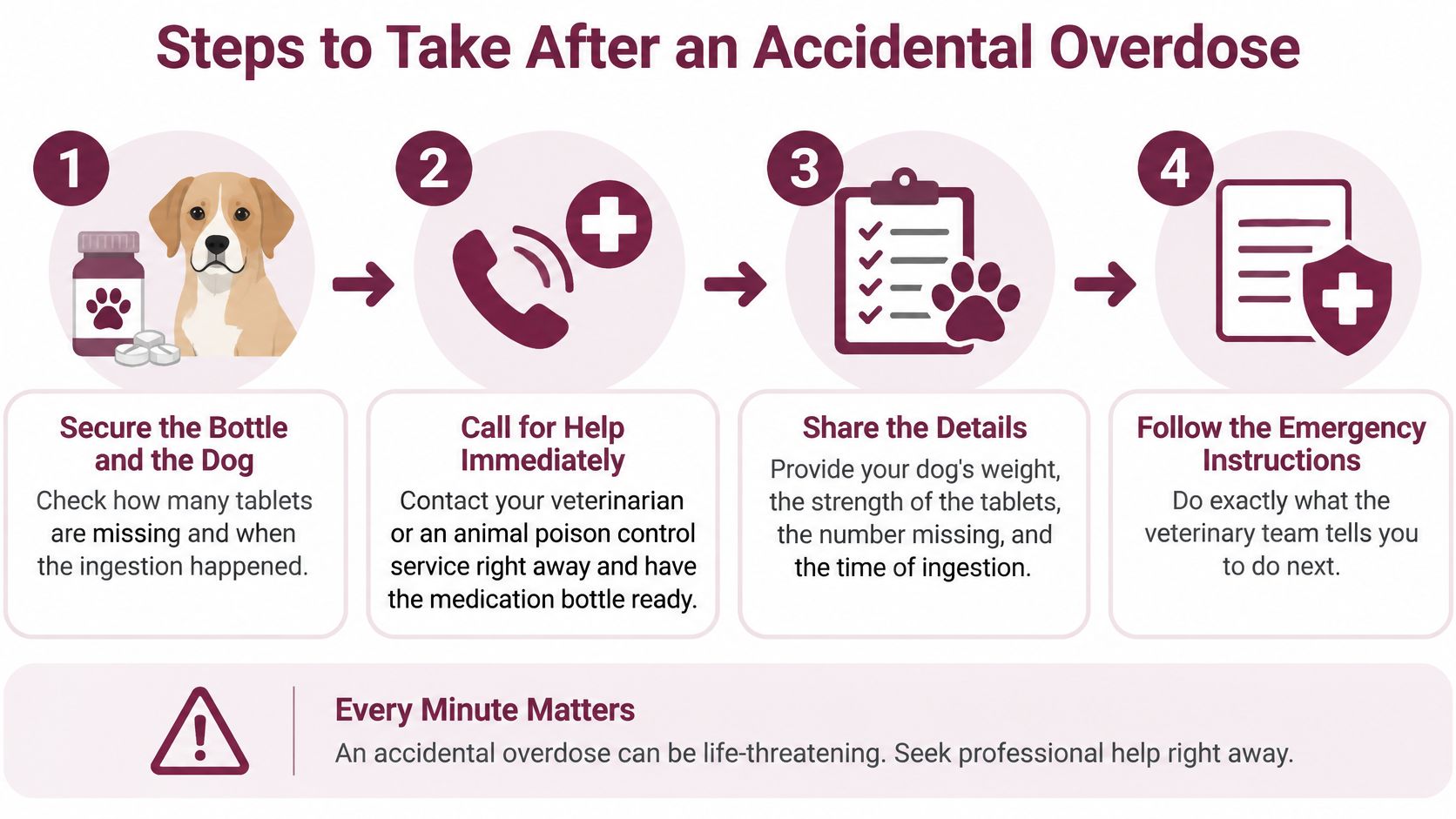
Bring the original container and any remaining tablets to the clinic. If you aren't sure how much is missing, say so rather than treating a guess as a confirmed amount.
Vomiting after a suspected ingestion shouldn't be evaluated only by its appearance. Although white-foam vomiting in dogs has several possible explanations, a known medication exposure makes immediate veterinary guidance the priority.
If another person is available, have them gather the medication information while you contact the clinic. Follow the veterinary team's transport instructions and don't delay departure to finish counting tablets when your dog has severe symptoms.
Confirm Your Prescription Before You Reorder
Methocarbamol is a prescription medication, restricted to veterinary use or use on a licensed veterinarian's order. A valid veterinary prescription must be in place before a refill can be dispensed.
A nearly empty bottle doesn't necessarily mean another course is appropriate. Ask whether the veterinarian intends treatment to continue, particularly if your dog still has symptoms or the original plan called for reassessment.
Check the Treatment Plan Before Ordering
- Compare the bottle with current instructions. Make sure an older dispensing label hasn't been superseded by a later veterinary direction.
- Request a new prescription if no refills remain. Contact the veterinarian rather than stretching the supply by reducing amounts or skipping scheduled doses.
- Confirm state eligibility. Check that the pharmacy can ship prescription medication to your state before placing the order.
- Place the order and retain confirmation. Keep the order details available so you can resolve a dispensing or delivery question.
- Inspect the new label before administering it. Compare the patient, medicine, strength, and directions with the current veterinary plan using the label checklist above.
Choose Reordering Options Carefully
Where a product offers Buy Once or AutoShip, the available options should appear on its product page. AutoShip can be convenient for products that need regular reordering, but availability should never be assumed for a particular medication.
An automatic delivery schedule is not authorization to continue treatment. Confirm the ongoing need with the prescriber, and review any scheduled order when your dog's treatment changes.
The importance of routine veterinary visits when using online pharmacies is especially clear when symptoms persist or medication needs change. A refill process supports the veterinarian's plan; it doesn't replace examination or follow-up.
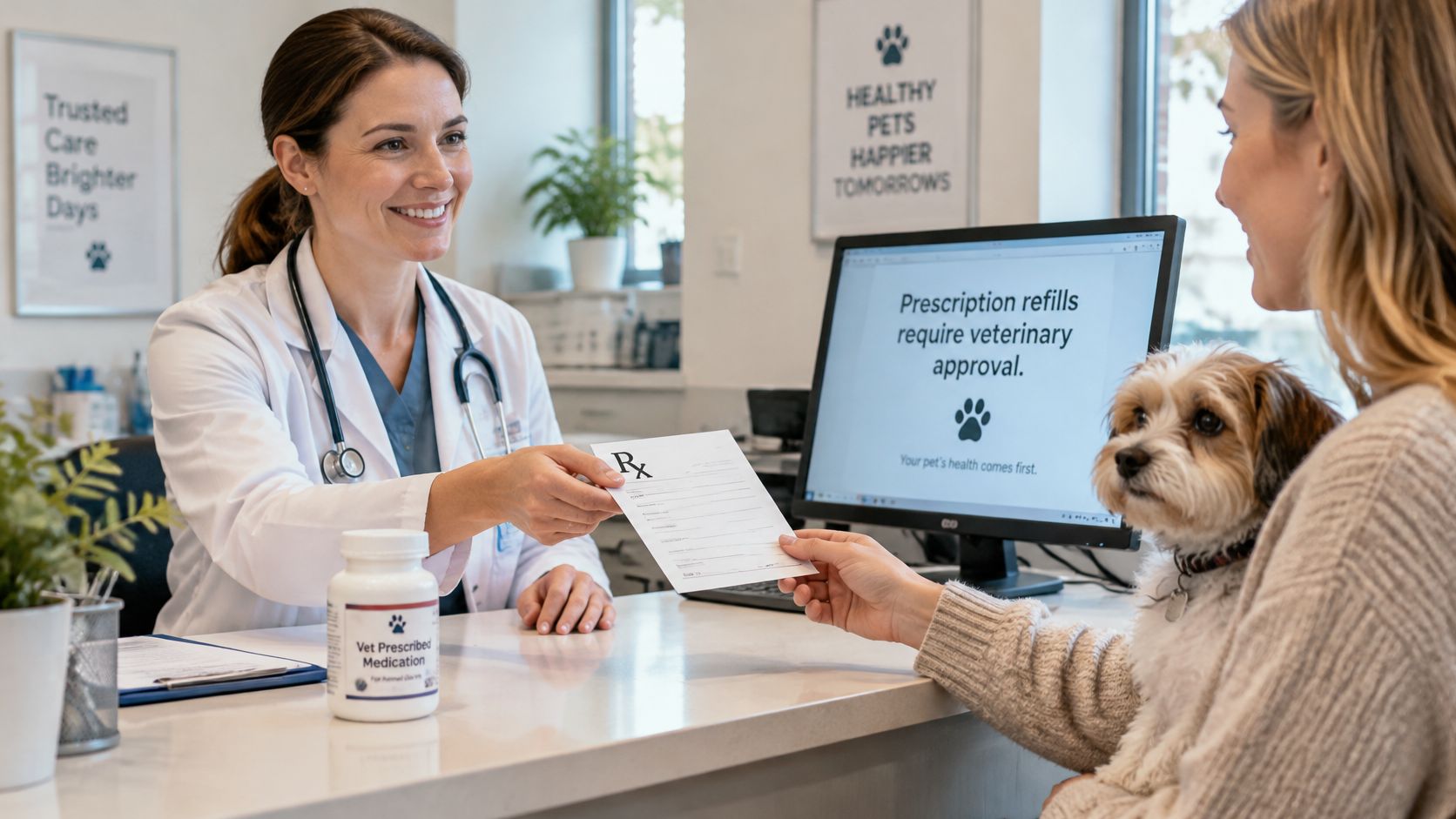
Keep a current copy of the prescription directions with your medication record. If the new bottle differs, ask the pharmacy to resolve the discrepancy before giving the next dose.
Bandana Rx offers prescription pet medications, over-the-counter care, and educational resources to help owners use medicines responsibly. Visit Bandana Rx to explore methocarbamol options and confirm availability for your dog's veterinarian-authorized prescription.