


Your dog may have just come home sleepy after a procedure, or your veterinarian may have mentioned butorphanol for a cough that won't let anyone rest. That often leaves owners with the same question. Is this a real pain medicine, a sedative, or a cough suppressant?
The honest answer is that butorphanol for dogs sits in all three categories, but not in the way many people expect. It's usually not the “strong opioid” people picture when they hear the word narcotic. In practice, veterinarians often choose it because it's useful for short procedures, calming effects, and cough control, with pain relief that tends to be brief and situation-specific.
That distinction matters. If you understand what butorphanol is good at, and what it isn't, the prescription label makes a lot more sense and your conversations with your vet get much easier.
Table of Contents
- When and Why Vets Reach for Butorphanol
- How Butorphanol Works Inside a Dog
- Butorphanol Dosage Ranges for Dogs
- Side Effects and Safety Considerations
- Butorphanol as a Cough Suppressant for Dogs
- How Butorphanol Compares to Other Pain Options
- Prescription, Monitoring, and What to Ask Your Vet
When and Why Vets Reach for Butorphanol
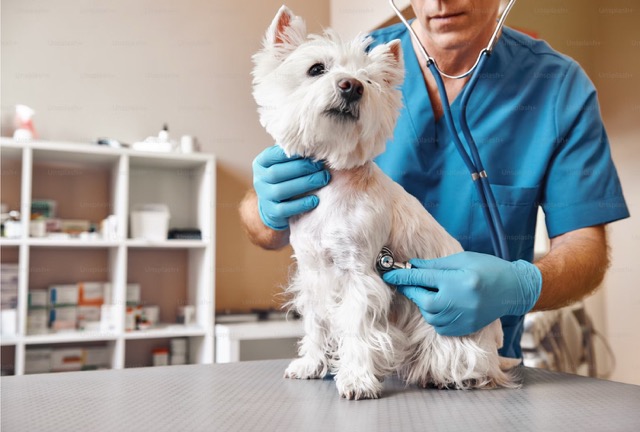
A common clinic moment goes like this. A dog needs a small wound cleaned and stitched, a brief dental extraction, or support during recovery from a harsh, dry cough. The veterinarian wants something that acts quickly, wears off predictably, and helps keep the dog comfortable without committing to a long-lasting opioid effect.
That's where butorphanol often fits. It's an opioid agonist-antagonist used in dogs for short-term analgesia and sedation, and it's also used as an antitussive, meaning a cough suppressant, according to VCA's butorphanol overview for pet owners.
The three roles owners should know
Most owner articles flatten butorphanol into “pain relief.” That misses how veterinarians use it.
- For brief procedures: Vets often pick it when they need a dog calmer and easier to handle for a short event.
- For mild to moderate short-term pain: Its strongest niche is usually visceral pain, or pain involving internal organs and soft tissues, rather than broad orthopedic or chronic pain.
- For cough suppression: It has a separate role in dogs with certain nonproductive coughs, where reducing the cough reflex can improve comfort.
A useful owner mindset is to think of butorphanol as a targeted tool, not an all-purpose pain tablet.
Practical rule: If your vet chooses butorphanol, the reason may be just as much about sedation or cough control as it is about pain relief.
Why vets like it for selected cases
Veterinarians usually choose medications by matching the drug to the job. Butorphanol has a reputation for being useful when the goal is a short window of effect. Product information for dogs reports an analgesic dose of 0.20 to 0.30 mg/kg by IV, IM, or SC injection, with effects seen within 15 minutes, and recommends giving it about 15 minutes before the end of anesthesia when post-operative relief is desired during recovery, based on veterinary product information for butorphanol injection.
Its pain-relief window is also limited. A foundational canine study found that across tested subcutaneous doses, analgesia lasted only 23 to 53 minutes, with the strongest visceral analgesic effect at 0.8 mg/kg, according to the 1991 AVMA study archived on PubMed Central. That short duration is one reason veterinarians often use it in a controlled setting, or as one part of a larger plan, rather than as broad ongoing pain therapy.
What often gets confused
Owners sometimes hear “opioid” and assume “strong pain control for any painful problem.” Butorphanol doesn't reliably fill that role. It's more often chosen because it is predictable, short-acting, and useful in specific workflows. A dog getting a small procedure may benefit from the calming and short analgesic effect. A coughing dog may benefit from suppression of the cough reflex. A dog with severe orthopedic pain may need a very different plan.
That's why the same drug can make perfect sense in one case and be a poor fit in another.
How Butorphanol Works Inside a Dog
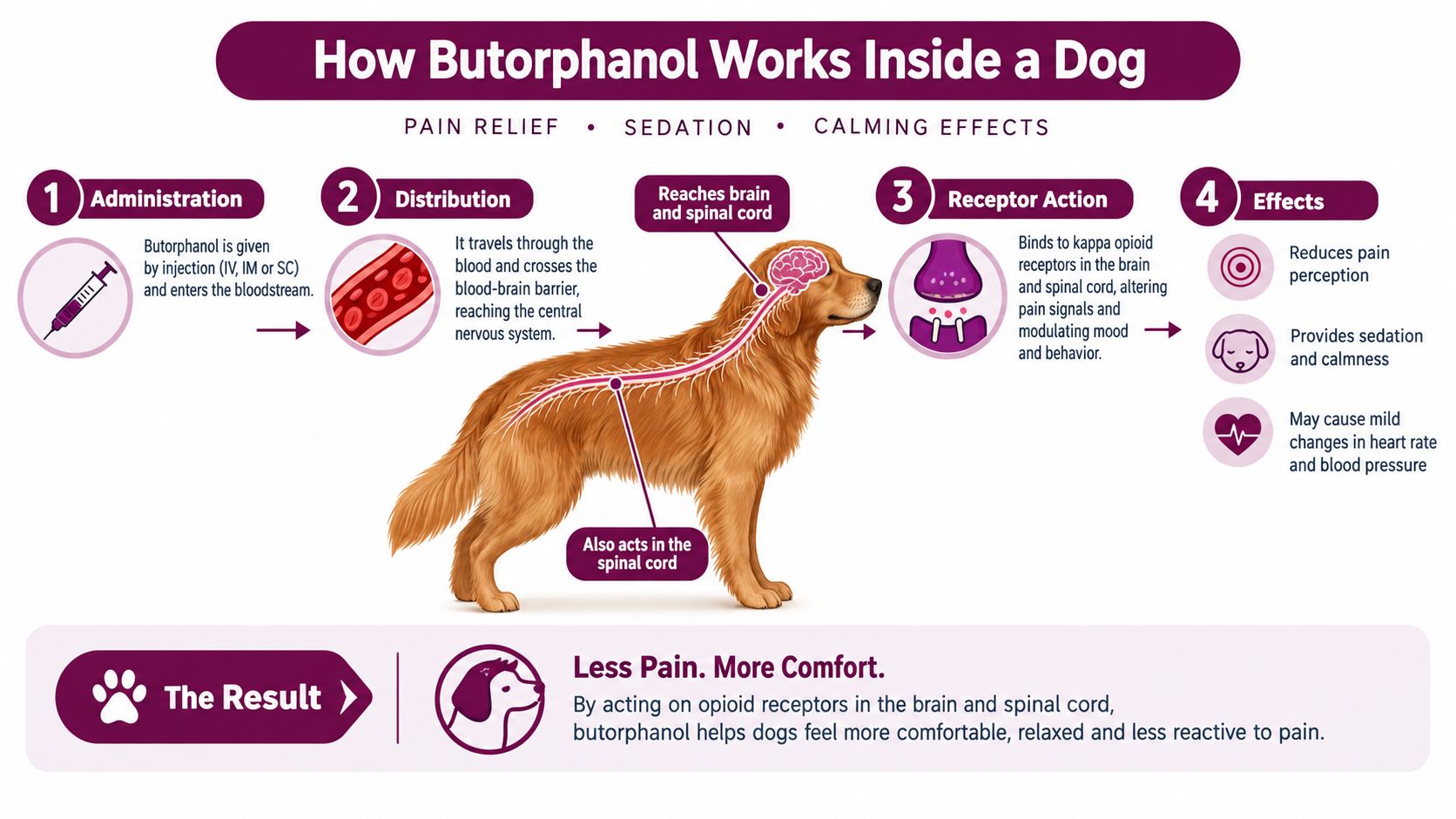
The easiest way to understand butorphanol is to picture opioid receptors as locks and drugs as keys. Different opioid medications open those locks in different ways, and that changes what you see in your dog.
Butorphanol is called a mixed agonist-antagonist. In simple terms, it activates some opioid pathways while blocking or partly blocking others. That mixed behavior is why it can calm a dog, reduce coughing, and provide some pain relief, but still not act like the strongest surgical opioids.
The receptor pattern behind the effects
In everyday veterinary teaching, butorphanol is usually described as a drug that activates kappa opioid effects while antagonizing or partially opposing mu opioid effects. For owners, the practical takeaway is more important than memorizing receptor names.
This receptor profile helps explain why butorphanol often produces:
- Sedation or drowsiness
- Moderate, short-lived pain relief
- Reduced coughing
- A ceiling effect on analgesia, meaning there's a point where giving more doesn't keep increasing pain relief the way a full mu opioid might
That ceiling effect is one reason a veterinarian may use butorphanol for a quick soft-tissue procedure but choose a different opioid plan for a more painful surgery.
What this looks like at home or in the clinic
If your dog receives butorphanol, you may notice that they seem sleepy, quieter, less reactive, or less inclined to cough. Those effects line up with what the drug is often chosen to do.
If you're trying to understand how sedative medications fit into travel, handling, or procedure planning more generally, this Passpaw dog sedation guide gives a helpful owner-level overview of sedation concepts and why medication choices should stay veterinarian-directed.
Sedation and pain control overlap, but they aren't the same thing. A calmer dog isn't always a fully comfortable dog.
Why it's not the same as morphine
This is the part many owners don't hear clearly enough. Butorphanol is not a stand-in for severe surgical pain control. If a dog has major orthopedic pain, advanced cancer pain, or a more invasive procedure, vets often turn to medications with stronger mu-opioid activity or combine several pain-control strategies.
So when people ask whether butorphanol is “strong,” the better answer is this: it's useful, but selective. It can be very helpful in the right setting and underpowered in the wrong one.
Butorphanol Dosage Ranges for Dogs
Dose questions are where owners get into trouble fastest, because the same medication is dosed differently depending on why it's being used. The amount used for injectable pain control is not the same as the amount used for cough suppression. You can't safely convert one use into the other on your own.
For injectable analgesia in dogs, Merck lists common dosing ranges of 0.2 to 0.4 mg/kg IV, IM, or SC every 1 to 2 hours, and for continuous IV use 0.1 to 0.24 mg/kg/hour after a 0.2 mg/kg loading dose, in its veterinary analgesics reference. For antitussive use, Merck separately lists 0.055 to 0.11 mg/kg SC every 6 to 12 hours or 0.55 to 1.1 mg/kg orally every 6 to 12 hours in its canine antitussive dosing table.
Butorphanol dosage ranges by indication
| Indication | Dose Range | Route | Frequency | Source |
|---|---|---|---|---|
| Acute analgesia | 0.2 to 0.4 mg/kg | IV, IM, or SC | Every 1 to 2 hours | Merck veterinary analgesics reference |
| Continuous analgesic infusion | 0.1 to 0.24 mg/kg/hour after a 0.2 mg/kg loading dose | IV continuous rate | As directed in hospital | Merck veterinary analgesics reference |
| Antitussive use | 0.055 to 0.11 mg/kg | SC | Every 6 to 12 hours | Merck canine antitussive dosing table |
| Antitussive use | 0.55 to 1.1 mg/kg | Oral | Every 6 to 12 hours | Merck canine antitussive dosing table |
Why the cough dose and pain dose look so different
This is one of the biggest points of confusion. Owners may see a lower milligram amount for cough and assume the prescription is weak or incorrect. It may be exactly right.
MSD Veterinary Manual notes that butorphanol's antitussive potency in dogs is about 4 times more potent than morphine and 100 times more potent than codeine for cough suppression, and that the oral dose is roughly 10 times the subcutaneous dose because of poor bioavailability, in its antitussive drug reference for animals. That helps explain why cough dosing sits in its own lane.
Two label-reading mistakes to avoid
- Don't compare routes casually: An oral dose and an injectable dose may look very different on paper.
- Don't borrow from another dog's prescription: A dose chosen for post-procedure sedation or analgesia is not a template for coughing, and vice versa.
If prescription instructions ever seem confusing, this guide on how to read pet medication labels, dosage warnings, and storage is a practical starting point before you call your veterinarian for clarification.
Side Effects and Safety Considerations
Butorphanol is often well tolerated when a veterinarian selects it carefully, but “well tolerated” doesn't mean side effects are unimportant. Some effects are expected, some require monitoring, and some matter more in dogs with underlying disease.
The most common owner-observed effect is sedation. Sometimes that's the goal. The same effect can also become a safety issue if a dog is more sensitive than expected or receives other medications that add to central nervous system depression.

Side effects owners may notice
Veterinary references and product information commonly mention effects such as:
- Sleepiness or dullness: Often expected after administration.
- Wobbliness: Mild incoordination can happen, especially when a dog is trying to walk before the drug has worn off.
- Less interest in food: Some dogs seem quieter and eat less for a short period.
- Digestive upset: Nausea or stomach upset can occur in some patients.
VCA also notes that butorphanol can cause frequent sedation and may contribute to respiratory depression in some cases, in its pet owner drug summary. That's one reason dosing decisions belong with the prescribing veterinarian.
Effects vets monitor more closely
Not all safety concerns are obvious to owners. In the canine study described earlier, there was no meaningful blood-pressure change, but pulse rate decreased significantly at 0.8 mg/kg, according to the 1991 AVMA study archived on PubMed Central. In practical terms, that means a dog with heart or breathing concerns may need a more individualized plan and closer observation.
A medication can be appropriate and still deserve monitoring. That's normal in veterinary medicine, especially with opioids and sedatives.
Breed genetics and medication sensitivity
Merck notes that butorphanol doses should be reduced in dogs carrying the ABCB1-1Delta mutation in its analgesics used in animals reference. Owners often know this mutation by the older term MDR1.
That matters most in breeds with known sensitivity patterns, including Collies and related breeds. It doesn't mean every herding dog can't receive butorphanol. It means the veterinarian may choose a lower dose, different monitoring, or another medication depending on the dog's history.
Other safety questions worth raising
Your vet may be more cautious if your dog has liver disease, kidney disease, head trauma, or is already receiving sedatives or other drugs that can slow the nervous system. If your dog takes behavior medications, antihistamines, or other calming drugs, bring the full medication list to the appointment.
For owners comparing sedating medications in general, this article on doxepin in dogs is also a useful reminder that drugs affecting alertness can overlap in ways that need veterinary review.
Butorphanol as a Cough Suppressant for Dogs
This is the use many owners don't expect. Butorphanol isn't only a procedure drug. It also has a legitimate role as a cough suppressant in dogs, particularly when the cough is dry, irritating, and nonproductive.
In the United States, butorphanol tablets are labeled for dogs with chronic nonproductive cough associated with tracheobronchitis, tracheitis, tonsillitis, laryngitis, and pharyngitis related to inflammatory upper-respiratory conditions, according to the Torbutrol tablet package insert.
Why suppressing cough can help
A harsh cough can become self-perpetuating. The more a dog coughs, the more irritated the airway becomes, and the more likely the cough is to continue. In the right patient, reducing the cough reflex can help break that cycle and improve rest.
That doesn't mean every coughing dog needs butorphanol. If a cough is productive, related to heart disease, or tied to a lower-airway disorder that needs different treatment, the plan changes. That's why vets try to identify the cause before repeating refills.
What the label says about timing
The federal label also says treatment should not normally be needed for longer than 7 days, with repeat dosing every 6 to 12 hours as required, and that the drug is restricted to use by or on the order of a licensed veterinarian, per the U.S. package insert for Torbutrol tablets.
For owners, the important point is simple. If the cough is still going strong after a short course, that usually calls for reassessment, not automatic long-term continuation.
Where it fits in real life
Butorphanol may be selected when:
- The cough is dry and exhausting: Especially when the dog needs rest.
- A short course makes sense: The problem may improve as airway irritation settles.
- Some sedation is acceptable: A quieter dog often coughs less.
- The veterinarian wants a measured opioid effect: Not every cough case calls for a stronger option.
If your dog's treatment plan includes other respiratory support, Bandana Rx also carries cough-related prescriptions such as Temaril-P, but the right product depends on the cause of the cough and your veterinarian's diagnosis.
How Butorphanol Compares to Other Pain Options
Many owners assume opioids are interchangeable. They aren't. The choice between butorphanol, a full mu opioid, an NSAID, or an add-on medication depends on what kind of pain the dog has and how long relief needs to last.
The clearest way to think about butorphanol is this. It tends to fit short, mildly painful, sedation-heavy situations better than moderate to severe surgical pain.
Where the limits show up
A veterinary evidence review noted insufficient evidence to prefer butorphanol over methadone for upper GI endoscopy, although butorphanol made duodenal intubation easier in that setting and did not change rescue-analgesia needs, according to the European veterinary medicines review document. That's a very telling finding.
It suggests that butorphanol can be valuable for handling and procedure flow without necessarily becoming the best stand-alone answer for stronger analgesia. That matches how many veterinarians already use it.
Butorphanol vs common canine pain and sedation options
| Drug Class | Analgesia Strength | Typical Use Case | Best-Fit Scenario |
|---|---|---|---|
| Butorphanol | Mild to moderate, short-acting | Brief procedures, sedation support, cough suppression | Short procedures or dogs that benefit from a calming effect plus limited analgesia |
| Full mu opioids such as methadone or morphine | Stronger analgesia | More painful procedures and perioperative pain plans | Moderate to severe acute pain where more reliable opioid analgesia is needed |
| NSAIDs | Not interchangeable with opioids | Inflammation-related pain, including many orthopedic problems | Ongoing inflammatory pain when the dog is an appropriate NSAID candidate |
| Sedatives such as dexmedetomidine | Sedation, not a direct substitute for analgesia | Handling, restraint, procedure support | Combined with analgesics when calm, controlled sedation is needed |
| Adjuncts such as gabapentin | Supportive, context-dependent role | Multimodal pain plans | Cases where a veterinarian wants layered pain control rather than a single drug approach |
The practical takeaway
If your dog has a painful orthopedic problem, chronic arthritis, or major post-operative discomfort, butorphanol usually won't cover the full job by itself. If your dog needs a short procedure, temporary calming, or cough control, it may fit very well.
That's why a broader pain conversation matters. This guide to pain management for dogs after surgery can help you understand how vets build a plan that often includes more than one medication class.
Prescription, Monitoring, and What to Ask Your Vet
Butorphanol is not an over-the-counter pet medication. It's a prescription drug that should be used only under direct veterinary guidance. For owners, that means you shouldn't adjust the dose, reuse an old prescription for a new problem, or combine it with other sedating drugs unless your veterinarian tells you to.
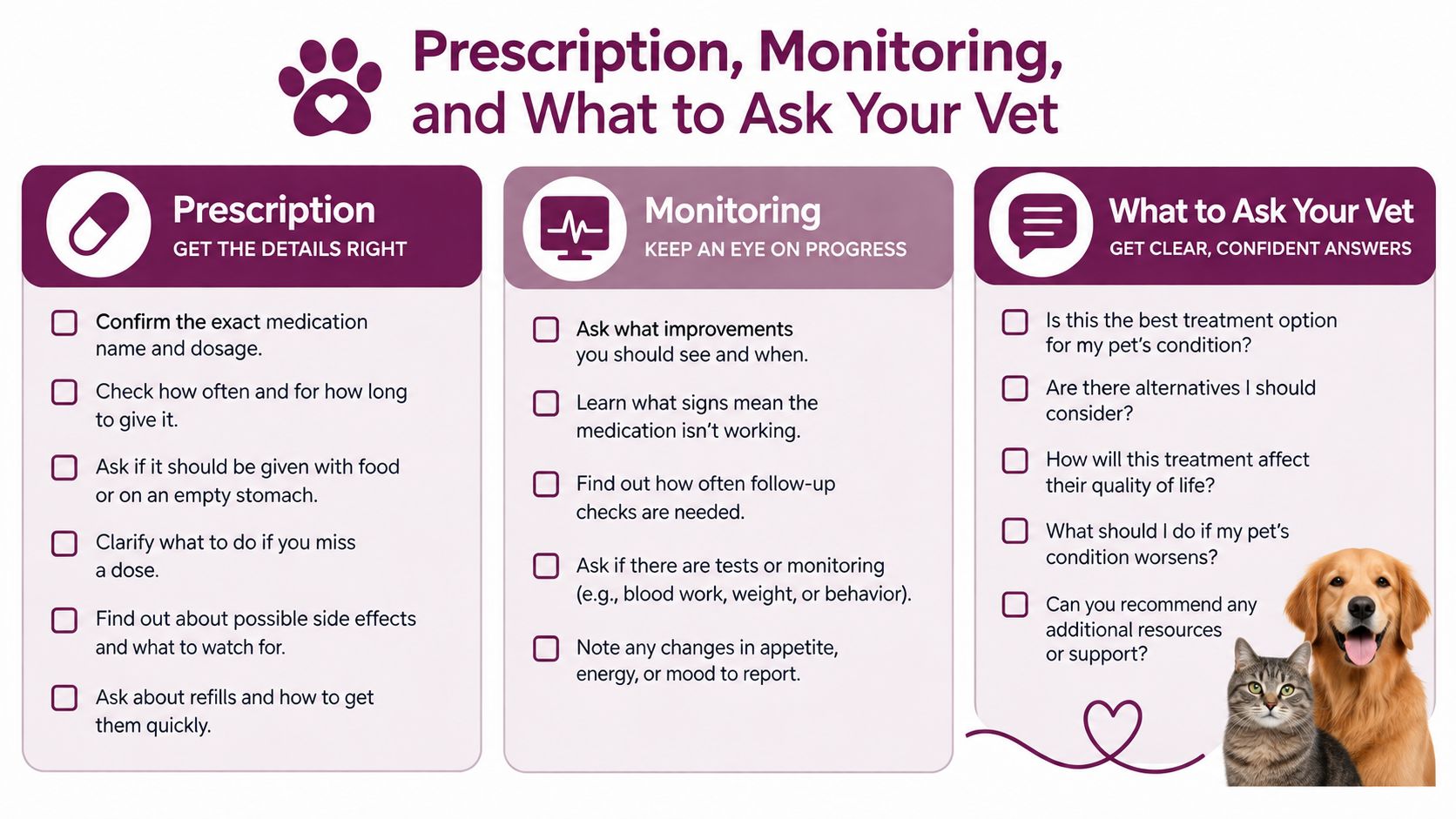
Monitoring starts before the first dose. Your veterinarian may focus on heart and lung sounds, current medications, breed sensitivities, and why the drug is being used in the first place.
Questions worth asking before it's dispensed
Bring a short list to the visit. Owners remember more that way.
- Why this drug for my dog's situation: Ask whether the goal is pain relief, sedation, cough control, or a mix of those.
- What should I expect to see: Should your dog be sleepy, quiet, less reactive, or less likely to cough?
- Which medications matter: Mention sedatives, antihistamines, behavior medications, and anything else that can add to drowsiness.
- What counts as a red flag: Ask what level of sedation, breathing change, or poor appetite should prompt a same-day call.
Monitoring matters most when the plan changes
Repeated use deserves fresh attention. A dog using butorphanol for cough may need recheck timing if the cough lingers. A dog that received it around a procedure may need a different at-home pain plan once the short opioid effect has worn off.
One useful example of procedure-specific use comes from anesthetized dogs receiving epidural butorphanol at 0.25 mg/kg, which reduced isoflurane minimum alveolar concentration by 31% ± 8.6%, with pin-prick insensitivity lasting 3 hours after the end of anesthesia, and minimal cardiorespiratory plus no neurologic side effects reported in that study's setting, according to the 1996 AJVR study PDF. That's a good reminder that route and protocol can change what the drug contributes.
Owner takeaway: Ask what problem butorphanol is solving in your dog, and ask what medication covers the next phase after it wears off.
Getting prescriptions filled safely
If your veterinarian prescribes butorphanol or another medication for pain or cough, use a licensed pharmacy that processes orders only after veterinary authorization. One option is the importance of routine vet visits in the age of online pharmacies, which also reinforces why ongoing veterinary follow-up matters when prescription drugs are involved.
The safest use of butorphanol always comes back to the same principle. Match the drug to the job, keep your vet updated, and don't assume a sleepy dog is automatically a fully comfortable one.
Bandana Rx offers veterinarian-authorized prescription fulfillment, pet medication education, and home delivery for many canine health needs, including cough and pain-related therapies when prescribed. If you're reviewing a new prescription or trying to better understand your dog's treatment plan, visit Bandana Rx for medication resources and pharmacy support.