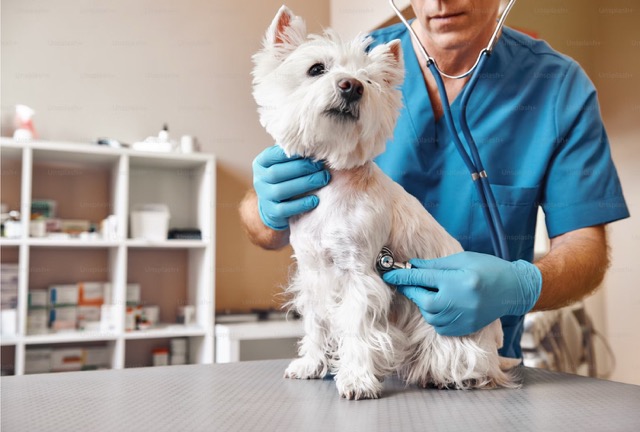



Allergic asthma is a chronic inflammatory airway condition in which a susceptible pet's immune system overreacts to inhaled allergens such as dust, pollen, or mold, narrowing the small airways and causing coughing, wheezing, or labored breathing. Smoke can also aggravate sensitive airways, although it's an irritant rather than an allergen.
Your cat starts coughing beside the litter box, then seems comfortable again. Or your dog wheezes after activity, leaving you wondering whether you're hearing an allergy, an infection, or something more serious. Those observations deserve attention, but they don't establish a diagnosis. Cats and dogs have important differences in airway disease, and understanding those differences helps you make safer decisions.
Table of Contents
- Understanding Allergic Asthma in Pets
- What Happens Inside the Airways During an Attack
- Common Triggers for Dogs and Cats
- Recognizing the Signs and When to Seek Urgent Care
- How Allergic Asthma Is Diagnosed
- Treatment Options Your Veterinarian May Recommend
- Long-Term Management at Home
- Working With Your Veterinary Team for the Best Outcome
Understanding Allergic Asthma in Pets
A pet who seems normal between coughing episodes can still have an ongoing airway problem. The word chronic means the condition can persist over time, even when its outward signs come and go. A quiet afternoon doesn't necessarily mean the underlying inflammation has disappeared.
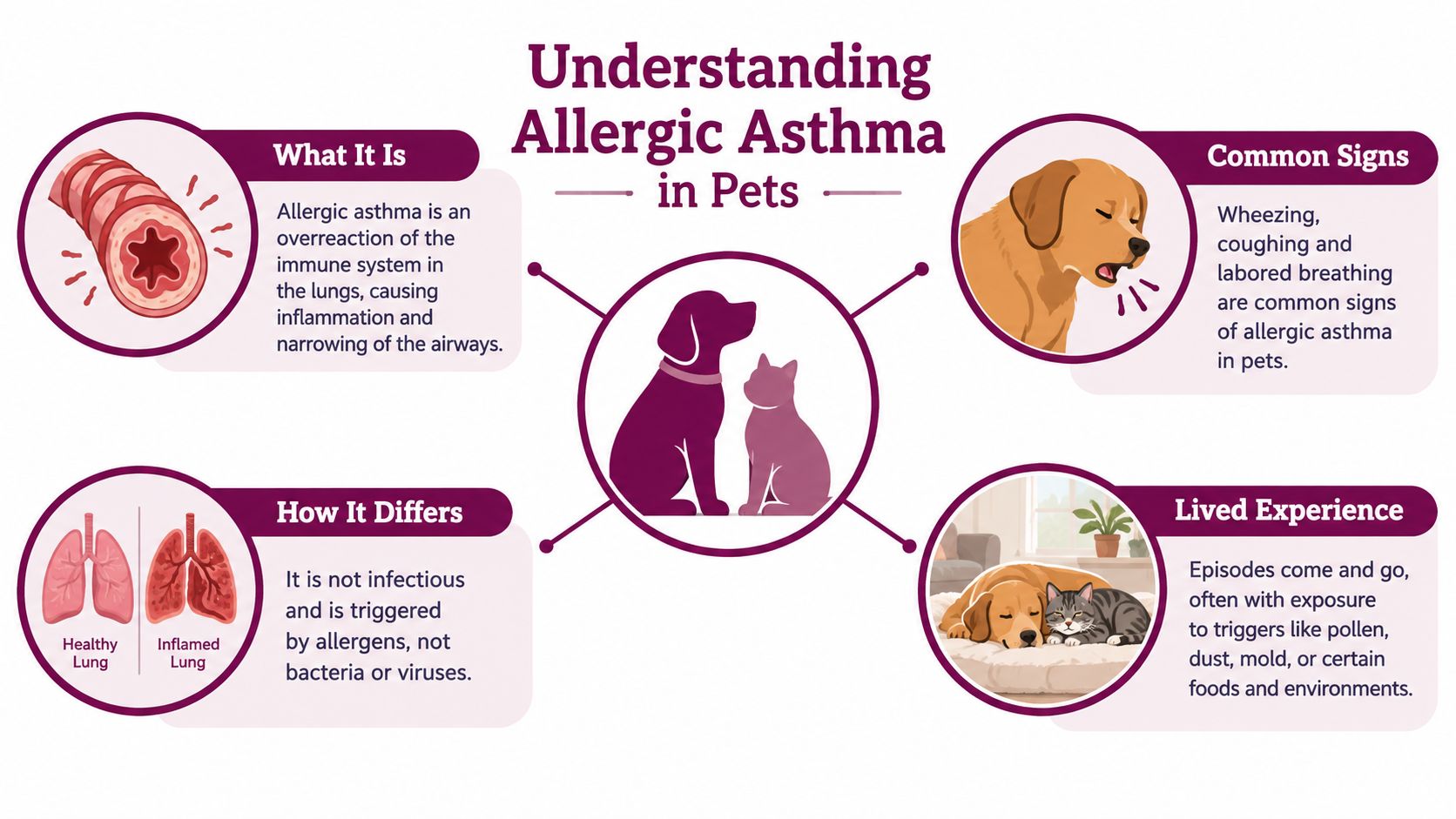
“Allergic” describes the immune system's involvement. In a susceptible animal, an inhaled substance provokes an exaggerated response inside the lungs. That's different from an infection caused by a microorganism, although infection and allergic airway disease can produce overlapping symptoms.
Why the species matters
Feline asthma is a recognized lower-airway condition involving inflammation and episodes of airway narrowing. Dogs can develop inflammatory airway disease too, but canine chronic bronchitis typically doesn't involve the severe bronchoconstriction associated with feline asthma. Calling every coughing dog “asthmatic” can obscure the underlying problem.
Human explanations offer a useful starting point, not a treatment template. In people, allergic asthma commonly involves immunoglobulin E, or IgE, an antibody involved in recognizing allergens and activating inflammatory responses. The National Library of Medicine's explanation of allergic asthma describes that mechanism, but human diagnostic categories and medicines shouldn't be transferred to pets.
A familiar symptom doesn't guarantee a familiar diagnosis. Your pet needs an assessment of their own airways.
If you're exploring how to find allergy asthma relief at home, treat household air-quality information as background, not veterinary treatment advice. An environmental change may complement a care plan, but it can't tell you why your pet is coughing.
The useful question isn't only “What is allergic asthma?” It's whether your pet's symptoms fit that condition, what else could explain them, and which next step protects their breathing.
What Happens Inside the Airways During an Attack
Think of an allergic response as an overly sensitive security alarm. The immune system reacts to an inhaled particle as though it poses a threat, then activates defenses that interfere with normal breathing. The analogy explains the exaggerated response, but the effects inside the lungs are physical.
In susceptible cats, an initial exposure can lead to antibody production against an allergen. Later exposure activates immune cells in the airways, which release inflammatory substances. The resulting irritation, swelling, and muscle contraction reduce the space available for air to move.
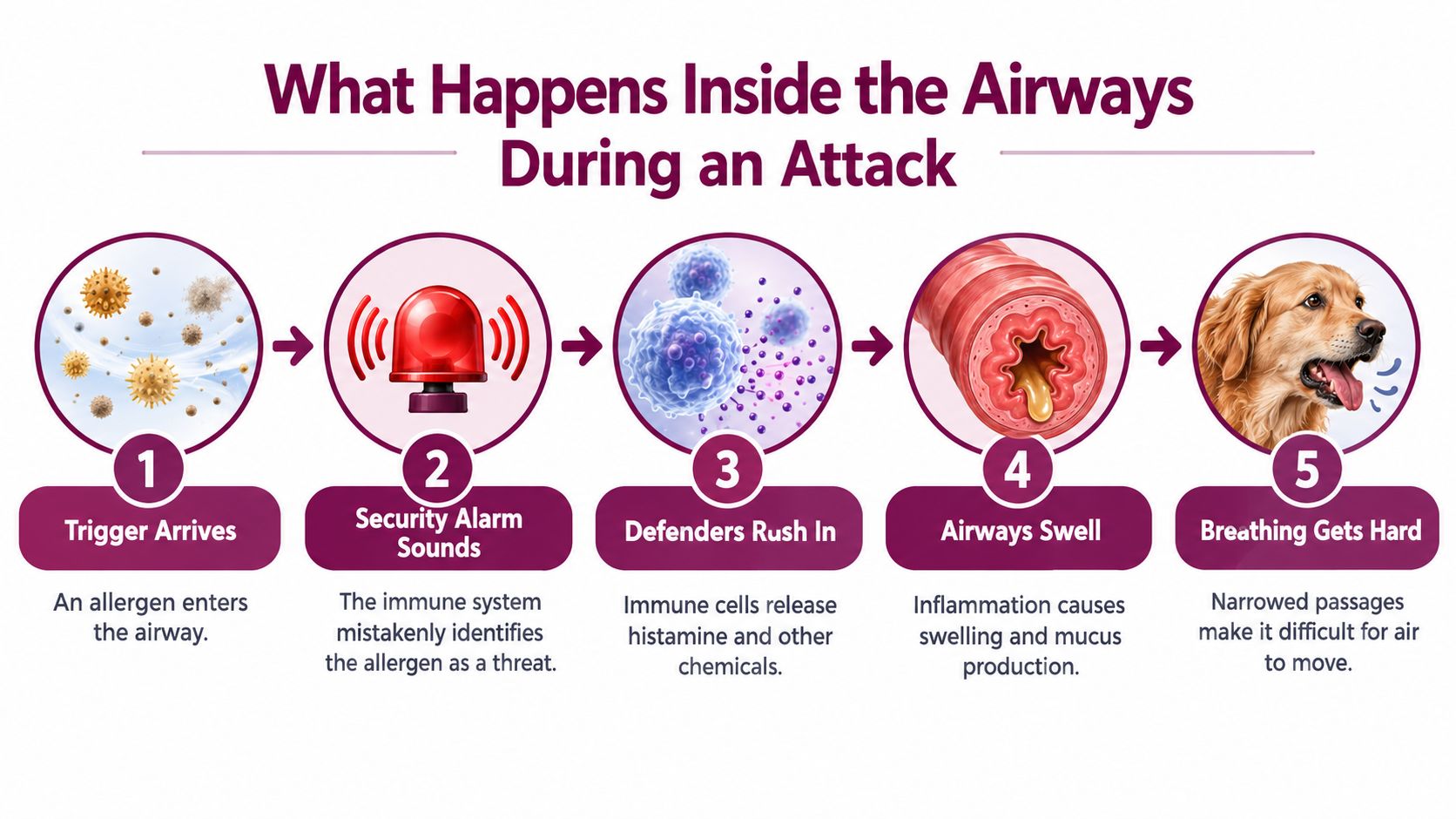
Several changes happen together
- The airway lining swells. Inflammation thickens the tissue bordering the breathing passage.
- Muscles tighten around the airway. This is bronchoconstriction, the squeezing component of an attack.
- Mucus accumulates. Secretions can further obstruct already narrowed passages.
- Inflammatory cells persist. Eosinophils, a type of white blood cell, can contribute to tissue injury and continuing airway sensitivity.
A feline airway disease review hosted by the National Library of Medicine describes eosinophilic inflammation, reversible bronchoconstriction, mucus plugging, and structural changes associated with persistent inflammation. These processes explain why coughing isn't merely a throat sensation in an asthmatic cat.
A helpful comparison is a flexible drinking straw. Squeezing its outside makes the opening smaller; swelling along its inner surface and material inside it restrict the opening further. That's why treatment may need to address more than muscle tightness alone.
Reversible narrowing doesn't mean every change is temporary. Persistent inflammation can produce airway remodeling, including changes in airway muscle and mucus-producing tissues. Treatment therefore focuses on controlling the underlying inflammation as well as addressing narrowing when appropriate.
Cats also differ from people in their inflammatory responses. Veterinary references identify serotonin as an important mediator of allergen-induced bronchoconstriction in cats. That species-specific biology is another reason owners shouldn't choose treatment by copying a human asthma routine.
Common Triggers for Dogs and Cats
Your cat coughs after using the litter box, or your dog coughs while you're cleaning. The timing is a clue, not proof of a cause. Start with those everyday observations rather than buying everything labeled “hypoallergenic.”
An allergen activates a specific immune response in a sensitized animal; an irritant can aggravate airways without that allergic mechanism. Different exposures may produce similar symptoms, much as different problems can set off the same alarm. Your veterinarian needs context to interpret them.
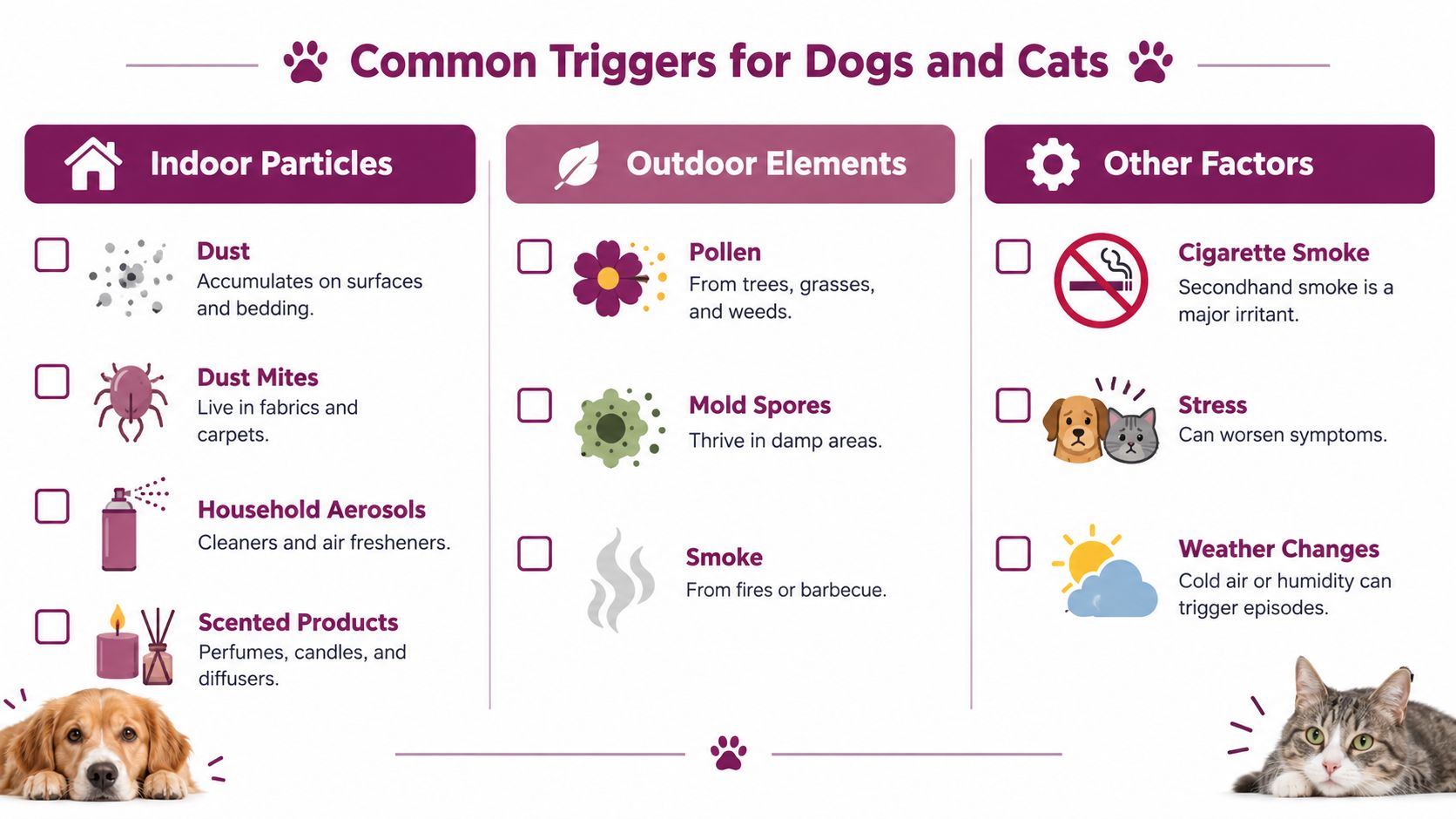
Walk through your pet's surroundings: Indoor particles. Household dust, dust mites, and litter particles are exposures to discuss, particularly for cats. Outdoor allergens. Pollen and mold may deserve attention when episodes follow environmental changes. Airborne irritants. Cigarette smoke and household aerosols matter even when no specific allergy has been established.
Scented candles, strong cleaning products, and fireplace smoke also belong in an exposure history. Record them as possibilities, not confirmed causes. A chart that includes weather or stress likewise cannot establish why your pet coughed.
Don't deliberately recreate an exposure to test your pet.
Instead, record naturally occurring patterns, such as coughing after litter-box use, cleaning, or time near an open window, and share them with your veterinarian. Resources about ways to boost indoor air can inform household cleaning routines; they do not establish that a cleaning service controls veterinary asthma.
A National Library of Medicine review of environmental exposures and asthma emphasizes distinguishing sensitization from clinically relevant exposure in human asthma. That principle supports targeted investigation, but human asthma explanations are not a diagnosis for a cat or dog. Species-specific assessment should guide exposure control and treatment decisions, rather than copying a human routine or paying to remove every substance on an allergy list.
Recognizing the Signs and When to Seek Urgent Care
The most useful observation is how your pet is breathing, not just whether they made a coughing sound. Feline asthma can involve coughing, wheezing, rapid or labored breathing, and reduced activity tolerance. Dogs with inflammatory airway disease may also have chronic cough, exercise intolerance, or respiratory distress.
A coughing cat may initially look as though they're trying to bring up a hairball. Don't use that resemblance to dismiss recurring episodes, especially if no material appears. The sound alone also can't distinguish asthma from other respiratory conditions.
Separate recurring symptoms from breathing distress
If your pet is comfortable between episodes, contact your veterinarian about repeated coughing or wheezing rather than waiting for a severe attack. Describe what happened before the episode, how your pet behaved afterward, and whether the pattern is changing.
Marked breathing difficulty is an emergency. Don't spend time experimenting with environmental changes, searching for a medication, or waiting to see whether a struggling pet settles.
- Visible effort at rest. Breathing that looks difficult even without activity warrants urgent assessment.
- Open-mouth breathing in a cat. Treat this as a warning sign, particularly when it accompanies distress.
- Blue-tinged or pale gums, or collapse. Seek emergency veterinary help.
- A sudden deterioration. A sharp change from your pet's usual breathing deserves immediate veterinary contact.
Practical rule: Recurring cough needs a veterinary appointment. Struggling to breathe needs urgent veterinary care.
If it's safe and doesn't delay care, a short video of an intermittent episode can help your veterinarian understand what you observed. Don't restrain or provoke your pet to capture a better recording.
Throat discomfort is another concern owners may associate with coughing. This guide to a dog with a sore throat offers related context, but throat symptoms don't establish the cause of lower-airway signs.
Avoid assigning urgency by sound alone. A cough that seems dramatic and a quieter episode with obvious breathing effort may require different responses. When you're unsure whether your pet is breathing comfortably, call the veterinary clinic or emergency service and describe the effort you can see.
How Allergic Asthma Is Diagnosed
A veterinarian diagnoses suspected allergic asthma by combining findings and ruling out other explanations. There isn't a single symptom or blood result that proves it. Infection, respiratory parasites, heart disease, and chronic bronchitis can resemble asthma.
The history helps establish the pattern. Be ready to discuss when signs began, whether they recur, possible exposures, changes in activity, and any medications your pet receives. Your veterinarian then uses the physical examination to guide the next tests.
Common Tests Used in Workup of Suspected Allergic Asthma
| Test | What It Checks | How It Helps | Source |
|---|---|---|---|
| Physical examination and history | Overall condition, respiratory signs, and exposure pattern | Directs the workup and assessment of urgency | Veterinary diagnostic guidance |
| Thoracic imaging | Structures within the chest | Helps investigate airway disease and competing explanations | Feline airway review discussed earlier |
| Complete blood count | Blood cells, including eosinophils | May identify supportive findings, but cannot confirm asthma alone | Veterinary diagnostic guidance |
| Blood chemistry and urinalysis | Broader health information | Helps assess the individual patient | Veterinary diagnostic guidance |
| Fecal examination | Evidence relevant to parasitic disease | Helps investigate a potential lookalike condition | Veterinary diagnostic guidance |
| Airway sampling, when appropriate | Cells and material within the airways | Can identify eosinophilic inflammation and aid further investigation | Feline airway review discussed earlier |
The table's source descriptions distinguish the veterinary information underlying these tests without implying that every pet needs every procedure.
Eosinophils require interpretation. These white blood cells are associated with allergic reactions, but they can also appear with parasitic disease. Finding them in blood or an airway sample supports a line of investigation rather than settling the diagnosis.
Before the appointment: Bring medication labels and exposure notes. Tell the team about any products you've already given your pet.
Human asthma evaluations may involve lung-function testing, allergy testing, and inflammatory biomarkers. Don't assume those approaches translate directly into the same veterinary workup.
If infection is suspected, your veterinarian may pursue a different treatment path. Information about antibiotics for respiratory infections in dogs provides context, but antibiotics aren't a substitute for establishing why your pet is coughing. Careful diagnosis helps avoid treating an allergic condition as an infection, or overlooking an infection while assuming asthma.
Treatment Options Your Veterinarian May Recommend
A quieter cough after treatment can be reassuring, but it doesn't mean every airway problem has resolved. In feline asthma, inflammation and tightened airway muscles need different treatment approaches. A narrowed airway is like a passage squeezed from outside while its lining is swollen. Relieving the squeeze doesn't necessarily address the swelling.
Prescription medications aren't universally appropriate for every coughing pet. Your veterinarian chooses the medication, dose, route, duration, and monitoring plan according to the diagnosis, species, and severity of signs.
Corticosteroids. These medicines reduce airway inflammation and are commonly used for cats with frequent or persistent signs. Important adverse effects are possible, particularly with prolonged use. Bronchodilators. These relax airway muscles to help open narrowed airways; their role depends on the individual patient. Neither treatment's purpose makes the other unnecessary, so improvement alone isn't a reason to substitute medicines.

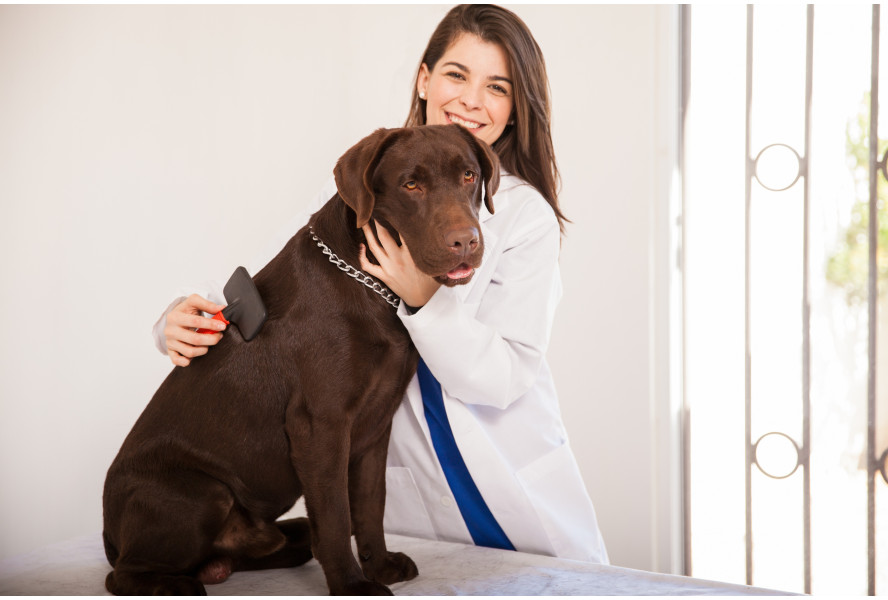
The dog pictured demonstrates a delivery technique. Canine coughing requires its own diagnosis and species-appropriate treatment decisions rather than a feline asthma plan.
Inhaled treatment. In feline care, fluticasone is an inhaled corticosteroid, while albuterol, also called salbutamol, is an inhaled bronchodilator. Both require veterinary instructions. Familiar names from human asthma care don't make these medicines suitable for unsupervised use in pets.
For a cat prescribed inhaled medication, the AeroKat Feline Aerosol Chamber for Cats may support administration. The chamber is a delivery device, not the medication itself. Ask the veterinary team to demonstrate its use and check your technique.
Never give your pet your own asthma medicine without veterinary direction, or independently start, stop, combine, or change prescribed treatments.
Follow-up checks comfort and safety together. Report changes after treatment starts, difficulty administering doses, and signs returning before the next scheduled dose. These observations help your veterinarian decide whether treatment needs adjustment.
Long-Term Management at Home
A home routine is easier to sustain when it follows where your pet sleeps, plays, and uses the litter tray. Environmental control works like reducing the load on sensitive airways: it supports prescribed treatment without replacing it. Choose changes with your veterinarian rather than applying human asthma advice to a dog or cat.
For an asthmatic cat, measures may include low-dust litter, eliminating cigarette smoke, reducing household dust, and considering air filtration. Review the litter area. Ask about lower-dust options and watch for visible airborne particles during use. Keep resting spaces smoke-free. This includes every room your pet uses, not only the medication area. A HEPA-style unit may be worth discussing, but a filter cannot eliminate every relevant exposure.
Clean thoughtfully. Build bedding and fabric cleaning into your routine without introducing strongly scented sprays around your pet. Resources offering expert rug care for sneeze-free living may suggest household-cleaning approaches; rug care alone cannot guarantee symptom-free breathing.
Human allergies to pets need a separate explanation.
The National Institute of Environmental Health Sciences' guidance on pet allergens distinguishes sensitization from actual symptom worsening and explains that no dog breed is reliably hypoallergenic. Those points concern human reactions to pet allergens. They do not establish that your pet's own coat causes their asthma.
Keep a simple record. Note symptoms, administration difficulties, and environmental changes together so patterns are easier to describe. Keep prescriptions and instructions accessible, request refills before supplies run out, and maintain the prescribed frequency rather than stretching doses.
Advice on how to reduce dog allergies can inform broader allergy discussions, but skin-allergy guidance cannot substitute for species-appropriate respiratory care. Ask about comfortable activity, weight, and handling routines suited to your pet. Avoid adding restrictions or making treatment decisions yourself.
Working With Your Veterinary Team for the Best Outcome
The most productive partnership gives your veterinarian clear observations and gives you clear instructions. Ask for a written plan that identifies what to do during an episode, whom to contact after hours, and which changes require reassessment. You shouldn't have to improvise while your pet is uncomfortable.
A good follow-up conversation goes beyond whether coughing stopped. Explain whether your pet tolerates administration, whether their activity has changed, and whether you've noticed any new signs. Don't assume a difficult routine is something you must manage alone.
Questions to bring to follow-up
- What is the working diagnosis? Ask which findings support it and whether anything remains uncertain.
- What does each treatment do? Clarify which medication addresses inflammation and which addresses airway narrowing, if both are prescribed.
- What should prompt a call? Get instructions specific to your pet's usual symptoms and emergency risk.
- How will refills work? Confirm prescription authorization, reorder timing, and the next review appointment.
If you're researching other respiratory or allergy prescriptions, keep their indications separate. Educational material about side effects of Temaril-P for dogs can inform a conversation about that prescription, but it doesn't establish that it's appropriate for feline asthma or a replacement for your pet's current treatment.
Keep the emergency contact information beside the treatment instructions, not buried in an old email.
For ongoing supplies, ask about Buy Once or AutoShip where offered. Scheduled delivery can simplify reordering, but availability varies by product and it doesn't replace veterinary review or prescription authorization. Check the actual listing rather than assuming a particular medicine has a recurring-delivery option.
A sudden change in breathing effort, abnormal gum color, or collapse still overrides the ordinary refill routine. Contact veterinary care rather than waiting for a delivery or trying an unapproved treatment.
Living with a pet who has airway disease is a continuing care relationship. Your role is to observe, follow the agreed plan, and speak up when something changes, not to diagnose every episode alone.
Bandana Rx offers prescription pet medications, veterinary health products, and the AeroKat Feline Aerosol Chamber to support veterinarian-directed care. Visit Bandana Rx to review relevant supplies and purchasing options, and coordinate any prescription order with your veterinary team.