


A smelly, itchy ear is not automatically "an infection," and the bottle already in your cabinet is not automatically the right fix. Head shaking, odor, and redness can come from bacteria, yeast, allergy-driven inflammation, a foreign body, or a problem deeper than the outer canal. Prescription ear drops for dogs are chosen after that distinction is made, not before it.
The drops that help one dog can be a poor match for the next. Concentrations, dosing schedules, and eardrum restrictions are printed on a specific label. This guide shows how to match a prescribed product to the cause, how to read that label, and which warning signs mean you should call your veterinarian instead of adding another product.
Table of Contents
- Common Ingredients in Prescription Ear Drops
- Why Your Vet Examines and Tests Before Prescribing
- How to Give Prescription Ear Drops Safely
- Side Effects and Ototoxicity Warning Signs
- Storage, Missed Doses and Leftover Medication
- Confirm the Right Ear Treatment With Your Vet
- How Bandana Rx Verifies and Ships Prescriptions
Common Ingredients in Prescription Ear Drops
A prescription ear drop is usually doing two or three jobs at once: killing an organism, calming the inflammation that organism caused, and clearing the debris that keeps either job from working. Which jobs your dog's bottle covers depends on what your veterinarian found in the canal.
That is the dividing line between a medicated drop and a cleanser. Prescription drops are dispensed for a diagnosed ear problem and selected by a veterinarian. Non-prescription medications do not require veterinarian authorization, so a routine cleanser can be bought for wax and odor alone. Using one is not the same decision as treating bacteria, yeast, or inflammation.
Otitis externa, inflammation or infection of the external ear canal, is common enough that otic medication is part of routine care. A large United Kingdom primary-care study of veterinary records from 2016 identified 1,631 otitis externa cases among 22,333 dogs, a one-year period prevalence of 7.30% with a 95% confidence interval of 6.97% to 7.65%, as reported in a paper indexed by the National Library of Medicine.
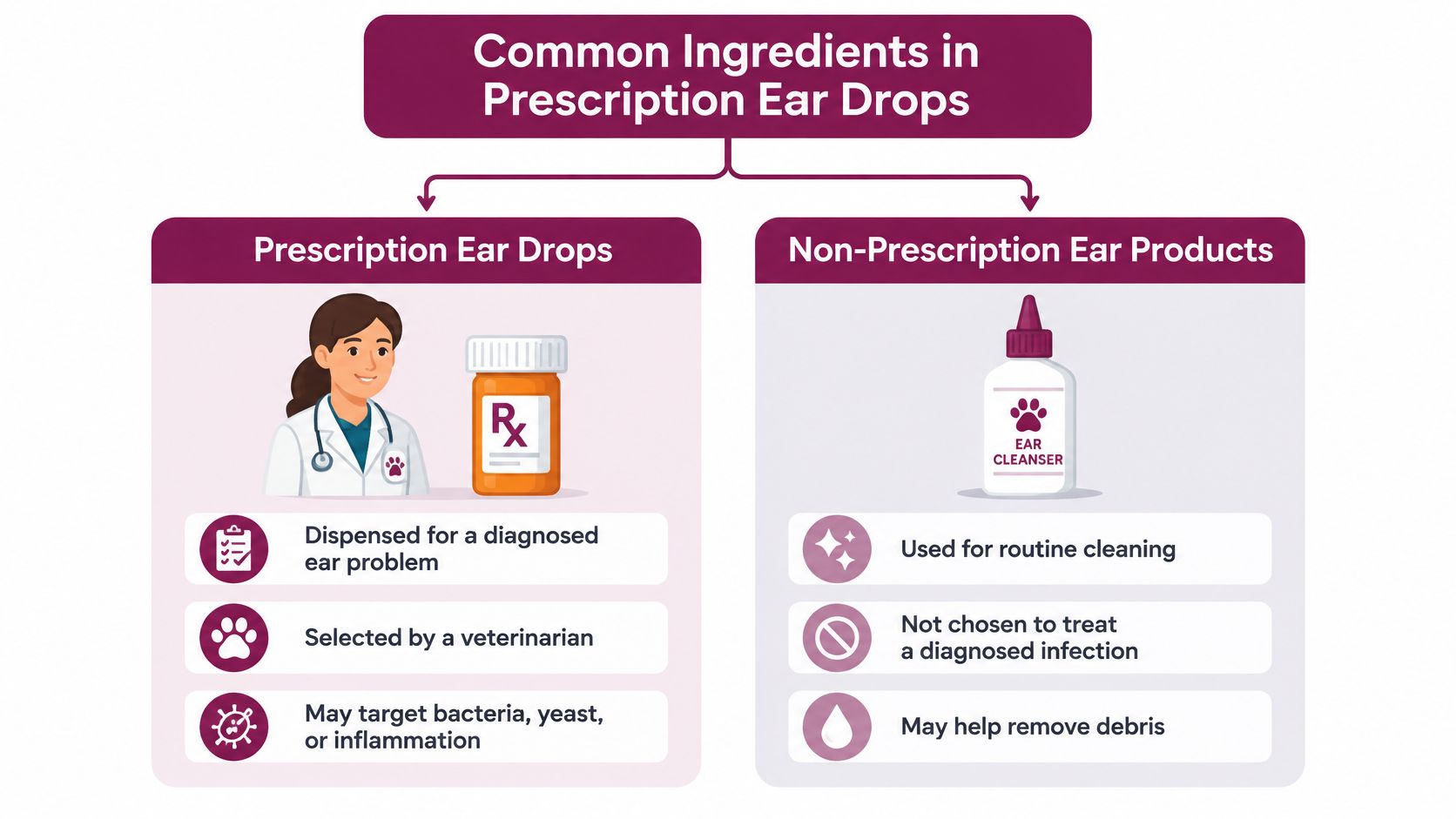
How the classes differ
Ear disease is rarely a single organism. The cause may be bacteria, yeast, inflammation, allergy, parasites, or several of these together, which is why many prescribed products pair an antibiotic, an antifungal, and a corticosteroid. Ingredients, concentrations, and restrictions still differ from one bottle to the next.
| Ingredient class | Typical target | Key consideration |
|---|---|---|
| Antibacterial agents | Bacteria such as Pseudomonas aeruginosa and coagulase-positive staphylococci | Choice follows cytology or culture, and some agents need caution if the eardrum is damaged |
| Antifungal agents | Yeast such as Malassezia pachydermatis | Examples include clotrimazole, miconazole, and terbinafine, matched to the organism found |
| Corticosteroids | Inflammation, swelling, pain, and discharge | Not used in dogs hypersensitive to corticosteroids, and usually paired with an antimicrobial |
| Ear cleansers | Wax, debris, and discharge that can block or inactivate medication | Use only as directed, and only with a cleanser that suits an intact or damaged eardrum |
Reading the label means matching each ingredient class to the reason it was chosen. Say your veterinarian names a combination product such as the ointment described on the Otomax ear medication page. That listing shows how a veterinary ear medication is put together; it is not a prompt to start treatment yourself. All medications Bandana Rx dispenses are intended for veterinary use only.
Before those ingredients go in, your veterinarian may examine canal material and check whether the eardrum looks intact, because some ingredients are unsafe if medication reaches the middle or inner ear. Cleaning follows the same logic. Heavily waxy or dry ears may need more frequent cleaning during therapy, on the schedule your veterinarian sets rather than a household routine.
Why Your Vet Examines and Tests Before Prescribing
A symptom check often picks the wrong target. In a laboratory survey of 604 canine otitis submissions, 78.1% had bacterial or fungal growth, and among the identified organisms 75.4% were bacterial and 24.6% fungal, according to a survey indexed by the National Library of Medicine. A drop chosen from odor or scratching alone can miss the organism, or it can be broader than your dog needs.
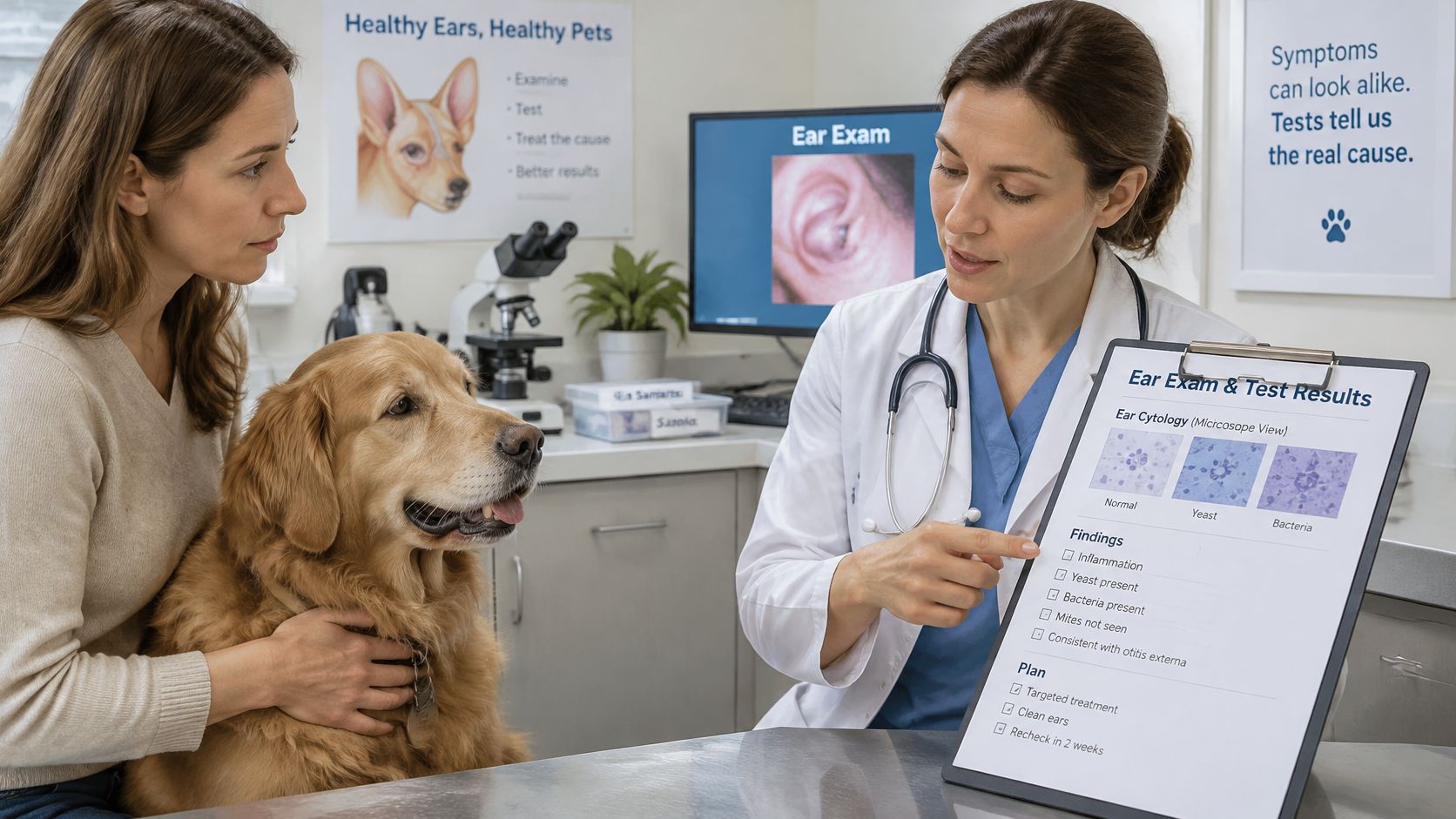
Canine otitis is not one disease. The canal may hold bacteria, yeast, allergy-driven inflammation, a foreign body, or middle-ear disease. One general "ear infection" label can hide those differences.
The exam in the order it usually happens
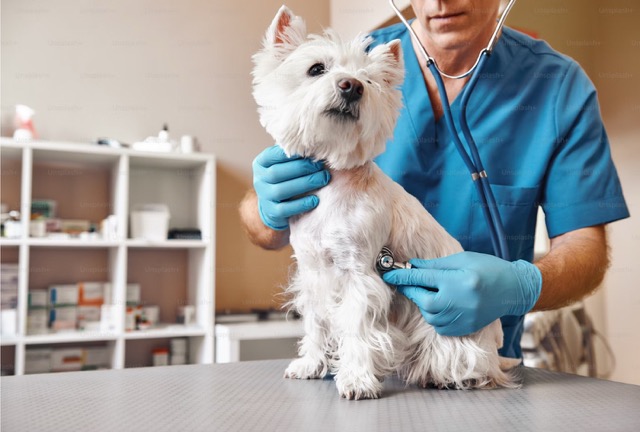
- Otoscopic look. Your veterinarian tries to see the eardrum and judge whether it appears intact before any medicated drop is chosen.
- Cytology of canal contents. This is the most informative routine test. It shows whether yeast, bacteria, or both are present, which steers the ingredient class.
- Repeat cytology during treatment. A later slide helps decide whether the drops should stay the same or change.
Three readings often mislead owners at home.
- Odor or discharge does not name the organism. A bad smell can come from yeast, bacteria, or both.
- Yeast is not treated like bacteria. An antibacterial agent does not stand in for an antifungal when Malassezia is the finding.
- Less redness or scratching does not prove the infection is gone. Comfort can improve while organisms remain.
Culture and susceptibility testing matter most for recurrent, severe, nonresponsive, or resistant infections. That same survey reported multidrug-resistant and methicillin-resistant bacteria and argued for evidence-based treatment.
Practical rule: Ask whether cytology was done, whether the eardrum was seen, how long the course should last, and which follow-up findings would change the drops.
Swimming adds moisture that can keep an already irritated canal damp. If beach days are part of your dog's year, it helps to explore Florida's dog-friendly beaches with a plan to dry the ears afterward, then let your veterinarian decide whether drops are needed at all. Ear disease in cats follows a different path, which is why dosing advice on our cat ear infection drops page should not be borrowed for a dog.
The exam is what lets your veterinarian pick a product that fits your dog. It is also the reason leftover medication from last year is a poor substitute.
How to Give Prescription Ear Drops Safely
Labels are product-specific, so a number from one bottle is not a number for every bottle. FDA animal-drug labeling for Synotic Otic Solution Veterinary gives one concrete example for dogs: 4 to 6 drops, equivalent to 0.2 mL, in each affected ear twice daily for no more than 14 days, with a total dosage not exceeding 17 mL. Those figures apply to that product. The directions on your dog's own prescription are the ones you follow.
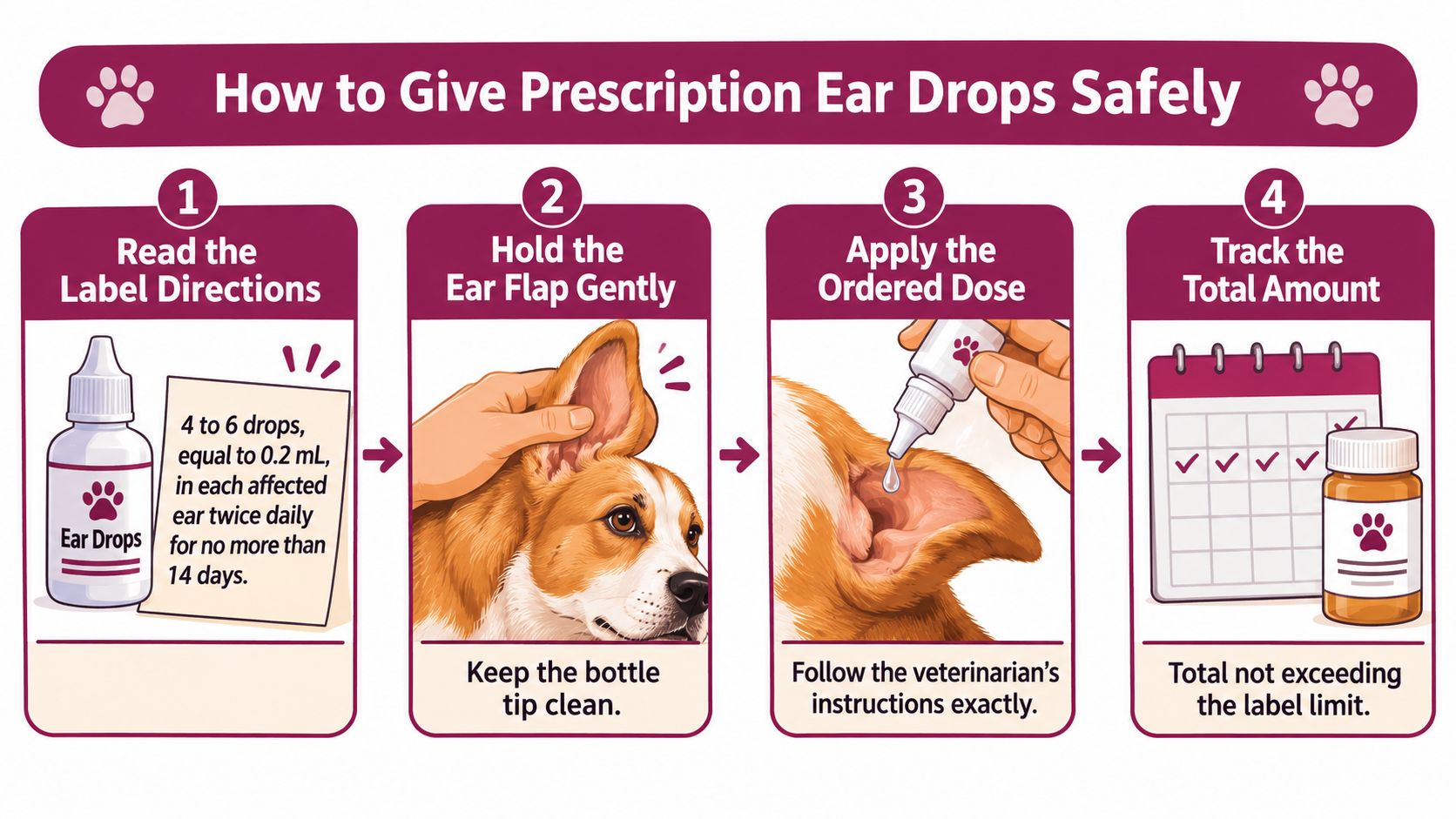
A short sequence with a reason for each step
- Match the label to the prescription. Check the product name, strength, and directions. A mismatch changes the treatment even when the bottle looks similar.
- Clean only as directed. The Synotic label recommends cleansing the affected canal before application. Wax and debris can keep medication off the canal surface. Use the cleanser your veterinarian named, not a substitute from the bathroom cabinet.
- Place the prescribed amount. Hold the ear flap up and count the drops or measure the volume on the label. Keep the bottle tip from touching the ear. The same label warns you to avoid contact with your dog's eyes and bare skin.
- Massage the outside of the canal base. Gentle external massage may help distribute the medication. You are not forcing the tip deeper into the canal.
- Wipe only what the label allows. Excess on the flap can be wiped away. Do not flush the canal unless the label or your veterinarian tells you to.
Hearing loss has been reported in a small number of dogs on that Synotic labeling. If hearing or vestibular dysfunction develops, the label instructs you to discontinue the product immediately and flush the canal thoroughly with a non-ototoxic solution. That flush instruction belongs to this product. Do not copy it onto a different drop.
If your dog will not hold still, or a line on the label is unclear, call the prescribing veterinarian. Guessing a larger dose is not a workaround.
More background on home care during an active problem is on our page about how to treat a dog ear infection. Do not change the dose or the schedule on your own, and do not stop early because the ear looks calmer after two days.
Side Effects and Ototoxicity Warning Signs
Ototoxicity means harm to hearing or balance. Two stories circulate online about it. One says any prescription drop will damage hearing if the eardrum is torn. The other says the risk is too small to think about. Neither story is careful enough.
What drives the risk: the drug or cleanser, the concentration, how much reaches the ear, how long it sits there, and whether it crosses the eardrum into the middle or inner ear. A recent review notes that canine ear anatomy makes drug delivery difficult and that a perforation can create ototoxicity concerns, with extra care advised for potentially ototoxic agents such as polymyxin B and neomycin when the tympanic membrane may be compromised, as described in a review indexed by the National Library of Medicine.
No one can predict in advance which dog will react. A normal-looking ear flap tells you nothing about whether the eardrum behind it is intact. The eardrum works like a door: drops are formulated to act on the outer side, and the label warnings describe what changes when that door is open. That is why an otoscopic exam comes before any product carrying an ototoxicity warning. "Uncommon" is not the same as "impossible."
What "stop and call" looks like at home
| Sign | What to do |
|---|---|
| New head tilt or loss of balance | Follow the label, stop the product as directed, and call your veterinarian promptly |
| Unusual or rapid eye movements | Follow the label, stop the product as directed, and call your veterinarian promptly |
| Change in hearing response | Follow the label, stop the product as directed, and call your veterinarian promptly |
| Marked pain, worsening swelling, or discharge | Call your veterinarian for reassessment |
| Eye or skin irritation after application | Avoid further contact with the eyes and skin and contact your veterinarian |
Do not add human ear products or household cleaners while you wait for that call.
Formulations are not interchangeable on safety rules either. FDA labeling for DuOtic says that product must not be used in dogs with a known tympanic perforation or in dogs hypersensitive to terbinafine or corticosteroids, and that use in dogs with perforated eardrums has not been evaluated.
Share every medication and ear product your dog already receives so your veterinarian can check interactions before the first dose. Dogs with deep facial folds can trap moisture near the ear opening, which changes how the canal is cleaned and monitored. The Precious Pets Transport guide to wrinkled dogs is a useful primer on that skin pattern, and it still leaves medication choice with your veterinarian. Product-specific cautions for one corticosteroid solution are summarized on our Synotic Otic Solution page.
Storage, Missed Doses and Leftover Medication
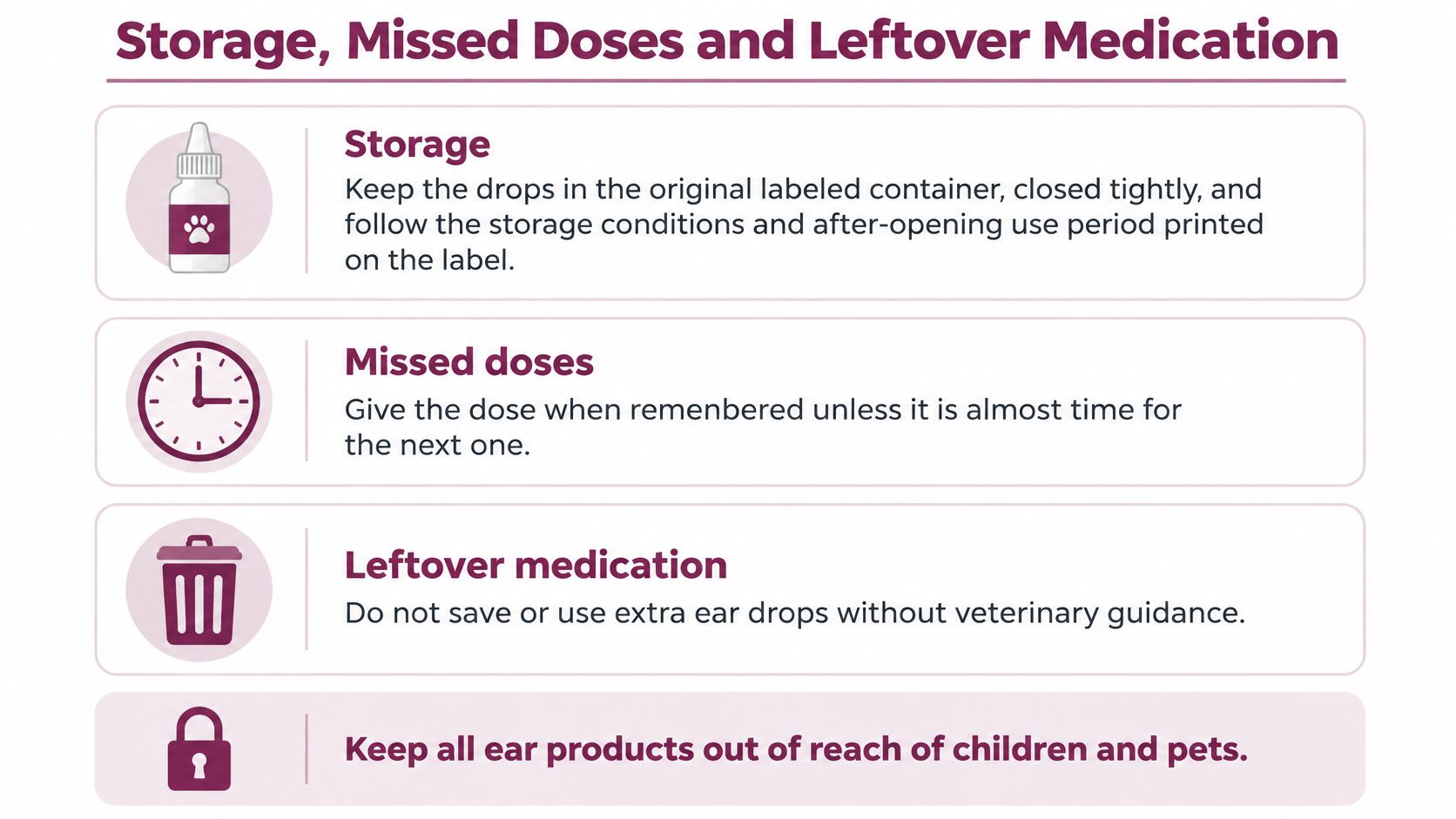
Where should the bottle live?
Keep the drops in the original labeled container, closed tightly. Follow the storage conditions and the after-opening use period printed on that label. A warm windowsill or a damp bathroom shelf can age a suspension faster than the carton expects. Keep every ear product out of reach of children and of pets other than the dog it was prescribed for.
What if you miss a dose?
Do not double the next dose, and do not rebuild the schedule on your own. Call your veterinarian or the pharmacy and ask what to do for that specific product. Skipping ahead or stacking two doses can change both safety and how much medication stays in the canal.
The ear looks better. Can you stop?
Finish the prescribed course unless your veterinarian tells you to stop. A quieter ear can still hold organisms. The recheck, not the smell at home, is what confirms that treatment can end. Between doses, clean only on the schedule you were given. A thick, waxy ear and a copiously draining ear are not cleaned on the same rhythm.
Can leftovers cover the next flare?
No. Last month's organism may not be this month's organism, and another dog in the house should not get the same bottle. Bring remaining containers to the recheck so your veterinarian can see what was used.
A simple home checklist keeps this workable. Confirm the label matches the prescription, keep a short dosing log, note any change in balance, pain, or discharge, and keep the recheck. Reading the carton itself is covered in our guide on how to read pet medication labels.
Confirm the Right Ear Treatment With Your Vet
Prescription ear drops should follow an examination and, when your veterinarian needs it, cytology. Book a visit for persistent odor, discharge, head shaking, scratching, pain, or swelling. Do not treat those signs with leftovers or products already at home.
Bring a short list so the visit answers the decision, not just the symptoms.
- What did you see, and is the eardrum intact?
- Was cytology done, and what did it show?
- Which ingredient class do you recommend, and why?
- How long should this course last?
- Which findings mean the drops should change?
- When is the recheck, and should remaining medication come back?
The veterinarian's answers set the product and the course. The label tells you how to give that product. It does not choose it.
Bandana Rx's categories include Ear, Eye, Flea & Tick, Joints, Medications, OTC, Skin & Coat, Vitamins, Treats, and Vaccines, so ear care sits beside related skin and preventive products rather than in a separate system. Once a prescription exists, review the label and confirm the dose with your veterinarian before you start an order. We will make every effort to work with your veterinarian on timely authorization and keep you informed while that happens. After the visit, you can look through ear-care options on Bandana Rx. There is no reason to place an order before the exam.
How Bandana Rx Verifies and Ships Prescriptions
We dispense prescription medications only after we receive authorization from your pet's veterinarian. We prefer that authorization directly from the veterinarian's office. If it has not arrived, we can contact the office by fax and/or other means to seek it before dispensing. We will make every effort to obtain timely authorization and keep you informed if the clinic needs another day to respond.
What you actually do, in order
- Place the order for the ear medication your veterinarian prescribed.
- At checkout, enter the shipping address, your pet's details, and the veterinarian's details for each medication. A prescription order needs all three.
- The veterinarian authorizes the prescription. You do not rewrite the dose or the frequency while you wait.
- The pharmacy verifies it, then the order is prepared.
- We ship to an eligible U.S. state and you can follow the package with real-time tracking. A valid prescription is required before prescription medications can be shipped, and shipping follows state requirements. A map on the site shows licensed states.
Have this ready so the authorization call is short. You will want the clinic name and phone number, the veterinarian's fax number if you know it, your pet's details, and the exact medication and strength on the prescription. If the clinic changes the product after cytology, wait for the updated authorization rather than substituting a similar-looking bottle.
Bandana Rx is a licensed pet pharmacy. The drugs we carry and dispense are the same drugs provided by local veterinarians, dispensed for veterinary use after that authorization step. If a line on the prescription is hard to read, ask us or your clinic before the first dose. Do not change the dose or the frequency without your veterinarian.
Bandana Rx is a licensed online veterinary pharmacy that fills prescription ear medications for dogs after your veterinarian authorizes them, and we can request that authorization from the clinic before anything ships. If your dog already has a current prescription for an ear product, you can review veterinary options and start an order with your clinic's details at checkout. Visit Bandana Rx when you are ready to look at ear medications your veterinarian has already chosen.