


Here's a question worth sitting with. If a medicated shampoo can knock down the yeast on a dog's skin by a wide margin, why does the same itch so often come back a few weeks after the last bath?
The shampoo didn't fail. A wash does one job: it lowers the number of organisms living on the surface of the skin, and it does that job well when the technique is right. What it can't do is change the reasons those organisms overgrow, or tell you whether the organism you're targeting is the one causing the problem.
That's why chlorhexidine and miconazole shampoo works best as one step inside a plan your veterinarian builds from a diagnosis, not as a bottle you reach for whenever the skin looks wrong. Knowing which conditions it treats, and which it doesn't, is the difference between a bath that helps and weeks of bathing that go nowhere.
Table of Contents
- What Chlorhexidine and Miconazole Shampoo Treats
- How to Bathe Your Pet With the Shampoo, Step by Step
- How Often to Use It and How Long to Leave It On
- How Long Improvement Takes and When to Reassess
- Protecting Dry or Irritated Skin During Treatment
- Precautions Before and During Use
- Confirm Your Treatment Plan With Your Veterinarian
What Chlorhexidine and Miconazole Shampoo Treats
Chlorhexidine and miconazole shampoo is a medicated wash for superficial skin problems caused by bacteria, yeast, or ringworm fungi. Superficial is the word that sets the limit. The product sits on the coat and the outer layer of skin, the way rinsing the surface of soil does not reach roots farther down. It can act on organisms near the surface. Infection deep in the tissue stays out of reach.
The two active ingredients split that surface job. Chlorhexidine is the antibacterial component. Merck Veterinary Manual's guidance on pyoderma describes chlorhexidine at 2% to 4% as an antimicrobial ingredient, explains that it works by coagulating bacterial cytoplasmic proteins and deteriorating bacterial cell membranes, and notes that 2% chlorhexidine combined with 2% miconazole provides both antistaphylococcal and antifungal activity. Miconazole is the antifungal component, aimed at yeast such as Malassezia and at the fungi involved in ringworm.
Matching the shampoo to the diagnosis
The condition your veterinarian names decides how far a bath can go. Canine yeast dermatitis has the clearest trial picture. In a randomized, single-blinded field trial of dogs with Malassezia dermatitis, yeast counts fell by at least 88% in 21 of 22 dogs bathed with chlorhexidine alone and in 30 of 32 dogs given the combination, and neither the yeast reduction nor the time to cytological recovery differed significantly between the groups, as reported in the Journal of Small Animal Practice field trial.
A sharp drop in yeast on a slide shows the wash is doing its surface job. Clearing the problem still depends on the diagnosis and on follow-up that says the plan is working.
| Condition | Role of the shampoo | Vet confirms first |
|---|---|---|
| Yeast (Malassezia) dermatitis in dogs | Antifungal and antimicrobial wash that sharply reduced yeast counts in the field trial | Yeast seen on cytology |
| Superficial bacterial pyoderma | Antistaphylococcal wash in the chlorhexidine range described for pyoderma | Lesion depth and infection severity |
| Ringworm (dermatophytosis) | Supporting topical wash while the infection is managed | Fungal diagnosis and when the infection has cleared |
| Unexplained itching or deep infection | Not a substitute for diagnosis | Underlying cause and whether topical therapy is appropriate |
Ringworm is the condition owners most often treat as if the bottle itself were the cure. Veterinary guidance on dermatophytosis in dogs and cats places a chlorhexidine and miconazole shampoo among topical options that support the plan. Baths lower fungi living on the coat and skin surface. The veterinarian is the person who decides the infection has cleared.
Limits are easy to miss because itchy skin can look the same from one week to the next. The shampoo does not reach deep infections, does not settle itching whose cause is still unknown, and does not replace cytology, culture, or a skin scrape. Some problems that look infectious have a different story, and rain rot in dogs is one surface condition that keeps going when a medicated wash is the only step.
How to Bathe Your Pet With the Shampoo, Step by Step
A thorough-looking bath and a working bath aren't the same thing. Technique decides how much active ingredient reaches the skin, how long it stays there, and whether your pet walks away with calm skin or a fresh flare. The sequence below follows veterinary guidance on topical treatment in animals, and it's worth repeating the same way every time so you can compare one bath to the next.
Here's the flow in one view.
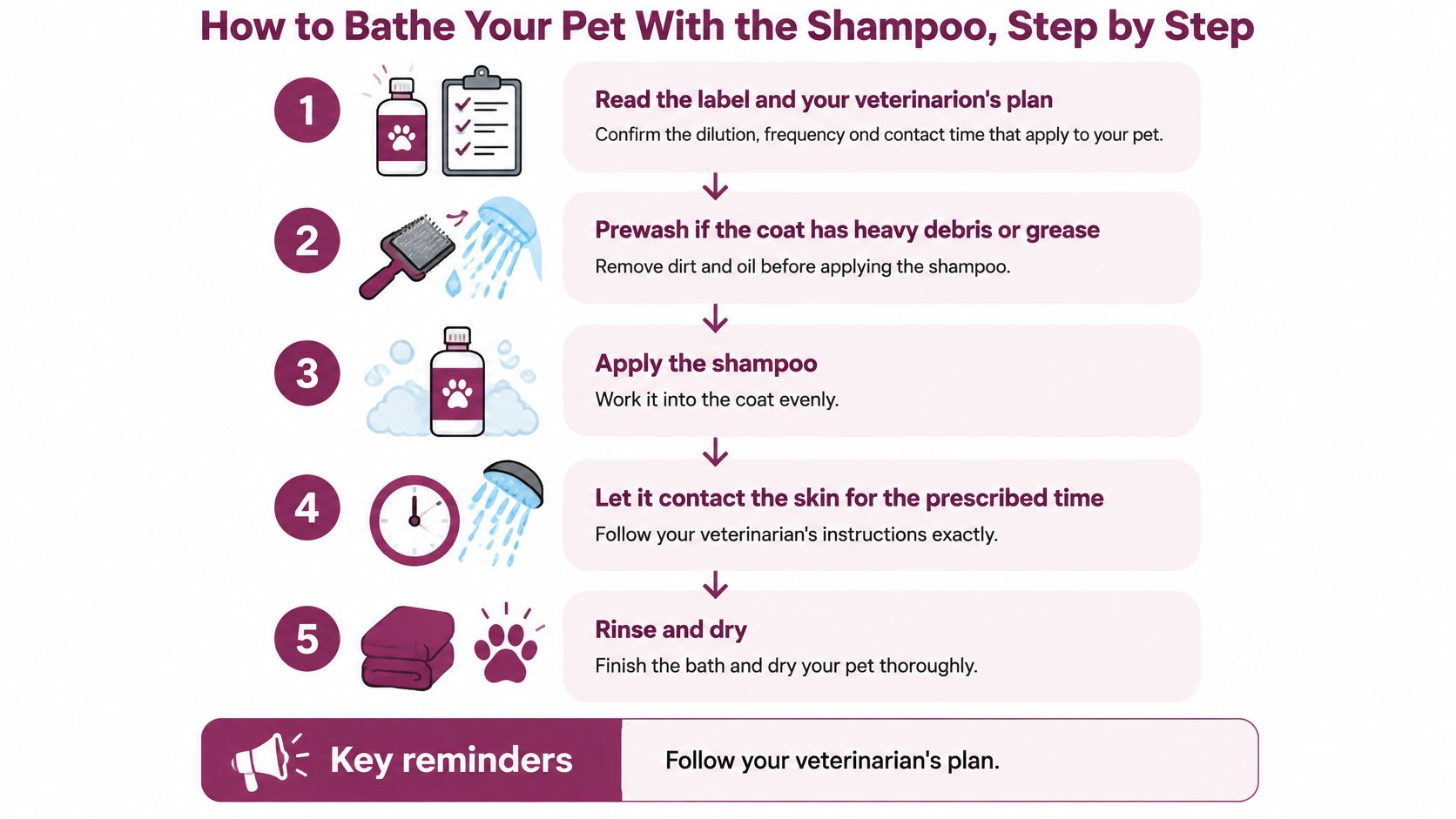
The steps that decide whether the bath works
Read the label and your veterinarian's plan before the first bath. Confirm the dilution, the bathing frequency and the contact time that apply to your pet's diagnosis, and note them where you can see them from the tub. Those three settings change with the condition being treated.
Prewash when the coat carries heavy debris or grease. Rinse, use a plain cleansing shampoo if your veterinarian recommends one, then rinse and drain before the medicated product goes on. Contaminants left in the coat reduce how much of the active ingredient reaches skin.
Predilute only when the label or your veterinarian tells you to. A prediluted product can spread more evenly and irritate less, but mix only what you'll use in the next few minutes. A dilution stored in a bottle is an unpreserved one.
Wet the coat right down to the skin with lukewarm water. On a thick or double coat, part the hair in sections and soak along the parting, because shampoo applied over a dry undercoat never makes contact.
Apply enough shampoo to reach both hair and skin, then work it in. Spend extra time between the toes, around the mouth and under the tail, where lesions like to hide. Keep it out of the eyes, ears and mouth.
Start the timer after the lather is spread, not when the water goes on. Most protocols call for 5 to 10 minutes of contact with the combination product, and a longer medicated bath may run 10 to 15 minutes when your veterinarian directs it. Counting from the start of the bath is the most common way owners shorten a treatment.
Practical rule: the clock starts when the last patch of skin is covered in lather, not when your sleeves get wet.
Rinse until the water runs clear. Residue left in the coat is a frequent cause of the redness owners blame on the shampoo.
Dry your pet in a warm, draft-free room. Towel off gently, then dry the folds and between the toes properly, since trapped moisture undoes part of the work.
A well-handled bath ends with a coat that feels clean rather than stripped, and skin that isn't newly red. If your dog's underlying problem is allergic itch rather than infection, the choices in shampoo for dogs with skin allergies work differently, and it's worth reading before you settle on a routine.
How Often to Use It and How Long to Leave It On
How often should the bottle come out of the cupboard? The answer sits on the label and in the plan your veterinarian writes for this pet and this diagnosis. A coat that looks dirty, or an itch that feels urgent, is a poor clock.
The same shampoo can carry different instructions for different problems. That is not a mix-up. Merck Veterinary Manual's guidance on topical treatment describes medicated bathing for pyoderma two to three times weekly, with a 10 to 15-minute contact time for each application, and notes that prediluting a medicated shampoo can improve distribution and reduce irritation. Yeast dermatitis often runs on another rhythm, one the veterinarian sets for that skin problem rather than a single timetable copied from every other case. Two owners can share a bottle and still bathe on different days.
A bath works like a timed wipe of the surface, not like a cure that finishes when the coat smells clean. The lather lowers the microbes sitting on the skin today. The gap before the next bath is there so new growth does not get a long head start, and so the skin can rest.
Who sets the schedule for each use
| Use or condition | Frequency reported | Contact time | Who sets the schedule |
|---|---|---|---|
| General medicated bathing with the combination shampoo | Set by the product label and by the veterinarian for the specific condition | The contact time printed on the label | Label and veterinarian |
| Superficial pyoderma | Two to three times weekly | 10 to 15 minutes | Veterinarian |
| Ringworm (dermatophytosis) | As often as the veterinarian prescribes for that case | The full contact time on the label, with no shortening between baths | Veterinarian, alongside systemic treatment if prescribed |
The principle behind every schedule: the wash reduces what is on the surface now, and the interval exists to catch what grows back before it takes hold again.
Extra baths do not turn surface control into a confirmed cure. The pauses let skin recover. Stacking washes onto a plan that is not helping usually dries the coat and still leaves the underlying problem in place. If the itching stays loud, or the routine is too hard to keep, bring that to the next visit and let your veterinarian change the timing. A schedule you can follow does more than a stricter one you drop after a few days.
How Long Improvement Takes and When to Reassess
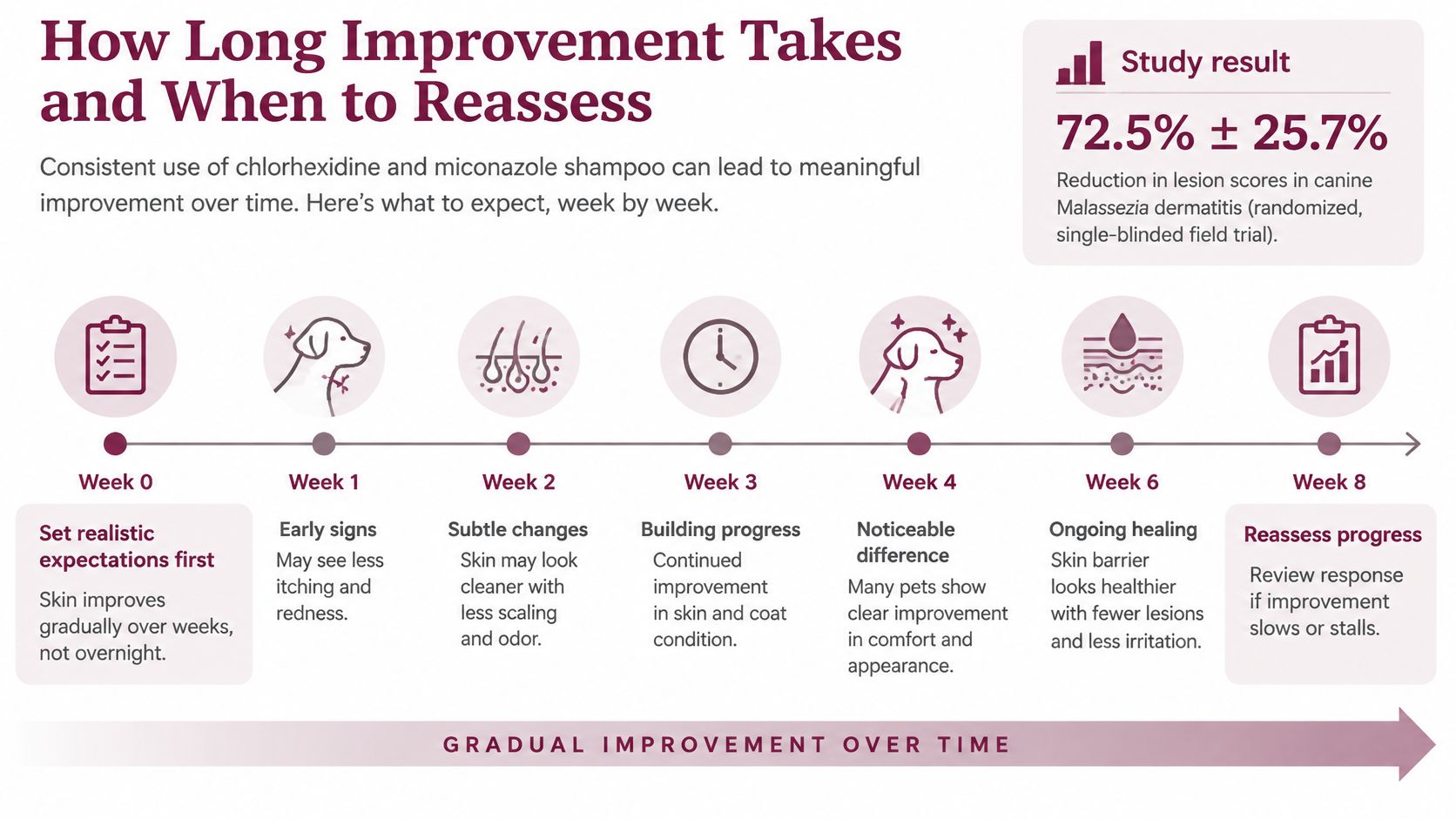
Skin doesn't turn around in a day. Cell turnover, inflammation and the yeast population all move on a slower clock than an owner's worry, so the useful question isn't whether the first bath helped but whether the trend across several weeks is heading the right way.
Ringworm is the condition where this shampoo most often gets oversold. Consumer-facing content tends to present the combination as a broadly effective antifungal wash, but a randomized clinical trial in cats with Microsporum canis found that lime sulfur significantly outperformed miconazole-chlorhexidine by week 7, with a mean time to cure of 27 days on lime sulfur versus 37 days on the combination, according to the trial summary in the DailyMed product labeling. Staff in that trial reported no meaningful differences in unpleasantness, administration difficulty or cat reactions.
That doesn't make the shampoo pointless. It means superficial microbial control and a confirmed cure are two different goals, and the gap between them matters most in shelters, multi-cat homes and households with immunocompromised people, where lingering infectiousness has real consequences. If ringworm keeps returning after treatment, why ringworm keeps coming back explains the environmental and diagnostic side that a bath can't fix.
Expected response timelines
| Condition | Documented timeline or result | Reassess if |
|---|---|---|
| Canine Malassezia dermatitis | Lesion scores fell 72.5% ± 25.7% and 78.7% ± 22.3% over up to six weeks | No meaningful improvement by the review date |
| Feline ringworm (Microsporum canis) | Mean time to cure 27 days with lime sulfur vs 37 days with miconazole-chlorhexidine in a randomized trial | Slow progress past the planned review, or new lesions |
| Ringworm in general | Cure requires veterinarian-confirmed mycological cure, not clinical improvement alone | Clinical improvement without a confirmed cure |
A slow response is a reason to reassess, not a reason to bathe more often. Book the review your veterinarian suggests, and bring photos from the first day so the comparison is real rather than remembered.
Protecting Dry or Irritated Skin During Treatment
Here's where a common assumption deserves a second look: that medicated shampoo always dries a pet's skin out.
A 2025 study of healthy dogs found that one bath with 2% chlorhexidine/2% miconazole shampoo did not change lateral-thoracic skin hydration. What did change hydration was what came afterward. A spray containing occlusive agents, humectants and physiological lipids applied after the bath significantly increased skin hydration for at least 24 hours. The shampoo itself may not be the culprit owners assume it is, and a targeted moisturizer can add something the wash doesn't.
Where a moisturizer fits
The animals most likely to benefit are those bathed repeatedly, those with allergic skin disease, and those whose barrier is already compromised.
- Get approval first. Use only a moisturizer your veterinarian has approved, because what sits on treated skin for hours can interact with the plan.
- Keep it off sensitive ground. Eyes, ears and mucous membranes are off limits, whatever the label says about the body.
- Add, never replace. A moisturizer goes on in addition to the prescribed contact time and a full rinse, never instead of them.
- Skip human products. Pet moisturizers are formulated for pet skin, so don't reach for a human lotion without veterinary advice.
- Handle the coat gently. Rinse completely and pat dry rather than scrubbing, since friction on a fragile barrier causes its own problems.
Guardrail: nothing applied after the bath replaces the prescribed contact time or a complete rinse.
Watch for redness, flaking, scratching, hot spots or a sudden change in comfort, and raise any of them at your next visit rather than waiting for the review date. If the coat and skin need support between medicated baths, dog conditioner for dry skin covers how conditioning products fit around an active treatment plan.
Precautions Before and During Use
Work through this list before the first bath, ideally with your veterinarian on the phone or in the room. Each item exists because something specific can go wrong when it's skipped.
Confirm the diagnosis first. The shampoo is designed for particular superficial problems, and it isn't a substitute for working out why a pet is itching or whether an infection runs deeper than the surface.
Check the species and the label. Confirm the product is labeled for your pet's species, and ask whether your pet's age, health history and other medications change anything.
Keep it away from eyes, ears and mucous membranes. If contact happens, rinse with water and follow the label's first-aid directions. Ear canals in particular are not a place to experiment without a veterinary exam.
Don't adjust the dilution, frequency or contact time on your own. Any change should come from your veterinarian, since those settings are tied to the diagnosis and to how your pet is responding.
Don't layer topical products without approval. Two medicated or degreasing products in the same week is a common route to irritation, and the combination tells you nothing about which one helped.
Ask about broken or painful skin. Inflamed, raw, or painful areas may need a different approach before a wash is appropriate.
Stop and call if a reaction appears. Redness, swelling, blistering or any new discomfort after a bath is a reason to pause and get advice rather than to push through the course.
Prescription status and directions depend on the specific product and your veterinarian's decision, so treat this as a starting point for that conversation rather than a complete safety guide.
Confirm Your Treatment Plan With Your Veterinarian
A cleaner coat can still hide an unfinished infection. A medicated bath works like wiping a counter after a spill: the surface looks better, but you still need to know what spilled and whether it went deeper than the top. Diagnosis is that second check. Contact time and a set bathing schedule only help once your veterinarian has named the problem.
Questions to take to the visit
- What exactly are we treating, and how was it confirmed?
- Which product, at what strength, and does the label match the plan?
- What dilution and contact time apply to my pet?
- How often should I bathe, and for how long in total?
- Is a moisturizer approved, and when should it go on?
- When is the review date, and what would make you want to see my pet sooner?
Those answers decide the bath. A short contact time for a surface yeast problem is a different job from a longer course aimed at ringworm, and only the person who examined your pet can separate the two.
Keep a simple bath log alongside those answers: the date, the contact time, what the skin looked like, and a photo every week or so. A review built on that record is far more useful than one built on memory.
Before you stop: looking better isn't the same as being clear, and your veterinarian decides when treatment is finished.
That distinction matters most with ringworm. Topical therapy may need to continue even after systemic treatment stops, and a veterinarian confirms cure with follow-up fungal testing rather than by appearance. Once the plan is set, you can compare medicated washes on Bandana Rx, where our Malapet Medicated Shampoo is an antifungal and antibacterial shampoo for dogs and cats. If allergies sit behind the recurring skin trouble, how to treat dog skin allergy covers the longer-term side of the picture.
Bandana Rx is a licensed online veterinary pharmacy in Concord, California, and we stock medicated shampoos, antifungals and everyday skin care for dogs and cats, with free standard shipping on orders over $49. Bandana Rx offers subscriptions with scheduled deliveries, which helps when a course of treatment runs for several weeks and you don't want to run out mid-plan. Once your veterinarian has confirmed the diagnosis and set the bathing schedule, visit Bandana Rx to compare options and order with your prescription on file.