

Primary and secondary glaucoma together affect approximately 1.7% of the North American canine population, according to the MSD Veterinary Manual. That share covers both forms of the disease, so this is a condition general practices see, not a rarity reserved for specialty hospitals.
Glaucoma is a rise in intraocular pressure (IOP) high enough to damage the optic nerve and vision. Dogs and cats can both develop it. The useful question isn't "which drop is on the list?" It's "what can this eye still do?" Vision, the pressure reading, pain, and lens position decide whether medicine, surgery, or removal is the kinder path. Cat plans aren't a smaller version of dog plans.
Table of Contents
- Glaucoma Treatment Options at a Glance
- How Your Veterinarian Chooses a Treatment
- Eye Drops and Oral Medicines Compared
- Why Cat Glaucoma Treatment Differs From Dogs
- Surgery and Laser Procedures and Their Results
- Pros, Cons and Side Effects by Option
- Emergency Care and Blind, Painful Eyes
- Plan Monitoring and Next Steps With Your Veterinarian
Glaucoma Treatment Options at a Glance
Veterinarians usually work toward three goals at once: lower IOP, preserve vision where the eye can still use it, and keep the eye comfortable. Glaucoma treatment options below are classes, not a menu you mix at home. Every medicine here is prescription or veterinary-directed. Don't start, change, or substitute one without the veterinarian who examined the eye.
The species column matters. A drug that moves fluid well in a dog can do little in a cat, or irritate the eye. Dorzolamide HCl is one carbonic anhydrase inhibitor used to help reduce pressure, and it still has to match the species, the eye, and the rest of the plan.
| Treatment class | Examples | Typical role | Species notes |
|---|---|---|---|
| Topical prostaglandin analogs | latanoprost | Increases uveoscleral outflow of fluid | Dogs; limited effect in cats |
| Topical carbonic anhydrase inhibitors | dorzolamide, alone or with timolol | Reduces fluid production | Dogs and cats |
| Topical beta-blockers | timolol | Reduces fluid production | Dogs and cats; use cautiously in small cats |
| Miotics | pupil-constricting drops | Improves drainage through the angle | Dogs; not a standard feline mainstay |
| Systemic carbonic anhydrase inhibitors | oral medicines | Supports pressure control | Veterinary-directed only |
| Osmotic agents | mannitol given intravenously, oral glycerin | Rapid pressure reduction in emergencies | Veterinary-directed only; glycerin not for dogs with diabetes |
| Laser and cyclophotocoagulation | endoscopic cyclophotocoagulation | Reduces fluid production when drops are not enough | Dogs; medical care is the usual feline mainstay |
| Filtering surgery and drainage implants | Ahmed glaucoma valve | Creates a new drainage route | Dogs; reported mainly as canine surgery |
| Enucleation | eye removal, with or without a prosthesis | Relieves pain in a blind, painful eye | Dogs and cats |
No single row suits every eye. Narrow drainage angles, a loose lens, or an eye that is already blind change the goal. The next sections walk through how that choice is made, without treating the table as a dosing guide.
How Your Veterinarian Chooses a Treatment
The plan starts with questions, not a favorite bottle.
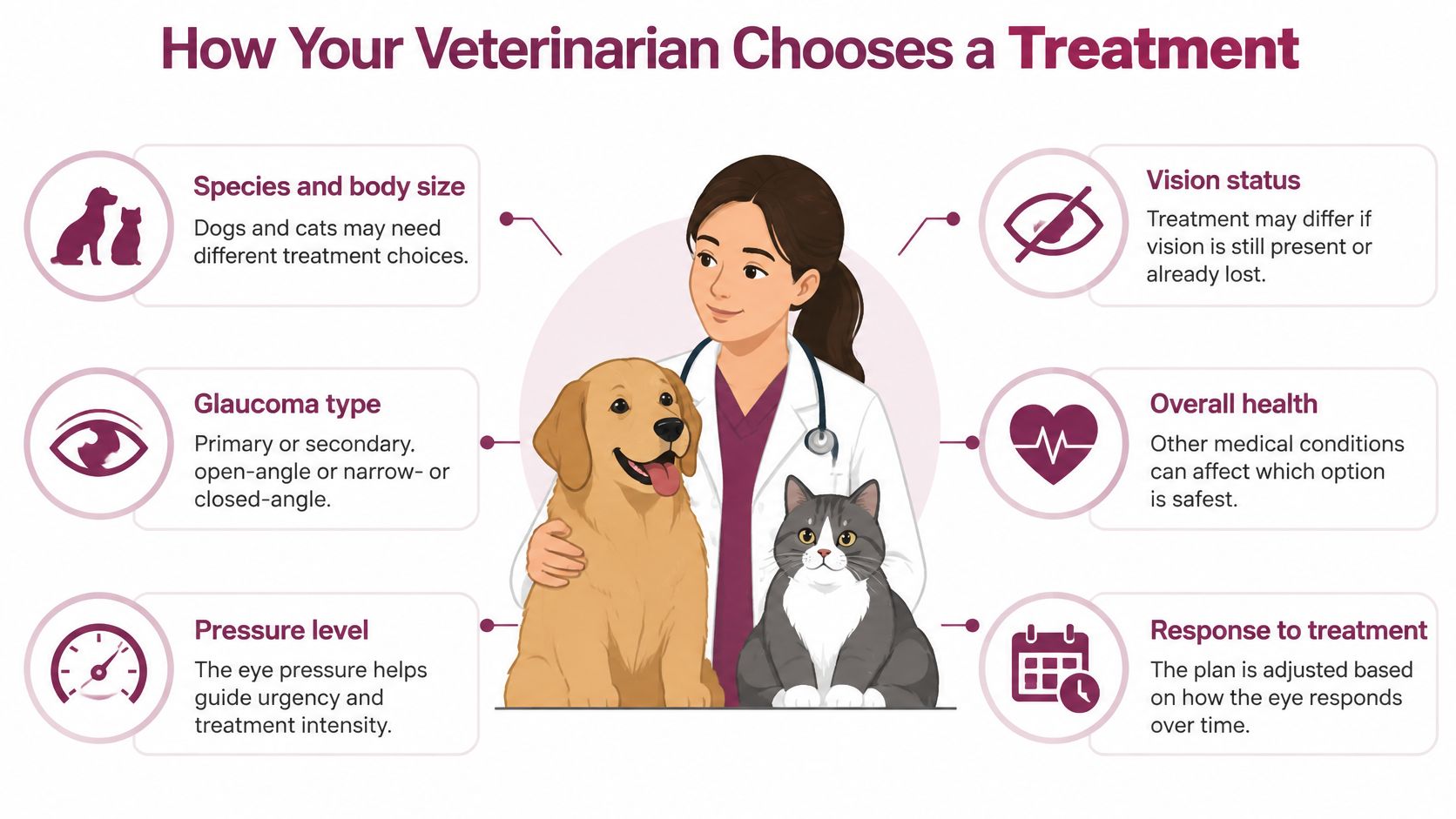
Species and body size come first, because cats and small patients don't tolerate the same drugs the way many dogs do. Glaucoma type is next. Primary disease starts in the eye's drainage tissues. Secondary disease follows something else, such as inflammation or a lens that has shifted. An open angle may respond to drops for longer. Narrow-angle and closed-angle disease often needs more than drops, because the drain itself is pinched shut.
Vision status splits the cases. An eye that still tracks a treat is managed to protect that sight. An eye that is already blind is managed for comfort. Current IOP sets the urgency. A moderately high reading on a calm recheck is not the same emergency as a rock-hard, painful eye. Pain matters even when the number looks improved, because a quiet pet can still be sore.
Lens position can rule a drug in or out before the first drop goes in. The underlying cause matters too. Pressure from uveitis isn't treated as if it were the same problem as primary angle closure. Your veterinarian also watches how fast the eye responds. If pressure stays high after appropriate medicine, waiting longer rarely helps the nerve.
Two practical limits sit beside the medicine. One is the medication burden your household can manage, day after day. The other is anesthesia risk if surgery is on the table, plus whether lifelong pressure checks are realistic.
Practical rule: The central question is often whether the goal is to save vision, control pain, or both. Prognosis leans heavily on early detection and on how that eye responds, so drops alone won't steady every case.
What to bring to the appointment
- Start time: When the cloudiness, squinting, or behavior change began.
- Prior readings: Any IOP numbers already taken, and which clinic took them.
- Current medicines: Every drop and pill, including the last time each was given.
- Home changes: Shifts in comfort, appetite, or how your pet moves through a familiar room.
Removal of a blind, painful eye is a separate welfare decision, covered with emergency care rather than mixed into this first sorting step.
Eye Drops and Oral Medicines Compared
Each class lowers pressure by a different route. Knowing the route helps you see why your veterinarian stacks some drugs and avoids others.
Prostaglandin analogs, such as latanoprost, help fluid leave through the uveoscleral pathway. That route is a meaningful exit in dogs, which is why these drops are a common canine option. Carbonic anhydrase inhibitors and beta-blockers do the opposite job. They reduce how much fluid the eye makes. Miotics constrict the pupil so fluid can move through the drainage angle more easily.
Carbonic anhydrase inhibitors are usually part of a combination, not the only bottle. One familiar pairing is dorzolamide 2% plus timolol 0.5%. A prostaglandin analog may be added when the eye still needs more pressure control. Timolol is a prescription beta-blocker used in open-angle and secondary glaucoma. It isn't a substitute you swap in because another drop ran out.
Urgent medicines stay with the clinic
Systemic carbonic anhydrase inhibitors and osmotic agents belong to more urgent or short-term care, under veterinary direction. They aren't a standing home kit. Which mix is used depends on how urgent the pressure is, the mechanism, lens position, whether vision remains, and the rest of your pet's health. Concentration, dosing interval, and any combination have to be set, then reassessed, by the prescribing veterinarian.
Don't stop, skip, double, or substitute a prescribed eye medicine on your own. A missed dose is a reason to call, not a reason to invent a catch-up schedule.
Call if you see new irritation, redness, squinting, or a change in comfort. Those signs can mean the drop isn't being tolerated, or that pressure is climbing again. A medicine that steadies one pet can't be assumed to suit the next, even in the same household.
Why Cat Glaucoma Treatment Differs From Dogs
A drop that steadies a dog's eye can be the wrong choice for a cat, even when the bottle looks familiar. The plan is still built from what the eye can still do: whether vision remains, how high the pressure is, how painful the eye feels, and where the lens sits. In cats, those answers usually point first to medicine, but the menu is narrower.
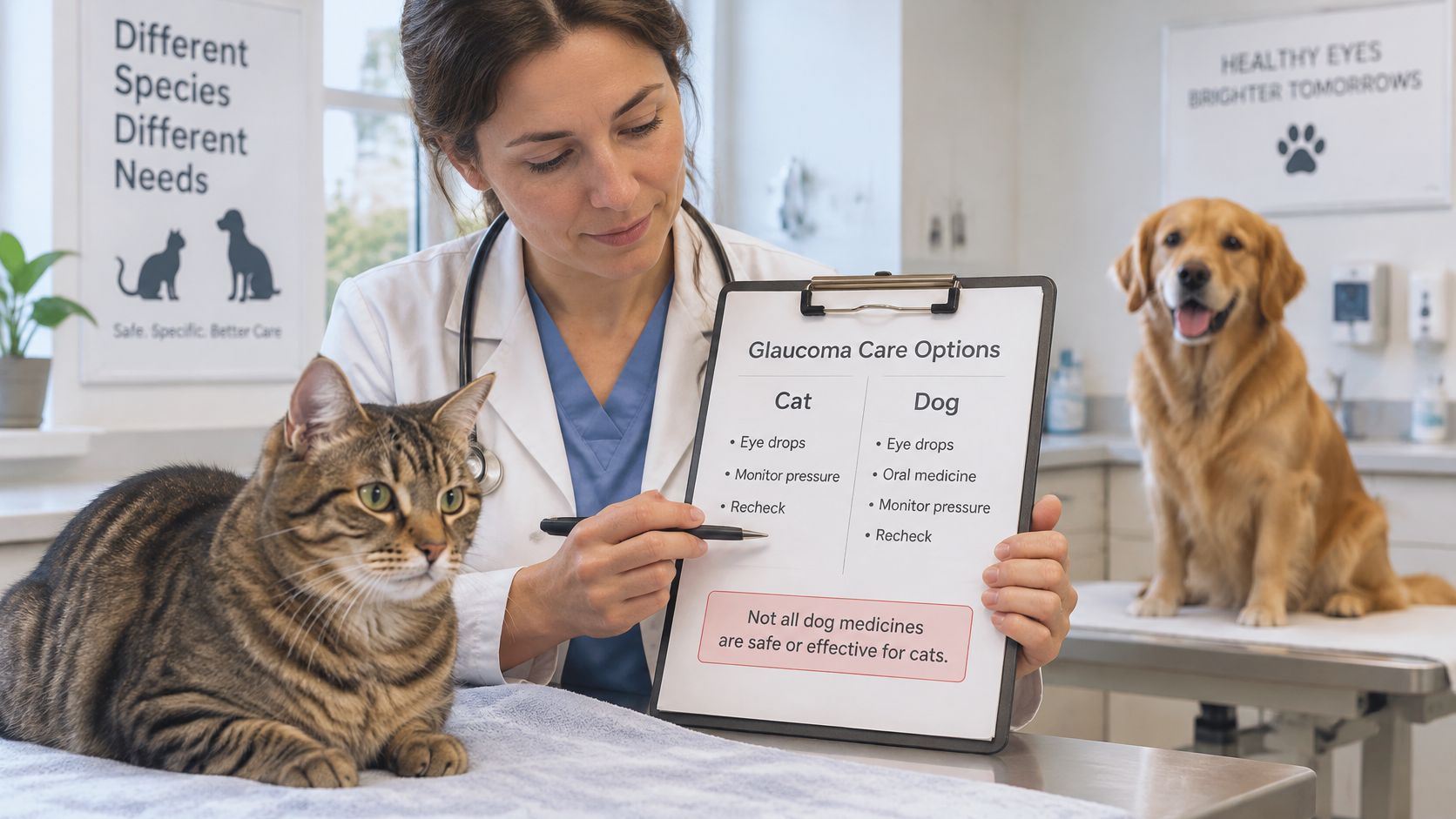
The reason starts with drainage. Aqueous humor has more than one way out, and the uveoscleral route works like a side door beside the main drain. About 15% of aqueous humor outflow in dogs travels the uveoscleral pathway, compared with about 3% in cats, as described in the Merck Veterinary Manual. Prostaglandin analogs lean on that side door. With so little feline outflow using it, they have limited, if any, benefit in cats and may cause ocular irritation or intraocular inflammation.
What usually goes in the feline plan
For many cats, the starting combination is a topical beta-blocker with a topical carbonic anhydrase inhibitor. Small cats need cautious beta-blocker use, and cats as a group are more sensitive to adverse effects than dogs, so follow-up has to be closer, not looser. If glaucoma is riding with anterior uveitis, a corticosteroid may be added for the inflammation. That addition serves the inflamed eye, not every cat with high pressure.
| Factor | Dogs | Cats |
|---|---|---|
| Uveoscleral outflow of aqueous humor | About 15% | About 3% |
| Prostaglandin analogs | Common medical option | Limited, if any, effectiveness; may cause irritation or intraocular inflammation |
| Usual medical mainstays | Several classes, including beta-blockers and carbonic anhydrase inhibitors | Topical beta-blockers and topical carbonic anhydrase inhibitors |
| Beta-blockers | Used as part of medical therapy | Use cautiously in small cats |
| Corticosteroids | Not the usual first glaucoma medicine | May be added when glaucoma is associated with anterior uveitis |
| Sensitivity to adverse effects | Lower than cats | Higher than dogs; monitor closely |
| Reported frequency | Reported more often than in cats | Reported less often than in dogs |
Before anything starts, the veterinarian reviews species, body size, concurrent illness, and the cause of the pressure. The feline version of that review is stricter because a useful dog drop may be weak, irritating, or unsafe in a cat. Never move a medicine from one pet to another, even for a single dose "until Monday."
Surgery and Laser Procedures and Their Results
When drops can't hold pressure in a sighted dog, procedures aim at the tissue that makes fluid or at a new way for fluid to leave. Endoscopic cyclophotocoagulation (ECP) treats the fluid-producing tissue from inside the eye. It is sometimes paired with lensectomy, removal of the lens. An Ahmed glaucoma valve is a drainage implant used in filtering surgery.
Surgery can preserve sight in some dogs. It doesn't promise permanent vision. Plan on continued ophthalmic monitoring, and often on medicine afterward. These figures come from dog studies. They shouldn't be applied to cats.
A study of dogs with primary glaucoma, summarized in this peer-reviewed surgical series, reported vision in 93% of eyes at 1 year after an Ahmed valve plus lensectomy-ECP, falling to 48% at 4 years. The same work found mean IOP reductions of 9.64 mmHg at 2 months and 9.71 mmHg at 6 months after lensectomy-ECP, with fewer glaucoma medicines at nearly every time point checked.
What the numbers mean for expectations
Success in these reports is usually sustained pressure control and comfort. It isn't lifelong sight, and it isn't freedom from every drop. Early referral may improve the chance of keeping vision, because the nerve has less time under high pressure. Repeat treatment and complications are part of an honest consent conversation, not a footnote.
| Procedure | Measure | Reported result |
|---|---|---|
| Ahmed valve plus lensectomy-ECP | Eyes with vision preserved | 93% at 1 year; 84% at 2 years; 60% at 3 years; 48% at 4 years |
| Lensectomy-ECP | Mean IOP reduction | 9.64 mmHg at 2 months; 9.71 mmHg at 6 months |
| ECP | IOP controlled | 90% of patients at 1 year; 95% at 2 years |
| ECP | Eyes with vision remaining | 63% at about 1 year; 49% at about 2 years |
| ECP | Repeat ECP needed | 15.4% of eyes |
| ECP | Median time to vision loss | 6.5 months |
| ECP | Corneal ulceration | 28% of eyes |
| ECP | Blinding hypotony | 11% of eyes |
| ECP | Retinal detachment | 11% of eyes |
| ECP | Hyphema | 10% of eyes |
More recent retrospective ECP data in that series found IOP controlled in most patients at 1 and 2 years, while vision remained in a smaller share of eyes. Corneal ulcers were the most common listed complication. Your dog's odds still depend on the eye in front of the surgeon, not on the average row.
Pros, Cons and Side Effects by Option
Every option trades pressure control against comfort, vision potential, species, lens position, and what your household can manage at home. The practical question is what the eye can still do and what it needs right now.
| Option | Pros | Cons and side effects |
|---|---|---|
| Prostaglandin analogs (latanoprost) | Common medical option in dogs | Limited effect in cats; may cause irritation or intraocular inflammation in cats; the veterinarian must confirm lens position first |
| Carbonic anhydrase inhibitors (dorzolamide, alone or with timolol) | Reduce fluid production; used in dogs and cats | Temporary stinging, burning, or eye irritation can occur after application; ask your veterinarian which effects matter for your pet |
| Beta-blockers (timolol) | Reduce fluid production; usual medical mainstay in cats | Use cautiously in small cats; cats are more sensitive to adverse effects |
| Miotics | Improve drainage through the angle | Constrict the pupil; not a standard feline mainstay |
| Mannitol given intravenously | Rapid pressure reduction in emergencies | Veterinary-directed only; reserved for acute care rather than routine home treatment |
| Oral glycerin | Emergency measure under veterinary direction | Not for dogs with diabetes mellitus; drug choice, dose, and timing belong to the veterinarian |
| Laser and endoscopic cyclophotocoagulation | Reduces fluid production when drops are not enough | Procedure risks and the need for continued care are weighed against pressure control |
| Ahmed glaucoma valve with lensectomy | Can preserve vision in some dogs | Does not guarantee permanent vision; ongoing monitoring continues |
| Enucleation | Relieves pain in a blind, painful eye | Permanent; discuss prosthesis options with your veterinarian |
These medicines fall into two broad groups. Some improve drainage through the eye's angle, while others reduce the amount of fluid being produced. That difference explains why a drop that helps one dog may be a poor choice for a cat, and why a sighted eye may receive different treatment from a blind and painful one.
Latanoprost's strong pupil constriction is a separate caution when lens position has not been confirmed. Inflammation is also a different problem from pressure. A separate anti-inflammatory, such as diclofenac sodium ophthalmic solution, treats surface soreness but does not lower eye pressure. Ask before any extra drop goes in, and never change, stop, or add a glaucoma medicine at home.
Emergency Care and Blind, Painful Eyes
Acute glaucoma in dogs needs urgent veterinary care aimed at lowering IOP quickly. Waiting overnight to "see if the cloudiness fades" can cost vision that was still present that morning.
Go promptly for sudden eye pain, redness, a cloudy or hazy cornea, a dilated pupil, squinting, or any abrupt change in vision. Nausea with a painful eye is also a reason to call the clinic or an emergency hospital, not to search for a leftover bottle.
What the veterinarian may use first
Short-term options described by the Merck Veterinary Manual include a topical prostaglandin analog such as latanoprost, systemic mannitol at 1 to 2 g/kg given intravenously, and topical or systemic carbonic anhydrase inhibitors. Before latanoprost, the veterinarian must judge lens position. Intense pupil constriction can trap an anteriorly luxated lens and push pressure higher.
Oral glycerin at 1 to 2 mL/kg may be prescribed as an emergency measure for an owner to give a dog. It should not be used in dogs with diabetes mellitus. None of these is a general home treatment. Drug, route, dose, and contraindications depend on the exam.
When comfort is the treatment
For an eye that is irreversibly blind and painful, or when intraocular neoplasia can't be excluded, surgery can be the most welfare-minded step. Options include cyclocryotherapy, an intrascleral prosthesis, and enucleation with or without an intraocular prosthesis.
Removing a blind, painful eye isn't a sign that treatment failed or that anyone gave up. It can be the choice that stops pain the drops can't reach.
A dry, irritated surface is a separate comfort issue. Artificial tears for cats don't lower glaucoma pressure and don't replace the emergency plan above.
Plan Monitoring and Next Steps With Your Veterinarian
Glaucoma is usually progressive. Many pets need checks for life, even after a good week on drops or a successful procedure. Each follow-up typically includes a pressure reading, an ophthalmic exam of the optic nerve and vision, and a review of whether the current medicines still hold pressure and comfort where they should.
One pressure reading works like a snapshot. Your veterinarian is watching the trend across visits, because a slow drift upward can matter more than a single acceptable number. That trend also keeps the plan tied to what the eye can still do: an eye that still sees is managed to protect vision, while an eye that has lost sight is managed for comfort.
Any medicine change, a missed dose, or a question about protecting the other eye calls for a pressure check and an exam first. Don't adjust the dose at home while you wait for that visit.
For the unaffected eye, prevention is individualized. A 2026 study of dogs with primary angle-closure glaucoma found no superior prophylactic regimen. Time to treatment failure didn't differ between topical carbonic anhydrase inhibitors and beta-blockers, and corticosteroid use showed no clear advantage. One preventive drop isn't automatically right for every breed or stage.
Ordered next steps
- Confirm the plan and the exact medicines with your veterinarian, including what to do if a dose is missed.
- Obtain a valid prescription. Prescription medicines ship only after veterinary authorization.
- Read the product page for prescription status, strength, and package size. If the medicine is used on a regular schedule, check the page for a subscription or scheduled-delivery option rather than assuming one exists for every item.
- Ask when the next pressure check should be. Put that date on the calendar before you leave.
Routine exams remain part of safe long-term care, including when you order through an online pharmacy. Our article on the importance of routine vet visits when using an online pharmacy explains how those visits and home delivery fit together.
Bandana Rx is a licensed U.S. veterinary pharmacy that can fill veterinarian-authorized glaucoma eye medicines, along with other prescription and over-the-counter pet health products, and ship them to eligible states. If your veterinarian has already chosen a pressure-lowering drop, you can review prescription options and refill paths with Bandana Rx. Bring any product question back to your veterinarian before you change what your pet receives.