


You pick up your pet's medication bottle and realize there's less left than you expected. You remember ordering it before, but you're not sure whether to contact the pharmacy, call your veterinarian, or place another order online.
Understanding how to get a prescription refill for your pet starts with one distinction: a refill is a veterinary authorization check, not just a repeat purchase. Your next step depends on whether the pharmacy already has a valid prescription with refills available, needs a transfer, or must obtain a new order from your veterinarian.
Table of Contents
- Choose Your Refill Route
- Reorder Your Pet's Prescription Step by Step
- Controlled Substance Refills and Federal Limits
- Refill Delays, Missed Doses and Cost Concerns
- Confirm Your Refill Before the Last Dose
Choose Your Refill Route
Start with the route that matches your situation: refills on file, phone assistance, a mailed original prescription, a pharmacy transfer, or a current prescription for a new customer. Choosing correctly helps you avoid submitting an order without the paperwork needed to dispense it.
If you've ordered from us before and still have refills available, you can use Refills on file at checkout. If you've never ordered from us or transferred a prescription to us, we don't have refills on file, even if another pharmacy has filled that medication.
Refill Routes and What Each One Requires
| Route | When it applies | What you need | Next step |
|---|---|---|---|
| Refills on file online | You've ordered before and refills remain | Remaining refills on your last label and a Bandana Rx account | Choose Refills on file at checkout |
| Phone refill | You have refills on file and want help | Your pet's details and medication information | Call 1 (888) 441-3856 |
| Mailed original prescription | Your clinic doesn't work with online pharmacies, or you prefer paper | Original written prescription for each prescription drug | Mail the prescription to Bandana Rx |
| Transfer from current pharmacy | You want to move an existing prescription | Your current pharmacy's pharmacist contacts our pharmacist | Ask your current pharmacy to make the call |
| New customer without refills | You've never ordered or transferred a prescription to us | A current prescription from your veterinarian | Provide the prescription through an accepted method for your order |
Transfers must be legally permissible. Ask the pharmacists to confirm whether your particular prescription can be transferred rather than assuming every medication qualifies.
Keep the Prescription With the Right Sender
We prefer to receive authorization directly from your veterinarian's office and can contact the clinic by fax or other means. We don't accept prescriptions customers send by fax or email. If your clinic doesn't work with online pharmacies, use the mailed-original method.
For clinic staff coordinating records, guidance on handling patient documents by fax provides document-handling context, but it doesn't change our prescription-submission requirements. Maintaining routine veterinary visits when using online pharmacies also helps keep prescribing decisions connected to your pet's ongoing care.
Reorder Your Pet's Prescription Step by Step
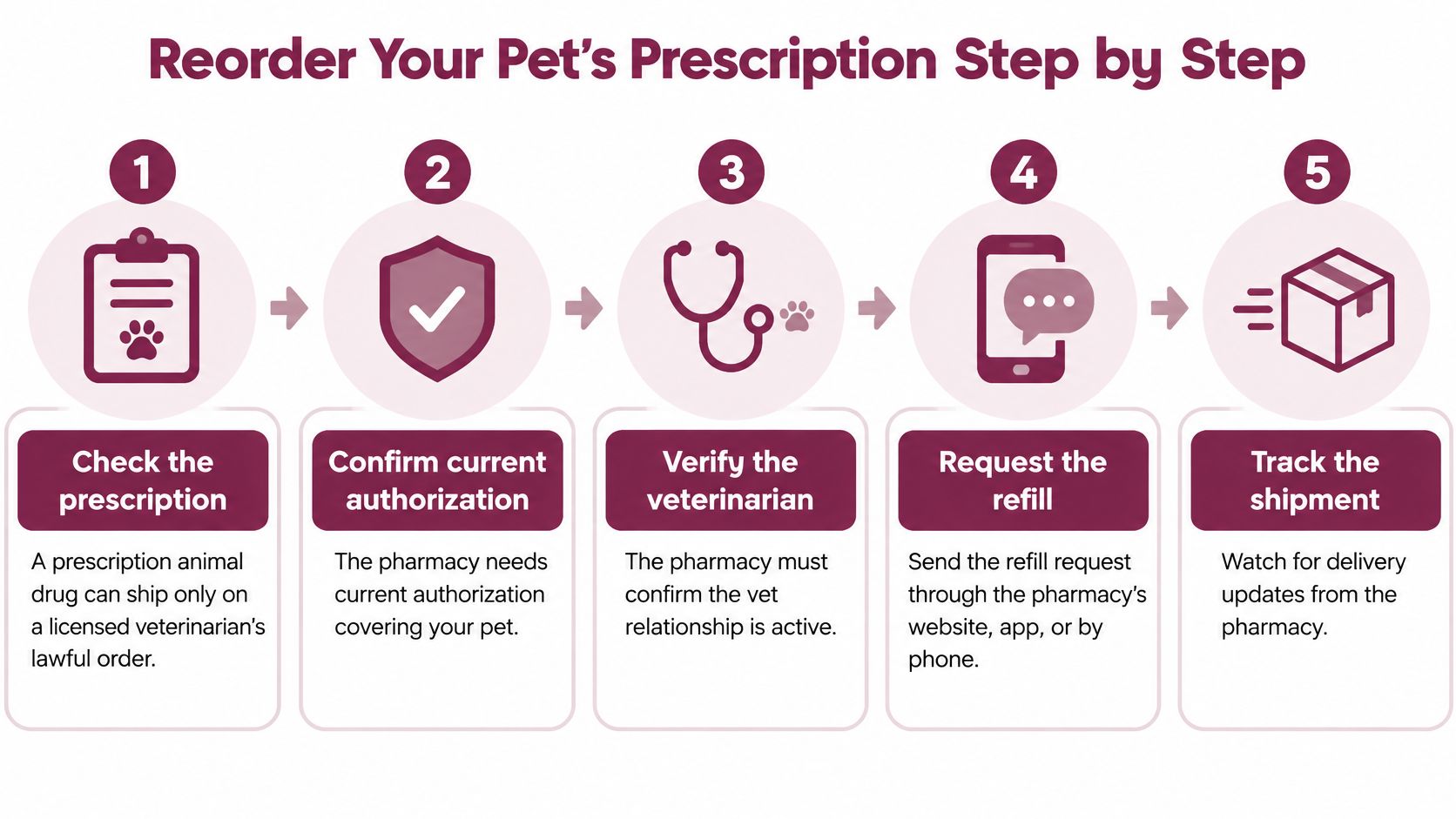
A prescription animal drug can be dispensed only by, or on the lawful order of, a licensed veterinarian acting within professional practice. The FDA's guidance on veterinary prescribing and veterinarian-client-patient relationships explains why the pharmacy needs current authorization for the animal and treatment involved.
For your order, that means matching your pet, medication, strength, directions, and authorized quantity or refills. Placing an order starts the request; it doesn't itself authorize the pharmacy to continue treatment.
Check the Label and Your Remaining Supply
Read the label from your last dispensed order. Available refills and the refill expiration date appear on that label. Check the medication name, strength, quantity, and directions, too. Our guide to reading pet medication labels, dosage instructions, warnings, and storage can help you identify those fields. The common slip is assuming that an old bottle proves the prescription is still valid. If the medicine is controlled, ask the pharmacist to confirm its schedule before proceeding.
Count what's left. Use the prescribed directions to calculate when your current supply will end, without changing the dose or frequency. Request the refill several business days before you run out, allowing time for veterinary review and delivery. Waiting until the last day leaves little opportunity to resolve a missing authorization or arrange an examination.
Practical rule: Tell the clinic when your current supply will end, not simply that you need a refill soon.
Submit a Complete Request
Sign in and select the appropriate refill option. A prescription-medication order requires an account. If you have eligible refills available with us, choose Refills on file while placing your order, or call for assistance. Don't choose that option merely because your pet has taken the medicine before.
Enter the details for each medication. At checkout, provide your shipping address, your pet's details, and your veterinarian's details for every prescription medication ordered. Review the entries before submitting. For example, if you have dogs with similar names, check that the request identifies the dog named on the prescription. Missing or mismatched information can prevent us from matching the order to the authorization.
Give us the clinic's current contact information. Confirm its phone or fax details and ask the clinic to send authorization directly. An outdated number can leave a request waiting at the wrong office. The veterinarian decides whether continued treatment is appropriate, consistent with the FDA's explanation of prescription animal-drug regulation.
An inactive veterinarian-client-patient relationship, often shortened to VCPR, can prevent approval. Ask whether your pet needs an examination, laboratory monitoring, or an updated weight before the veterinarian can authorize more medication. Don't assume a pharmacy request replaces that clinical review.
Follow Through Until Shipment Is Confirmed
- Monitor both authorization and shipment. Reply promptly if we request clarification, and check whether the order is awaiting your clinic, additional information, or dispatch. We'll make every effort to obtain timely authorization and keep you informed, but the veterinarian retains the prescribing decision.
If your order combines prescription and non-prescription items, the whole order waits until authorization is secured for every prescription medication. Prescription processing time begins when all required authorizations have arrived, not when you first place the order. That distinction helps explain why an order confirmation isn't the same as a shipment confirmation.
Controlled Substance Refills and Federal Limits
A Schedule II prescription cannot be refilled. When another supply is needed, your veterinarian must issue a new, legally valid prescription. Federal rules may permit multiple separate prescriptions totaling up to a 90-day supply, subject to specific conditions, including an earliest fill date for each prescription, as explained in the DEA's Federal Register discussion of controlled-substance prescriptions.
That arrangement isn't an automatic refill or permission to fill every prescription immediately. Ask your veterinarian whether it's legally and clinically appropriate for your pet.
Refill Limits by Drug Schedule
For Schedule III and IV medications, federal regulations permit no more than five refills within six months of the original issue date, according to the federal controlled-substance prescription regulations. A new prescription is needed when either limit is reached.
| Drug schedule | Refills allowed | Time limit | What to do |
|---|---|---|---|
| Schedule II | None; separate prescriptions may cover a combined supply under the federal conditions described above | No refill window | Ask your veterinarian for a new prescription before your supply ends |
| Schedule III and IV | Refills within the federal limits stated above | Measured from the original issue date | Request medication while authorization remains valid |
| Schedule V | As authorized under applicable federal and state requirements | Confirm the applicable prescription-validity period with your pharmacist | Have the pharmacist verify the limits for your prescription |
| Non-controlled prescription | According to your veterinarian's authorization | Applicable prescription-validity rules and authorization dates | Follow the label and your veterinarian's instructions |
Don't apply the Schedule III and IV limits to every controlled medicine. Schedule V requirements need their own check, including applicable state rules and the prescriber's authorization.
What the Pharmacy Must Verify
The DEA's overview for veterinarians describes requirements for controlled-substance prescribing, including a legitimate medical purpose, appropriate DEA registration, and the prescriber's required signature. Signing authority can't be delegated to clinic staff.
Before requesting the medication, have the bottle available and confirm:
- Drug classification: Ask your veterinarian or pharmacist which schedule applies.
- Prescription status: Check the issue date, authorized quantity, and remaining medication.
- Matching details: Verify your pet's identity, prescribed dosage, and prescriber information.
- Clinical follow-up: Ask whether monitoring or reassessment is needed before approval.
A pharmacy can request corrected information, but it can't replace a veterinarian's missing prescribing authorization.
Avoid waiting until the medication is depleted or expecting a pharmacist to extend an expired authorization. If the medicine requires close monitoring, ask the clinic about outstanding laboratory results before submitting the request.
State requirements can also affect dispensing and shipment. Review our prescription-state information when planning an order, especially if your delivery address has changed.
Refill Delays, Missed Doses and Cost Concerns
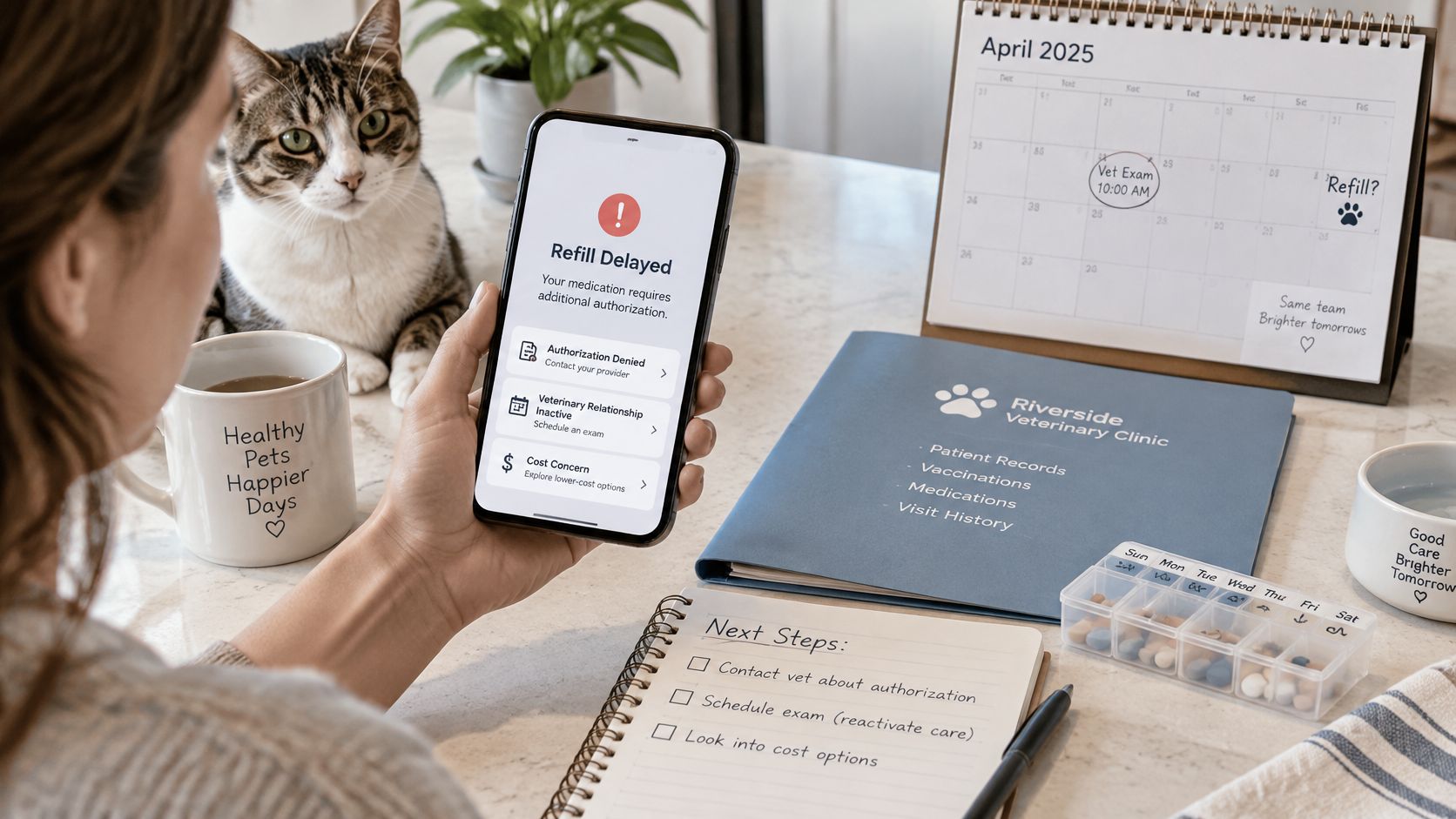
A delayed refill doesn't always mean the medication is unavailable. Ask what specifically is holding the order: denied authorization, an examination requirement, an expired prescription, missing information, or a shipment issue. We notify you promptly if your veterinarian denies an authorization request.
Each cause needs a different response. Correct an address with the pharmacy, discuss a clinical denial with your veterinarian, and ask the clinic what's needed to renew an expired order.
Address Cost Without Changing Treatment Yourself
If the refill is unaffordable, tell your veterinarian before the supply ends. Ask whether a suitable generic, a therapeutically appropriate alternative, a smaller supply, or clinic or manufacturer assistance might be available. These are questions for your veterinarian, not instructions to substitute medication yourself.
Check the full expense, including delivery, rather than the medication price alone. Our shipping policy helps you review delivery considerations before ordering.
Don't stretch doses, split a dosage form without approval, substitute human medication, or stop treatment without veterinary guidance. If a dose is missed, ask for instructions specific to your pet's medication rather than guessing about the next dose.
Report Health Changes Before Continuing
The FDA's pet pain-reliever guidance explains that veterinary NSAIDs for dogs and cats require a prescription and identifies potential adverse effects that warrant veterinary attention. Report vomiting, diarrhea, appetite changes, unusual thirst or urination, weakness, behavior changes, allergic signs, and other suspected reactions before requesting continued treatment.
Tell the veterinarian about other medicines and recent health changes, too. Seek immediate veterinary assistance for a possible overdose, severe reaction, or a pet that appears seriously ill, rather than waiting for routine refill processing.
When calling about a shortage, have clear answers ready: How many doses remain? What can your budget cover? What interruption, if any, does the veterinarian consider medically acceptable?
Confirm Your Refill Before the Last Dose
Before you put the bottle away, check whether your request has moved beyond being submitted. You want a clear answer about prescription status, clinic follow-through, and delivery details, not a receipt confirming that you placed an order.
We store refill information on file for all orders you place with us. That record supports future requests, but it doesn't mean an exhausted or expired authorization remains usable. Compare your current label and account information, and contact us if something doesn't match.
Make Your Final Check
- Authorization: Confirm that remaining refills are available or that your clinic is reviewing a request for a new prescription.
- Contact details: Make sure your shipping address, pet information, and veterinarian's details are current.
- Follow-up: Check for messages requiring a reply and confirm whether shipment has been arranged.
For ongoing treatment, consider whether your refill planning also needs to account for veterinary follow-up. For example, our thyroid hormone therapy overview provides condition-specific reading to support a conversation with your veterinarian. It isn't a reason to adjust your pet's treatment yourself.
Plan the Next Request Around the Current Prescription
If you reorder regularly, check the medication's product page for Buy Once or AutoShip options. Availability differs by product, and AutoShip may be convenient for a steady ordering schedule. A recurring purchase arrangement doesn't replace current veterinary authorization or any required monitoring.
The fastest way to place a medication order with us is through our website. We fill, dispense, and ship most prescription and non-prescription orders across all states and the District of Columbia, subject to applicable requirements.
Your action today is straightforward: check your remaining supply, confirm the authorization status, and submit a complete request with time for review and delivery. If your supply may end before the order arrives, call your veterinarian first for a medication-specific plan. Don't pause, stretch, or change prescribed doses while you wait.
Bandana Rx offers prescription verification, refill coordination, order tracking, and home delivery for eligible pet-medication orders. Visit Bandana Rx to request your pet's refill with your current label and clinic details ready, while keeping any treatment changes under your veterinarian's guidance.