



If the same drug always meant the same dose, a chart for an SMZ-TMP antibiotic for dogs would list one number. It doesn't. Veterinary references list different amounts and different lengths once the infection changes, and that gap is where copied instructions cause harm. A leftover tablet from a bladder infection is not a plan for a skin infection, and a figure from a textbook is not a dose for your dog.
This combination is a prescription antibacterial. Your veterinarian confirms the infection, picks the product, and writes the amount, the schedule, and the stop date. What follows is how the two ingredients work, why those reference ranges shift, when a culture changes the choice, and which signs should send you to the phone.
Table of Contents
- What SMZ-TMP Is and How It Works in Dogs
- Dosing Reference Ranges and Why Vets Adjust Them
- Common Uses in Dogs and When Culture Testing Matters
- Side Effects, Risk Patterns and Warning Signs
- Monitoring and Drug Interactions
- Get a Prescription and Confirm the Plan Before You Start
What SMZ-TMP Is and How It Works in Dogs
SMZ-TMP is short for sulfamethoxazole plus trimethoprim. Veterinarians may use this prescription antibacterial in dogs for certain bacterial infections when the bacteria are likely to respond to it. It is not a general bottle to keep for coughs, scrapes, or an upset stomach. A veterinarian has to confirm an infection before this drug is chosen. All medications we dispense are intended for veterinary use only.
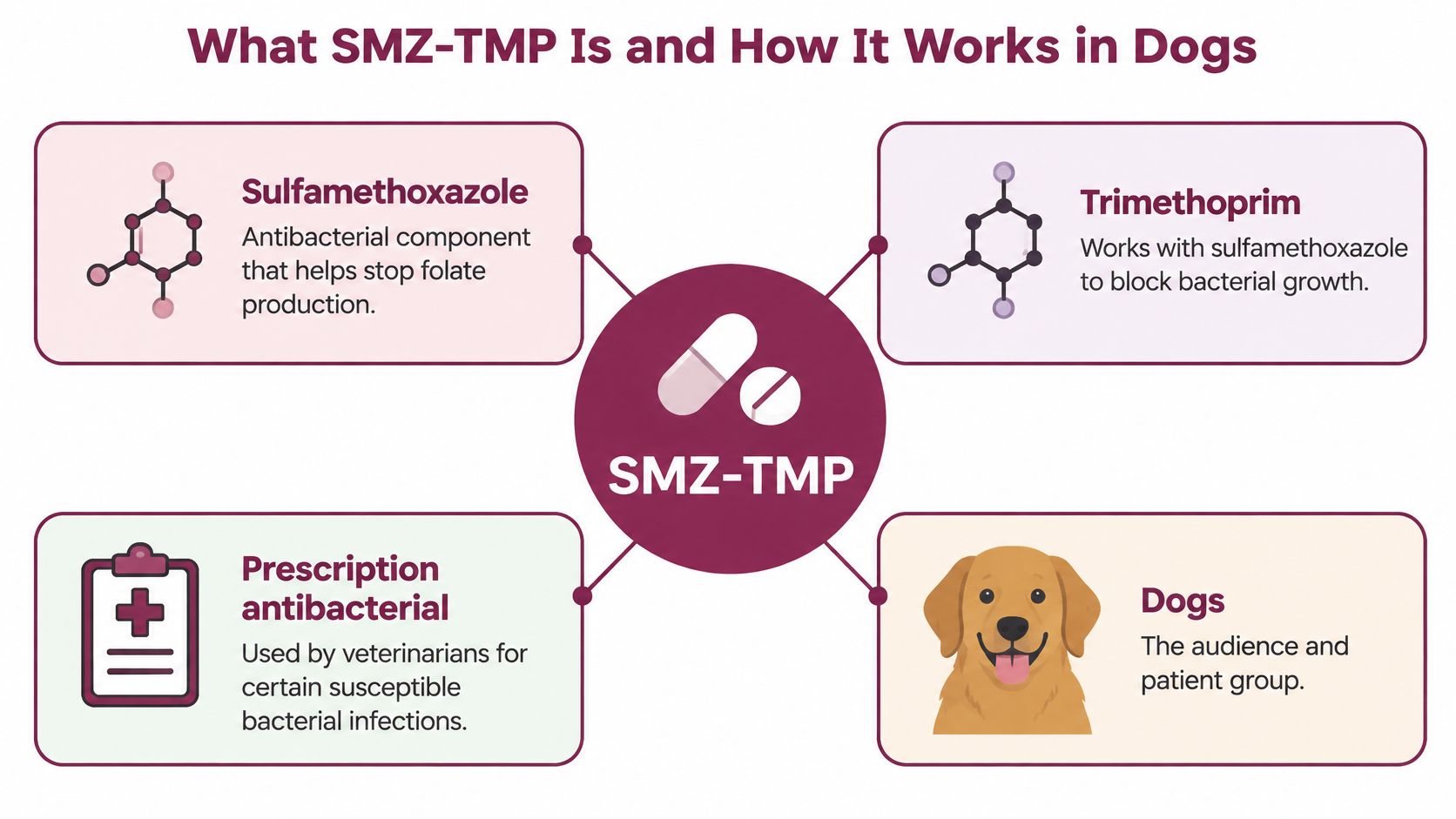
Picture folate production as a road bacteria must travel if they are going to multiply. The two ingredients close two gates on that same road.
Two gates, one pathway
The Merck Veterinary Manual table of potentiated sulfonamide dosages describes the pairing clearly. Sulfamethoxazole inhibits bacterial dihydropteroate synthase. Trimethoprim inhibits dihydrofolate reductase. Blocking those steps in sequence keeps the bacteria from making the folate they need. The combination is called potentiated because the two parts act more strongly together than either one alone. That sequential blockade can cover susceptible Gram-positive and Gram-negative organisms.
In dogs, this use is extra-label. Extra-label means the prescribing veterinarian sets the indication, the dose, the duration, and the monitoring plan. Formulation and the infection itself change which reference range even appears on a chart, so those ranges are not a dose you select at home. A deep, returning, or stubborn infection is a reason to ask about culture and susceptibility testing rather than reaching for a previous bottle.
Airway illness shows the same matching problem. Some cases are bacterial and some are not, which is why a look at antibiotics for respiratory infections in dogs still starts with a diagnosis.
Practical rule: SMZ-TMP is matched to a susceptible infection. It is not a stand-in for every sickness.
The mechanism is specific. That is why your veterinarian reserves it for infections it can treat, instead of using it for any day your dog seems off.
Dosing Reference Ranges and Why Vets Adjust Them
The table below is veterinary reference data. It is not a home dosing plan, and it is not permission to split, crush, or stretch tablets already in a cabinet.
Reference dosing ranges by condition in dogs
| Condition or reference | Dose (oral, per kg) | Frequency | Duration |
|---|---|---|---|
| General oral reference | 30 to 45 mg/kg | Every 12 hours | Set by veterinarian |
| Bacterial skin infection (staphylococcal) | 15 to 30 mg/kg | Every 12 hours | 14 to 42 days, based on infection and response |
| Sporadic bacterial cystitis (study dose) | 15 mg/kg | Every 12 hours | 3 days |
The Merck Veterinary Manual discussion of sulfonamides and sulfonamide combinations lists a general oral dosage of 30 to 45 mg/kg every 12 hours. That figure is for the combined medication, not for trimethoprim alone. Your veterinarian converts it into a product strength and a calculated amount for your dog's weight. Reading milligrams off the wrong half of the tablet is a common mix-up, which is one reason how to read pet medication labels matters before the first dose.
Skin infections sit in a different band. For canine staphylococcal skin infections, the Merck Veterinary Manual antistaphylococcal dosing table lists trimethoprim-sulfamethoxazole at 15 to 30 mg/kg orally every 12 hours for 14 to 42 days, with the length depending on the infection and the clinical response. Superficial infections are generally treated for 7 days beyond surface healing, commonly 3 to 4 weeks. Deep infections may need 7 to 21 days beyond resolution and can require 8 to 12 weeks when improvement continues. The same table notes gastrointestinal upset and orange discoloration of body fluids, along with blood-cell changes, and it reports that some dogs may develop fatal hepatotoxicity. For these treatments, liver-enzyme activity should be monitored at least every 2 weeks.
The third row is narrower still. It records a short course used in a comparison of uncomplicated bladder infection, not a dose for kidney infection, repeat infection, or skin disease.
Why the numbers move
Your veterinarian adjusts the written plan for the infection site, the likely organism, susceptibility results, kidney and liver function, hydration, and your dog's overall health. A deep, recurrent, or nonresponsive infection may need culture results before that plan is locked in.
A chart can show three honest answers for one drug. Only the plan written for your dog is the dose you give.
Common Uses in Dogs and When Culture Testing Matters
A urinalysis report and a skin swab can point toward the same drug for two very different infections. The uses below follow the infection in front of the veterinarian, not a nickname on the bottle, and they do not share one timetable.

Sporadic bacterial cystitis
For a single, uncomplicated bladder infection, the Merck Veterinary Manual chapter on bacterial cystitis in small animals reports that treatment durations of 3 to 5 days are currently recommended. It identifies trimethoprim-sulfonamide as one reasonable empirical choice in many areas. The same chapter cites a study in which trimethoprim-sulfamethoxazole at 15 mg/kg orally every 12 hours for 3 days was noninferior to cephalexin at 20 mg/kg every 12 hours for 10 days.
That comparison applies to dogs with sporadic bacterial cystitis. It should not be stretched to complicated, recurrent, kidney-associated, or nonbacterial urinary disease. Straining, blood in the urine, or a dog who is also drinking heavily still needs an exam, not a shorter course borrowed from that study. Background on a kidney or urinary tract infection can help you describe what you are seeing, while the regimen stays with your veterinarian.
Bacterial skin infections
Surface healing is not the same as a finished course. Superficial infections are generally carried past the day the skin looks calm, and deep infections are carried further past resolution when improvement is still underway. The stop date follows how the skin responds. It is not a fixed number you can copy from a previous bottle.
When the infection returns
A first bladder infection and one that comes back after treatment call for different plans. The second usually needs a fresh culture before a drug is selected. A dog with a history of resistant organisms, or one whose infection is deep and not responding, is the clearest candidate for culture and susceptibility testing. Those results tell your veterinarian whether this combination still fits.
Read across a reference table and the same drug turns up under several conditions with different durations. That is exactly why the written plan outranks the numbers. If a longer antimicrobial course is prescribed, your veterinarian decides when urine cultures are rechecked during treatment and after the final dose, and that schedule belongs in the plan you take home.
Side Effects, Risk Patterns and Warning Signs
Important reactions can show up even when the prescribed dose is correct. They are uncommon in the pooled evidence, and uncommon is not the same as impossible for your dog.
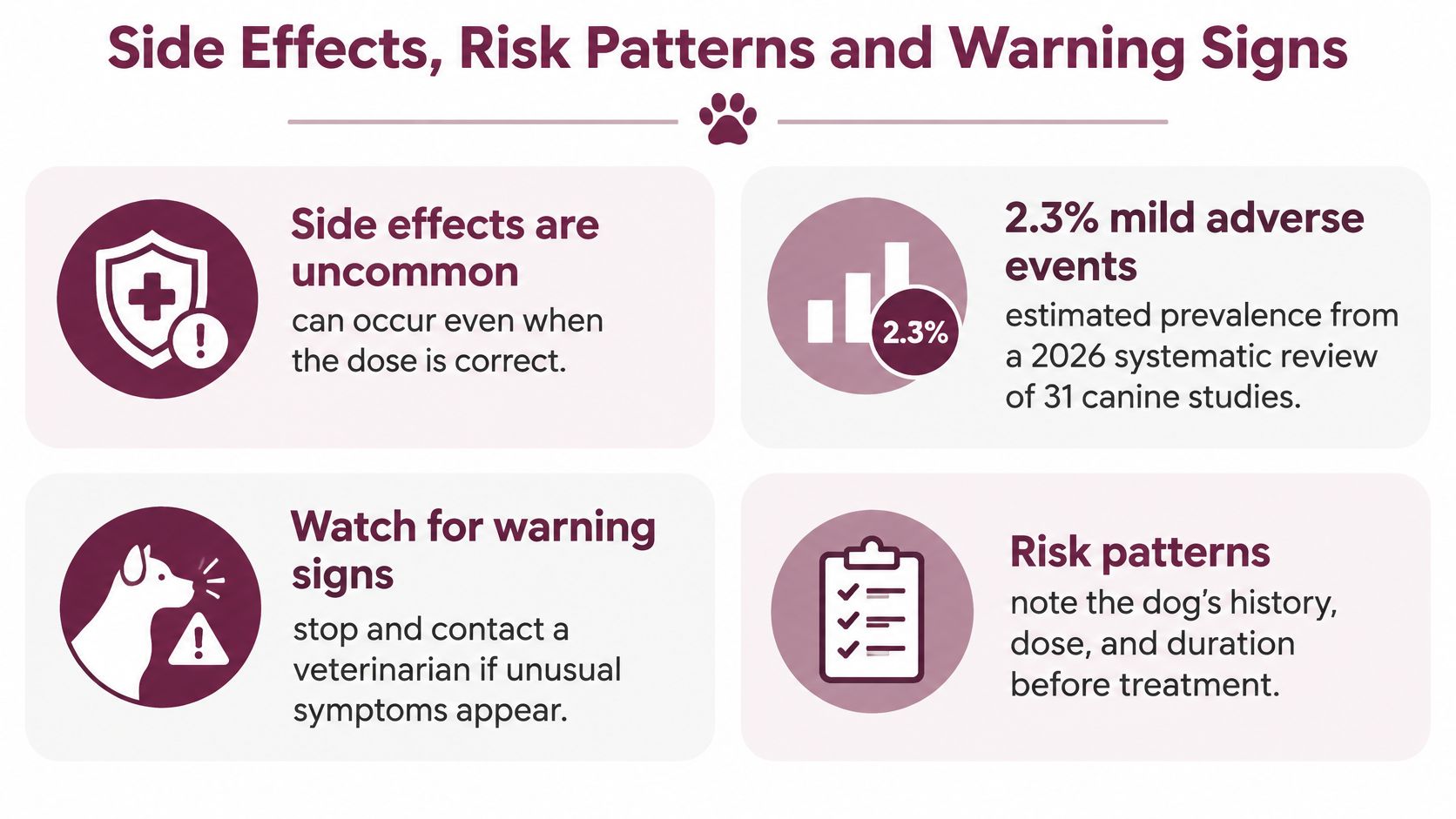
A 2026 systematic review of trimethoprim-sulfonamide adverse events in dogs estimated prevalence across 31 canine studies at 2.3% for mild adverse events and 0.2% for severe adverse events. Those are population estimates, not a forecast for one patient. Adverse events appeared more often when therapy continued beyond 7 days, and severe reactions generally began later than mild ones. The review's closer look at severe cases involved the eyes, joints, liver, and blood, including keratoconjunctivitis sicca (dry eye), immune-mediated polyarthritis, hepatic necrosis, and hematologic disorders. Doberman Pinschers were overrepresented in reports of polyarthritis.
What owners usually notice first
Digestive upset is the sign most owners spot early. Vomiting, diarrhea, and a dropped appetite still deserve a call, even though they are the more familiar effects. If stools stay soft, keep notes on meals and ask your veterinarian before you add anything new. Questions about dog gut health come up often during antibiotic courses, and any supplement belongs on the list you share with the clinic.
VCA Animal Hospitals guidance on sulfamethoxazole-trimethoprim also flags reactions that should not wait. New eye discharge or squinting may indicate drug-associated dry eye and needs prompt evaluation. Yellow mucous membranes, marked weakness, fever, facial swelling, painful movement, or bloody or straining urination are urgent warning signs. An immune-mediated syndrome commonly begins around 8 to 20 days after therapy starts, though severe hypersensitivity can appear anywhere from days to weeks and can be more likely after a previous exposure.
Warning signs and what to do
| Sign | What it may point to | What to do |
|---|---|---|
| Vomiting, diarrhea, or reduced appetite | Common digestive side effects | Call your veterinarian for guidance |
| New eye discharge or squinting | Possible drug-associated dry eye | Contact your veterinarian promptly for evaluation |
| Yellow gums or whites of the eyes | Possible liver involvement | Seek urgent veterinary care |
| Fever, facial swelling, or painful movement | Possible immune-mediated reaction such as polyarthritis | Seek urgent veterinary care |
| Bloody or straining urination | Possible urinary concern such as crystals or obstruction | Seek urgent veterinary care |
| Marked weakness | Possible serious reaction | Seek urgent veterinary care |
Keep a simple log: start date, dose, each new sign, and the day it began. Bring that page to the visit.
Dogs with a prior sulfonamide reaction, immune-mediated disease, liver dysfunction, blood abnormalities, or poor hydration may need a different antibiotic or closer lab checks. Do not extend the course, stop it on your own, or reuse leftover tablets without veterinary direction.
Monitoring and Drug Interactions
Lab checks exist so a problem can be caught while the course is still underway. On a longer prescription, your veterinarian may schedule bloodwork that includes liver-enzyme activity. For a urinary infection that needs more than a few days, a culture during treatment and another after the last dose are common checkpoints. The calendar for those tests belongs in the written plan, not in a guess from the internet.
Interaction risk depends on the specific medicines involved. There is no safe shortcut that lets an owner decide which combinations are fine. Build one complete list before the appointment.
What to bring to the veterinarian
- Every product your dog receives: Write down prescriptions, over-the-counter medicines, supplements, and flavored treats that contain active ingredients.
- Any past sulfonamide reaction: Note the drug name, what happened, and how many days into treatment it started.
- Known medical history: Include liver, kidney, blood, or immune conditions, plus any trouble keeping water down.
- The questions that set the safety net: Ask which signs mean a same-day call, and ask which lab checks are planned and when they will happen.
Inadequate hydration should be on that list too. A dog who will not drink, or who is losing fluid through vomiting, needs that fact reported before more tablets are given. When risk is higher, the veterinarian may choose a different antibiotic or order closer laboratory monitoring. That decision is not one to make by comparing labels at home.
Routine exams are where this history stays current. Why routine vet visits still matter is worth reading if most of your refills now start online, because the pharmacy still depends on the clinic's picture of your dog.
Get a Prescription and Confirm the Plan Before You Start
SMZ-TMP is a prescription medicine. The first step is a visit or a call with your veterinarian, not an order placed from memory.

From the first call to the first dose
Your veterinarian confirms the diagnosis and decides whether culture testing is needed. Then ask four questions before anyone fills the prescription.
- Product strength: Which tablet or liquid will be used, and how many milligrams are in each unit?
- Calculated dose: What is the dose in milligrams for your dog's current weight, and how many units is that per dose?
- Course length: How many days should you give it, and what should you do if the signs fade early?
- Monitoring: Which checks are planned, including liver tests or urine cultures, and on which dates?
Prescription medications are dispensed only after we receive authorization from your pet's veterinarian. We can contact the veterinarian's office by fax and/or other means to seek that authorization before dispensing, and we prefer the clinic's authorization directly. To provide appropriate care, we ask for your pet's medical conditions, weight, breed, and age so the order matches the plan. If a refill is coming due, how to get a prescription refill walks through what the clinic and the pharmacy each need.
Do not change the dose, stop early, extend the course, or reuse leftover tablets without veterinary direction. If the signs worsen, or a warning sign from the table above appears, call the clinic before the next dose rather than adjusting it yourself.
Bandana Rx is a licensed pet pharmacy that dispenses veterinary medications after your veterinarian authorizes the prescription. If your dog has been prescribed an antibiotic, we can work with the clinic on that authorization and ask for the medical details that keep the order aligned with the written plan. Visit Bandana Rx to view available veterinary options for your pet.