



81% of U.S. pet owners consider flea and tick treatment essential, yet 71% don't use prevention consistently. The central problem usually isn't awareness, it's making parasite control fit reliably into everyday life.
That gap matters because a missed application, an overlooked refill, or a product used incorrectly can interrupt an otherwise sensible prevention plan. A 2025 survey of 4,072 pet owners and 582 veterinarians across 15 countries found that 56% of owners still considered administration difficult, while 46% of dog owners and 51% of cat owners had forgotten a dose during the previous year. The same survey found that 74% of veterinarians were concerned about inconsistent or missed dosing. These findings support a practical conclusion: confidence doesn't guarantee compliance, and a good flea and tick plan must account for routines, travel, reminders, and real household constraints. (Merck Animal Health survey findings)
Table of Contents
- Why Flea and Tick Prevention Falls Short Despite High Awareness
- Understanding Flea and Tick Biology and Disease Risk
- How Different Prevention Products Work and What to Expect
- Choosing the Right Prevention Strategy for Your Pet
- Creating a Year-Round Prevention and Home Care Routine
- Challenging Seasonal Mindsets in an Era of Expanding Risk
Why Flea and Tick Prevention Falls Short Despite High Awareness
A pet parent can understand the risks and still miss prevention. Consider a household with a dog whose monthly medication is kept in a cabinet. The owner remembers it most months, but a holiday, an unexpected veterinary visit, or a change in work schedule shifts the routine. By the time the next reminder appears, the intended application may already be late.
That isn't carelessness in the usual sense. It is a predictable failure of a system that depends on memory. Owners may also feel confident because they know how to administer a product, while the actual task remains inconvenient, difficult to schedule, or easy to overlook in a multi-pet home.
Confidence isn't the same as consistency
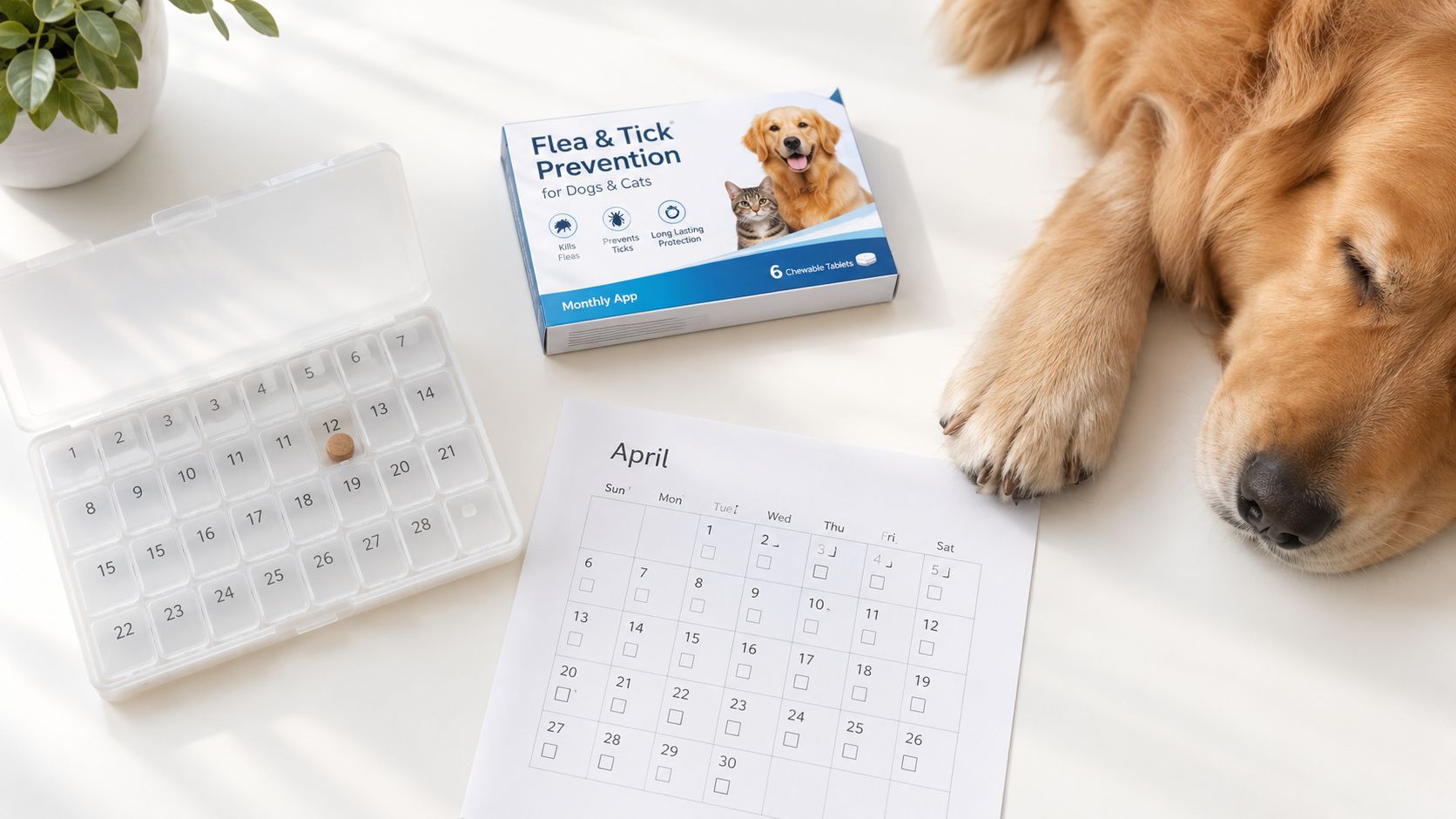
The survey's contrast between confidence and difficulty is important. A person may know which product the veterinarian selected, understand the label, and still struggle to administer it on schedule. Forgetting a dose can also happen when several pets have different products or when a household changes address, travels, or takes in a new animal.
A more dependable system attaches prevention to something that already happens, such as a calendar review, a recurring pet-care task, or a scheduled pharmacy reorder. Write down the date, pet, product, and next due date. For multiple animals, record each pet separately rather than relying on a single household reminder.
Practical rule: Choose a prevention routine your household can repeat accurately, not merely a product that looks convenient at the time of purchase.
Product comparisons can help, but they shouldn't replace a discussion of administration habits, especially when an owner is unsure whether an over-the-counter option fits the pet's needs. This guide to the effectiveness of over-the-counter flea products can help frame that conversation, while the final selection should follow veterinary advice and the product label.
The biology of fleas and ticks makes follow-through more than an administrative detail. Parasites feed, attach, reproduce, and expose pets to risk on their own schedule. Understanding those mechanisms explains why prevention needs to be continuous and why finding a parasite doesn't always mean a product has failed.
Understanding Flea and Tick Biology and Disease Risk
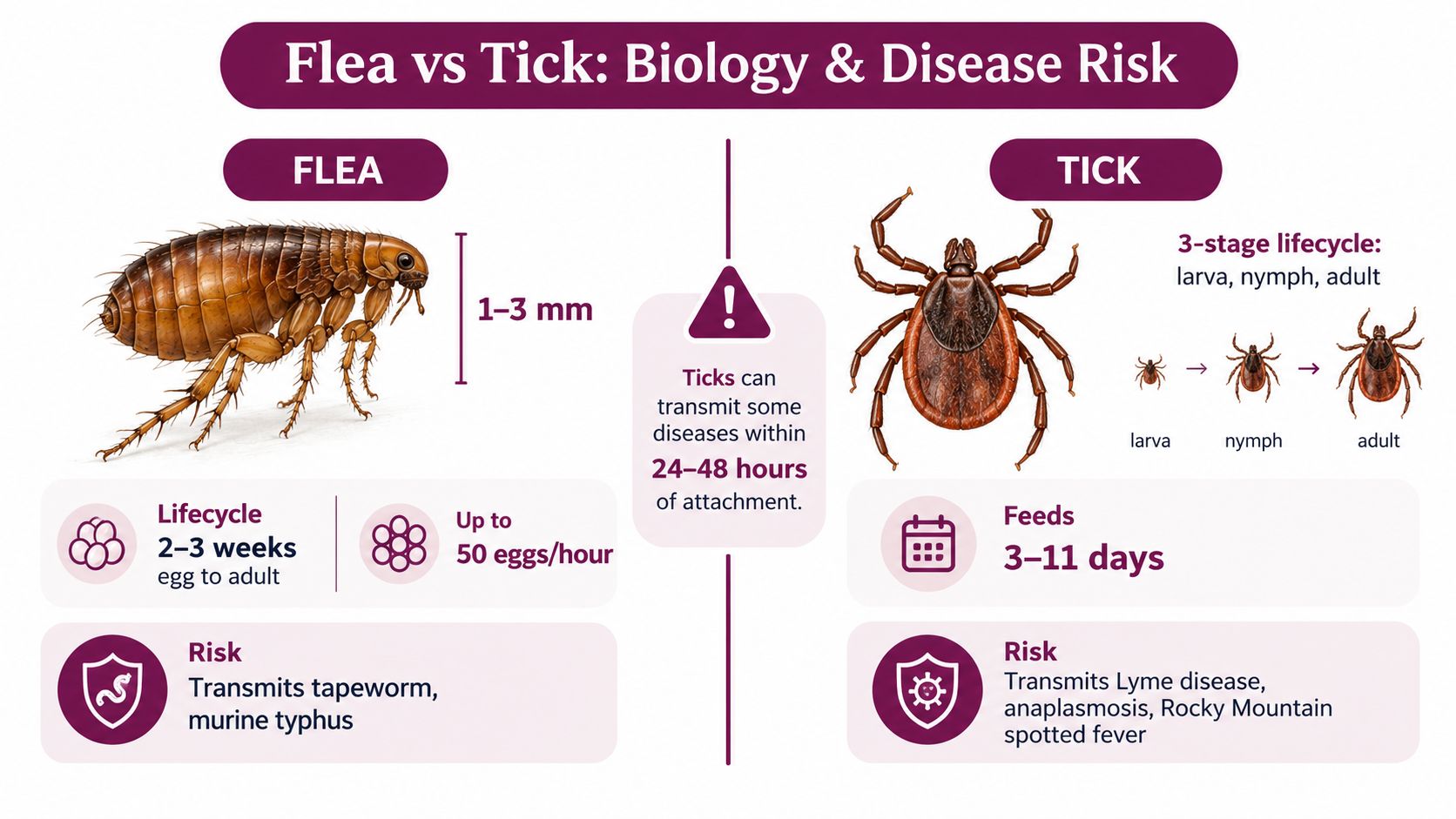
Fleas and ticks are different parasites, so they create different prevention challenges. Fleas are small, mobile insects that live through multiple life stages, while ticks are external parasites that attach to a host and take a blood meal. A flea problem can involve the pet and the home environment, whereas a tick problem also depends heavily on attachment and feeding time.
Historical records illustrate how widespread flea biology is. Researchers have identified roughly 2,000 flea species worldwide, with nearly 20 species that attack humans in the United States. Scientific knowledge expanded from 15 identified species by 1850 to about 1,500 cataloged species by 1950, and nearly 2,500 varieties with binomial names by 2003. Fleas also became important to public health after researchers recognized their role in transmitting bubonic plague in the late nineteenth century. (Historical flea records)
Ticks present a different public-health concern. The CDC has estimated about 476,000 Lyme disease cases each year, while more than 89,000 cases were reported in 2023. A federal review found that annual reportable tick-borne disease cases increased by 75% from 2011 to 2022, rising from 40,795 to 71,346. Ticks transmit more than 75% of vector-borne disease cases reported each year to the U.S. CDC, and Lyme disease accounts for more than 80% of tick-borne illnesses nationwide. (Yale summary of federal tick-borne disease data)
Why attachment time matters
A tick doesn't transmit every pathogen at the same speed. Several bacterial agents, including Ehrlichia, Anaplasma, and Rickettsia, generally require about 3 to 24 hours of attachment before effective transmission. Some viral agents can transmit faster, with evidence indicating transmission within 24 hours and possibly during the first hour of feeding for certain tick-borne viruses. (Review of tick-borne pathogen transmission)
| Pathogen type | Examples | Minimum attachment time | Transmission risk |
|---|---|---|---|
| Bacterial agents | Ehrlichia, Anaplasma, Rickettsia | About 3 to 24 hours | Risk can rise as feeding continues |
| Viral agents | Certain tick-borne viruses | Within 24 hours, possibly within the first hour for some viruses | Some agents may transmit rapidly |
This is why checking your dog after outdoor activity and removing an attached tick promptly are sensible parts of prevention. It also explains why product mechanics matter. A product that prevents attachment addresses a different part of the risk pathway than one that kills a parasite after it reaches the pet.
Fleas can cause intense itching and may contribute to skin problems, but persistent scratching isn't automatically proof of a flea infestation. Owners looking into flea-related hair loss in dogs should ask a veterinarian to assess other possible causes as well.
How Different Prevention Products Work and What to Expect
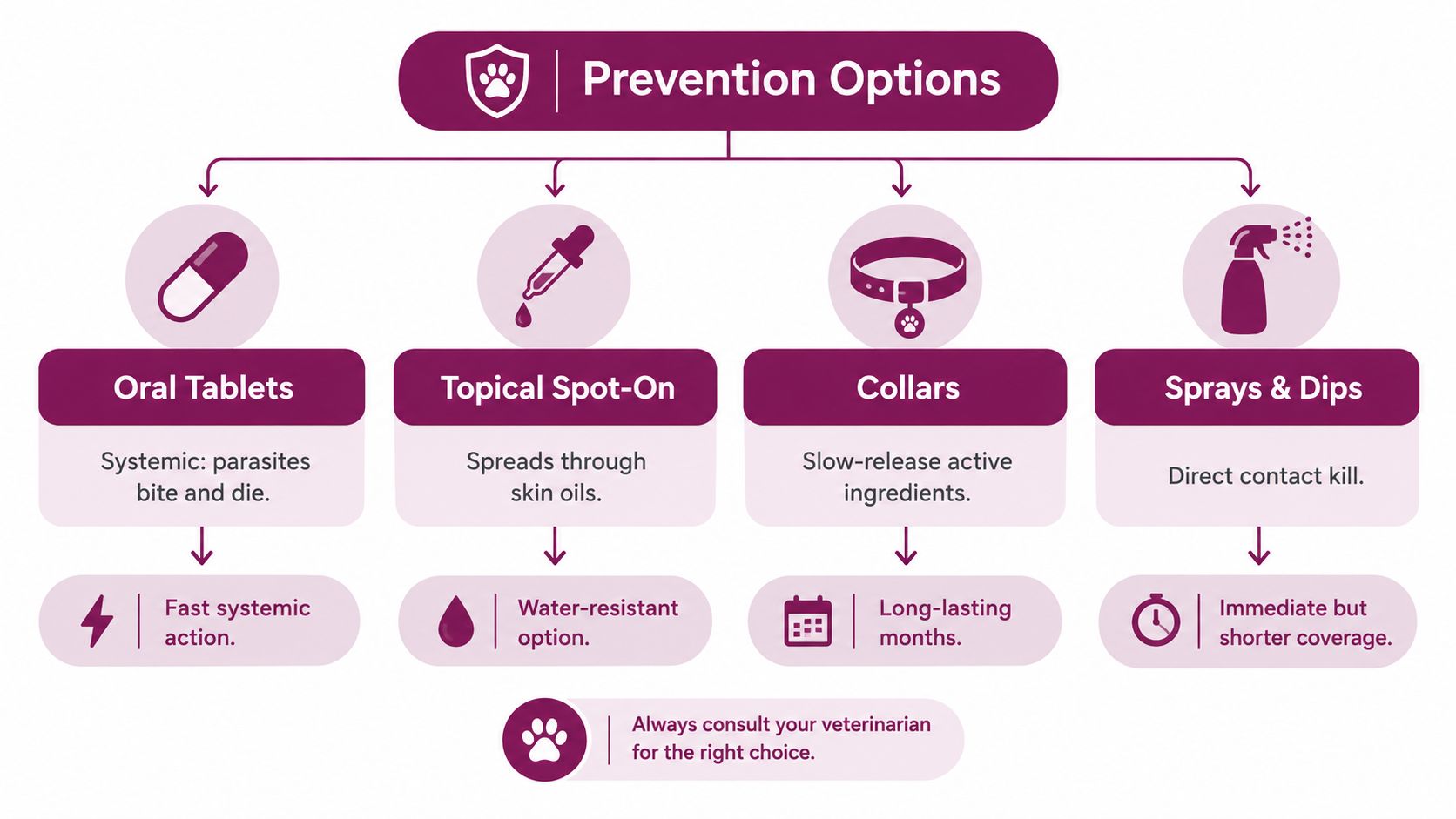
Flea and tick products don't all work in the same way. Some are designed to act through the pet's system after administration, some spread across the skin, and some collars release active ingredients over time. The right category depends on the animal's species, age or life stage, weight, health status, lifestyle, and the parasites a veterinarian wants to target.
The most important distinction is attachment prevention versus kill after contact. Collars with true repellent activity and some permethrin-containing topical products can help prevent ticks from attaching. Fipronil-based products don't repel ticks or stop attachment, so a tick may still be seen crawling on a treated animal even when the product continues to kill after contact.
That observation can confuse owners. Finding a tick doesn't automatically prove that a non-repellent product failed, because the product may be intended to shorten the parasite's survival after contact rather than prevent the initial encounter. However, a product that blocks attachment reduces the opportunity for a pathogen to be delivered at the bite site.
The route of administration changes oversight
Federal regulation also differs by product type. The FDA oversees products given orally, including pills, chews, swallowable liquids, and injectable products. The EPA regulates some topical products as pesticides. The division, which has been used since the mid-1970s, depends in part on whether a topical product is absorbed systemically or remains on the skin. (FDA explanation of flea and tick product reporting)
That regulatory distinction doesn't tell you which product your pet should receive, but it explains why labels, approval information, and adverse-event reporting pathways can differ. It also reinforces the value of reading the actual label instead of assuming that every flea and tick product has identical instructions.
A collar, oral preventive, topical treatment, spray, or dip may have a different target, duration, application method, and safety restriction. Ask the veterinarian what the product is intended to do, whether it repels or kills after contact, and what you should expect to see during routine checks.
For a closer look at one frequently misunderstood category, review this explanation of how flea and tick collars work. The goal isn't to identify one universally superior format. It's to match the mechanism to the pet and the household's ability to use it correctly.
Choosing the Right Prevention Strategy for Your Pet
The right prevention plan starts with the pet, not the package. Use a flea and tick product only for the animal species and size or weight specified on its label. FDA guidance also requires matching the product to the pet's species, life stage, and weight class. A treatment made for one animal should never be shared with another because they live together.
Use a safety-first selection process
Give your veterinarian a clear picture of the pet and its exposure:
- Identify the animal. Dogs and cats may have different safety requirements, so products are not automatically interchangeable.
- Confirm the weight class. Weigh the pet when necessary and select the label's stated range instead of estimating.
- Note life stage and health status. Puppies, kittens, older pets, pregnant animals, and pets with medical conditions may need individualized guidance.
- Describe exposure. Include outdoor activity, travel, contact with other animals, shelter or rescue settings, and any parasites already found.
- Review the complete label. Follow the listed species, weight, application method, frequency, storage instructions, and warnings exactly.
The EPA guidance on controlling fleas and ticks recommends discussing the appropriate application type with a veterinarian and following the label carefully, since a collar, oral preventive, topical treatment, spray, or dip may differ in its target, duration, application method, and restrictions.
A product choice also has to fit the household's routine. Missed doses, incorrect weight ranges, or applying a product to the wrong species can create gaps that look like product failure. Ask whether the product repels parasites, kills them after contact, or works after they bite, then clarify what you should expect to see during regular checks.
Safety check: Never assume that a product safe for one pet is safe for another, even when the animals share a home.
Timing needs a clear default. FDA guidance notes that starting treatment at the beginning of flea season can help prevent infestation, but CDC guidance supports treating pets for fleas year-round because adult fleas can survive indoors through winter. For most households, year-round prevention is the safer default, confirmed with your veterinarian and followed according to the label. (FDA guidance on safe flea and tick product use)
Year-round treatment does not mean every pet should receive the same medication continuously. The schedule should reflect the product label, the pet's health, local exposure, and veterinary advice. Prescription preventives require authorization, and an online pharmacy can process them only after receiving that authorization.
Owners can review this flea and tick prevention category before discussing suitable options with their veterinary team. Do not start, stop, combine, or change a prescription preventive without professional guidance.
Creating a Year-Round Prevention and Home Care Routine
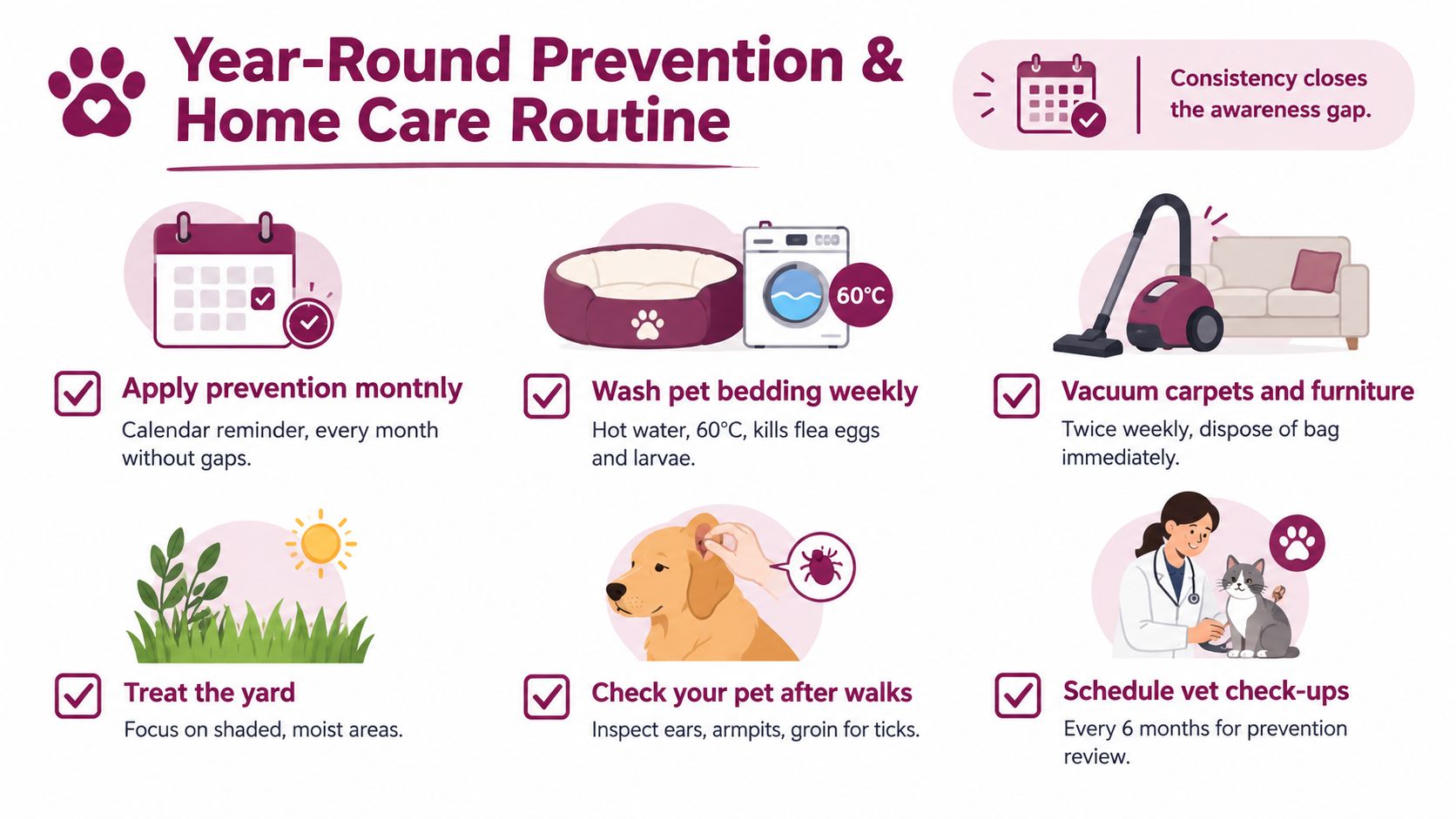
A dependable routine works on two connected fronts: the pet and the home. Fleas develop through several life stages, so treating only the animal may leave eggs and immature stages in bedding, carpets, furniture, and other resting areas. Cleaning alone has the opposite limitation. It can reduce environmental contamination, but it does not replace veterinary-guided prevention for the pet.
Start with one written record for every animal. Note the product, application or administration date, next due date, and the pet receiving it. Separate entries matter in multi-pet homes, where a cat's treatment can easily be confused with a dog's. During travel, carry the product information and set reminders for the actual due date, not for the day you return.
Build around the moments that cause missed doses
Longer-duration options can reduce the number of dosing decisions a household must remember. In the 2025 survey, 65% of veterinarians said they would likely recommend an annual medication option, and 75% of pet owners said they would likely try one. (U.S. flea and tick survey fact sheet)
A longer interval does not guarantee correct use. It may, however, suit a household that often misses monthly tasks. Ask your veterinarian whether the format fits your pet's health, the parasites in your area, and the exposure your pet faces. Follow the label and record each dose or administration.
Flea control also requires attention to the environment. The EPA identifies vacuuming every day as the best method for initial control because it removes flea eggs, larvae, and adults. Dispose of collected material properly, clean resting areas according to their care instructions, and seek advice from a veterinarian or pest-control professional if the infestation continues.
Outdoor spaces may need review, especially shaded or protected areas where pets spend time. If you need broader information about yard management, you can find flea and tick solutions for your property at this yard-control guide, then confirm that any approach is appropriate for your animals and follow every product direction.
After outdoor exposure, check the coat, ears, armpits, and groin for ticks or other signs of parasites. Grooming and cleaning can also help reduce exposure to irritants. For additional context on reducing dog allergies, use the guide alongside veterinary assessment, especially when itching or skin irritation persists. A written routine turns prevention into a series of manageable checks rather than a response to every new infestation.
Challenging Seasonal Mindsets in an Era of Expanding Risk
“Flea season” sounds like a fixed calendar period, but parasite exposure doesn't follow a universal date. Indoor pets can encounter parasites through household contact, other animals, travel, or visits to places where pets gather. Outdoor conditions also vary by location, and warmer temperatures are linked with the geographic spread of fleas and ticks.
Survey materials from 2025 found that many owners still treat prevention as seasonal. In U.S. data, 24% of dog owners and 39% of cat owners reportedly used sprays only during flea and tick season, a pattern that leaves the prevention plan dependent on a narrow interpretation of risk. (U.S. flea and tick survey fact sheet)
The better question is not “When does flea season start?” Ask instead how the plan should respond to changing circumstances:
- Climate and location: Discuss local exposure with your veterinarian rather than relying on a calendar from another region.
- Indoor lifestyles: Remember that indoor living reduces some exposure opportunities but doesn't eliminate them.
- Travel and relocation: Reassess prevention before entering a new area or spending time around unfamiliar animals.
- Shelter and rescue contact: Pets entering a household may need a veterinary evaluation and a coordinated parasite-control plan.
- Household practicality: Select a delivery format that you can administer accurately and on schedule.
Year-round prevention is widely recommended for ongoing flea control, but the exact product and schedule should remain individualized. Monthly, quarterly, and longer-duration options each create different adherence demands, so the most suitable choice is the one that fits the pet's health needs and the owner's ability to follow the instructions.
Prevention works best when it is treated as a continuing care routine, not a seasonal reaction to seeing the first parasite.
Bandana Rx provides prescription and over-the-counter flea and tick preventives for companion animals, with prescription orders processed after veterinary authorization. Visit Bandana Rx to review available pet-care options and coordinate ongoing prevention with your veterinarian.