

The most popular advice about dog anti itch powder is also the easiest to misunderstand: dust it on the irritated area and the problem is solved. Itching is a symptom, not a diagnosis. A powder may reduce surface moisture, friction, or temporary discomfort, but it can't determine whether your dog has fleas, mites, an infection, food allergy, environmental allergy, or another cause that needs specific treatment.
That distinction matters because a drier-looking coat doesn't necessarily mean healthier skin. Use a powder, if appropriate, as a narrow form of supportive comfort care. First decide whether home care is reasonable, then read the label, apply the product cautiously, and watch for signs that your dog needs veterinary assessment.
Table of Contents
- Why an Anti-Itch Powder Is Not a Cure
- What Causes Dog Itching in the First Place
- Common Active Ingredients in Anti-Itch Powders
- How to Apply Dog Anti-Itch Powder Safely
- Where Powders Fit Among OTC and Prescription Options
- Cats Versus Dogs and Label-Based Safety
- Red Flags That Mean Stop and Call the Vet
Why an Anti-Itch Powder Is Not a Cure
Dog anti itch powder treats what you can see or feel, not necessarily what caused it. The visible problem may be scratching, licking, redness, flaking, or moisture between skin folds. Those signs can come from very different conditions, and each one may require a different response.
A drying powder might be useful on a small area of clean, dry, intact skin where moisture or friction is contributing to minor irritation. It won't eliminate a flea infestation, clear a bacterial or yeast infection, treat mites, identify a food trigger, or control allergic inflammation. Even a product marketed as natural or soothing shouldn't be assumed to be diagnostically neutral.
Veterinary guidance treats canine pruritus as a problem that calls for identifying the underlying trigger, while topical therapy and antipruritic medication may be considered as part of care. The role of topical medication for itchy skin is therefore supportive and situation-dependent, not automatically curative.
Practical rule: If the itch is persistent, widespread, recurrent, moist, painful, or causing self-trauma, don't use a powder to postpone an examination.
A sensible decision starts with three questions:
- Is the affected area limited? A small, localized patch is different from itching across the body.
- Is the skin intact and dry? Powder is not a substitute for evaluating open, oozing, hot, or severely inflamed lesions.
- Is your dog otherwise well? Vomiting, facial swelling, weakness, breathing difficulty, or marked discomfort changes the situation.
The safest mindset is simple. A powder may help your dog feel more comfortable while you monitor a minor irritation or follow a veterinarian's plan. It should never be used to prove that an underlying disease has gone away.
What Causes Dog Itching in the First Place
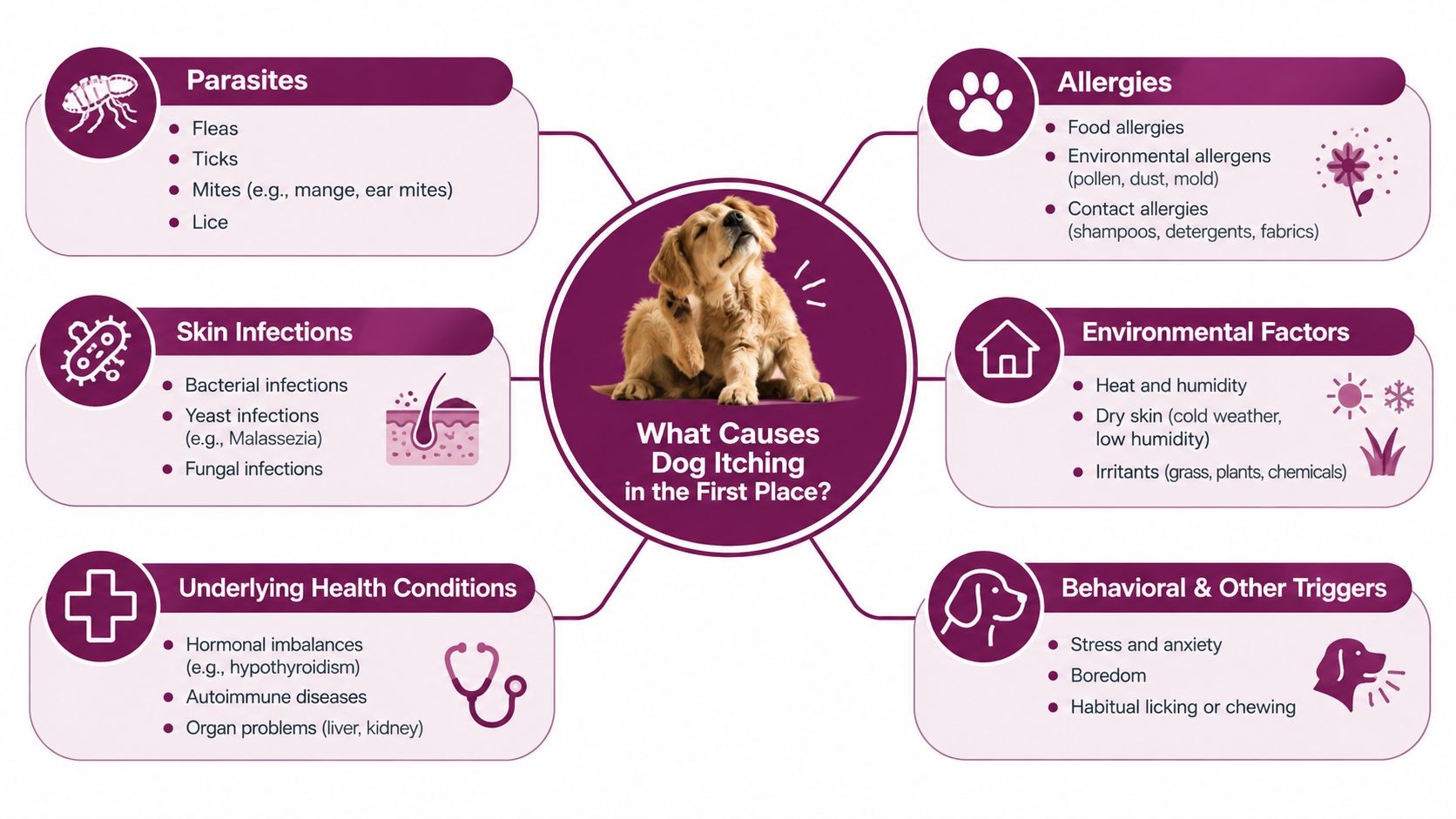
Veterinarians use the word pruritus for itching. It describes a clinical sign rather than a single illness, which is why two dogs that scratch in similar ways may need entirely different treatment.
Common possibilities include:
- Parasites: Fleas, ticks, Demodex mites, contagious mites, and lice should be considered and excluded when appropriate. Flea-bite hypersensitivity can produce intense itching even when you don't see a flea.
- Infections: Bacterial or yeast overgrowth may develop after scratching damages the skin barrier. Odor, discharge, pustules, moisture, or worsening redness increase concern.
- Food allergy: The Merck Veterinary Manual summarizes a literature review in which food allergy affected approximately 1–2% of dogs receiving veterinary care, 0–24% of dogs with dermatitis, and 9–40% of dogs presenting with pruritus (Merck Veterinary Manual).
- Atopic dermatitis: A chronic or recurrent allergic skin condition associated with barrier dysfunction and abnormal immune responses. A 2024 peer-reviewed review estimated worldwide prevalence at 3–15% and reported atopic or allergic dermatitis and atopy in 4.7% of dogs in a study of 31,484 dogs examined at 52 U.S. veterinary practices (peer-reviewed atopic dermatitis review).
Atopic dermatitis also has recognizable but overlapping patterns. The distal limbs were involved in 62–81% of affected dogs, the face in 27–57%, and the underside of the body in 39–66%, according to the review linked above. Those locations may explain why owners look for localized products for paws, folds, or areas exposed to friction, but location alone can't establish the diagnosis.
A veterinarian may ask about seasonality, parasite prevention, itch distribution, previous treatments, and environmental exposure. Depending on the case, the workup can include flea combing, skin scrapings, skin cytology, and ear cytology. Owners looking for general background on checking for dog skin irritation relief should still treat educational material as a starting point, not as a replacement for that evaluation.
For practical home triage, a powder is most defensible when irritation is minor, localized, dry, and limited to an area your dog can't easily lick. Persistent or recurring itch needs a cause-focused plan. Guidance on whether fleas can cause hair loss in dogs can help owners recognize one important possibility, but it can't rule out other explanations.
Common Active Ingredients in Anti-Itch Powders
A label tells you more than the front of the container. Start by identifying the active ingredient, intended species, target condition or pest, application site, warnings, and directions. A product called an anti-itch powder may be a drying grooming product, a medicated topical, or a pesticide dust. Those categories aren't interchangeable.
Drying and soothing ingredients
Some powders are designed primarily to absorb surface moisture. Starch-based carriers and other absorbent materials may reduce dampness or friction in a limited area. That can feel helpful around a dry, minor irritation, but excessive drying may worsen scaling when the skin barrier is already compromised.
Colloidal oatmeal is more commonly associated with soothing topical products than with pesticide dusts. Zinc oxide may appear in human topical preparations, but it deserves special caution around dogs. The MSD Veterinary Manual's guidance on toxicosis from human topical agents notes that acute ingestion of zinc oxide can cause gastric irritation, vomiting, and diarrhea within approximately 2–4 hours. Repeated licking over days to weeks has also been associated with potentially serious zinc toxicosis, including hemolysis.
Antimicrobial and antifungal ingredients
A powder containing an antimicrobial or antifungal ingredient is not automatically appropriate for every red or itchy patch. Infection should be evaluated in context, and the product's label must support use on dogs and on the specific site.
For example, ketoconazole is an antifungal medication used in veterinary care, but an owner shouldn't apply a product just because a dog is itchy. Review the ketoconazole product information available through Bandana Rx, and follow veterinary direction for species, formulation, site, and frequency.
Pesticide ingredients
Flea-and-tick dusts are regulated in the United States by either the EPA or FDA, depending on the product and its intended use. The FDA explains that EPA generally regulates products applied topically to a pet's skin or fur, including shampoos, collars, dusts or powders, sprays, and spot-on products (FDA flea and tick product reporting guidance).
That means the product label is the authority. Don't infer safety from the words “dog-safe,” a plant-based description, or a familiar ingredient. Check the exact active ingredient and every restriction before use.
How to Apply Dog Anti-Itch Powder Safely
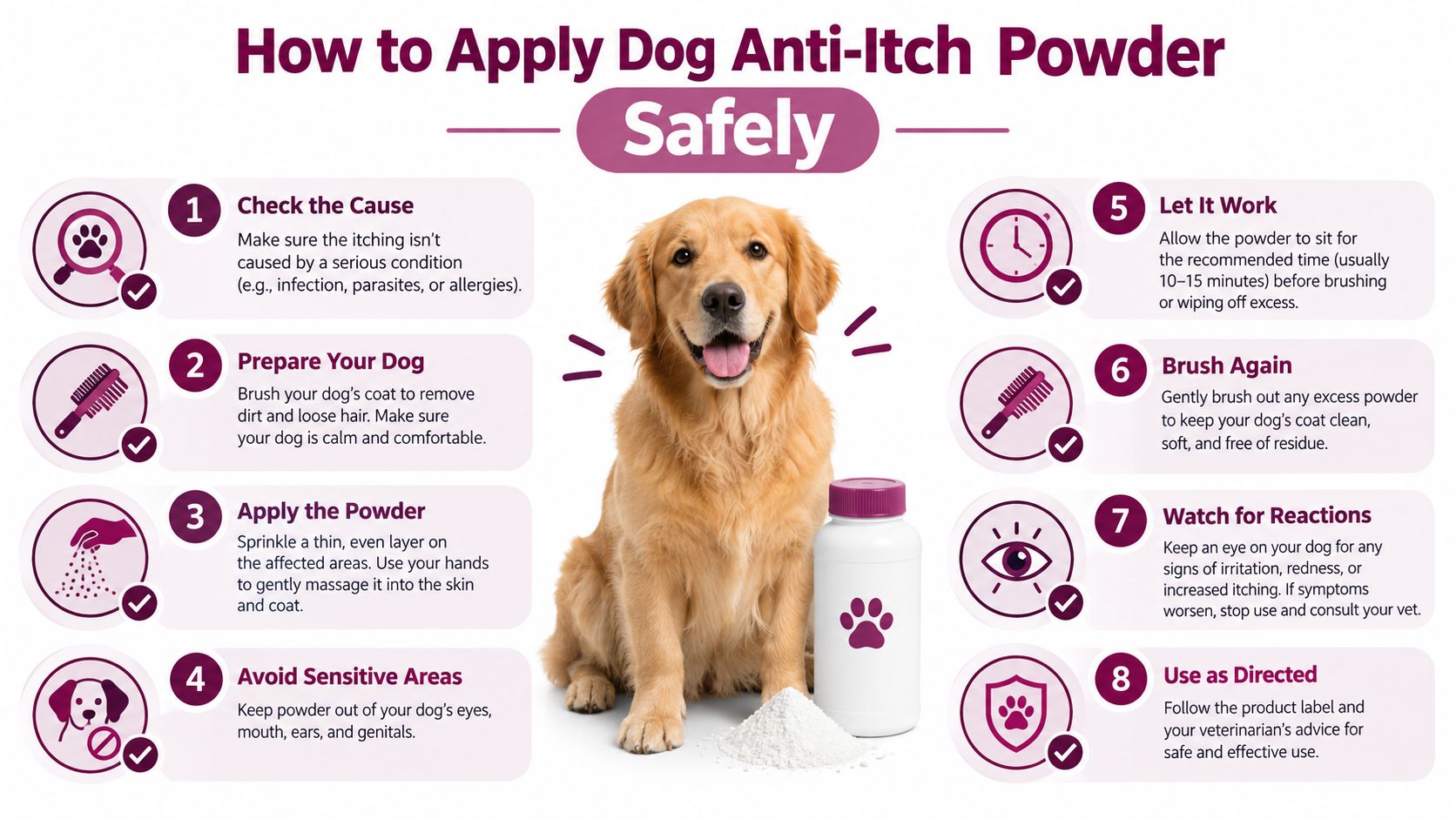
Application should be controlled, light, and limited to the site named on the label. Before opening the container, examine the skin in good light. If the area is wet, open, bleeding, markedly swollen, painful, or producing discharge, pause and seek veterinary advice instead of covering it with powder.
A careful application routine
- Read the entire label first. Confirm the species, weight or size range, age requirements, active ingredient, frequency, and permitted application sites. The guide to reading pet medication labels can help you interpret directions and warnings without guessing.
- Clean and dry the area as directed. Don't apply over dirt, trapped moisture, or product buildup. A clumped coat can hold moisture against the skin.
- Part the coat gently. Expose the skin rather than shaking a cloud over the entire dog. Use only the amount stated on the product label.
- Keep sensitive areas clear. Avoid the eyes, nose, mouth, genital openings, ear canals, open wounds, heavily inflamed lesions, and moist folds unless a veterinarian specifically directs otherwise.
- Limit airborne dust. Apply in a well-ventilated area and avoid creating particles your dog or household members could inhale.
- Prevent licking. Supervise your dog after application and use the label-approved approach to prevent oral exposure until the product has settled.
- Wash your hands. Keep the container closed and stored as directed, away from pets and children.
- Recheck the skin. Stop if redness, swelling, coughing, vomiting, facial changes, or worsening itch develops.
Don't use reduced scratching as proof that the underlying condition is resolved. A powder can make the surface feel drier while the trigger continues underneath.
Take a photograph before application, then record the location, appearance, itch intensity, and timing relative to use. Note seasonality, outdoor exposure, parasite prevention, and any new food or household product. That record gives your veterinarian useful history instead of relying on memory during a stressful appointment.
Where Powders Fit Among OTC and Prescription Options
A powder occupies a narrow place in canine skin care. It may provide temporary surface comfort for a minor, localized irritation, while other treatments address infection, parasites, allergic inflammation, or a damaged skin barrier.
| Option | Main Role | Best For | Limits |
|---|---|---|---|
| Anti-itch powder | Reducing surface moisture or localized discomfort | Small, dry, intact areas when the label permits use | Doesn't diagnose or resolve fleas, mites, infection, ear disease, or allergy |
| Antibacterial or anti-yeast shampoo | Cleansing the coat and delivering topical treatment across selected areas | Cases where a veterinarian identifies a suitable topical approach | Requires the correct active ingredients, contact instructions, and rinsing |
| Prescription antipruritic | Reducing allergic itch and inflammation under veterinary supervision | Chronic or significant allergic skin disease when prescribed | Isn't appropriate to start, stop, combine, or adjust without veterinary direction |
| Allergen-specific immunotherapy | Addressing selected allergic triggers over a longer-term plan | Dogs assessed as candidates for allergy-focused management | Requires veterinary evaluation and doesn't replace infection or parasite control |
The Merck Veterinary Manual lists parasites, infections, and allergic skin diseases among common causes of pruritus and emphasizes excluding parasitic causes such as fleas, ticks, mites, and lice (Merck dermatological problems in animals). For selected dermatologic cases, it describes a topical antimicrobial shampoo containing 2% chlorhexidine and 2% miconazole that may be used every 24–48 hours, but that isn't a blanket recommendation for every itchy dog or for powders.
Canine atopic dermatitis often requires multimodal care. That may include allergen avoidance, bathing, infection management, prescription antipruritics, and allergen-specific immunotherapy. A powder can sit beside those measures only when it has a defined, limited role.
Prescription treatment also needs a veterinarian's diagnosis and authorization. Never substitute a powder for a prescribed therapy or change a prescribed schedule because the skin looks temporarily calmer.
Cats Versus Dogs and Label-Based Safety
A powder made for dogs isn't automatically suitable for cats. Species differences can affect how an ingredient is handled, how the product is applied, and what exposure risks matter. Keep dog and cat products separate, and don't rely on a shared household routine unless the label explicitly covers both species.
Pesticide-bearing products require especially careful label review. EPA guidance says owners should use flea-and-tick products only on the animal species and size or weight specified on the label, and should follow restrictions involving puppies, weak, aged, medicated, sick, pregnant, or nursing pets, as well as animals that previously reacted to pesticide products (EPA flea and tick control guidance).
The FDA and EPA framework also explains why a retailer can't supply a universal dosage or one-size-fits-all safety statement. The legal label determines the permitted species, target pests, application method, warnings, and restrictions.
An EPA product label for ECTO Dog & Horse Flea & Tick Insecticide illustrates the point. It prohibits use on puppies under 12 weeks or below the label's specified weight threshold, warns against ingestion and contact with the eyes or mouth, identifies moderate eye irritation as a hazard, and advises consultation with a veterinarian before use on debilitated, aged, medicated, pregnant, or nursing dogs, or dogs with known organ dysfunction (ECTO EPA product label).
Never transfer a product from one pet to another based on appearance or household convenience. If you're uncertain about an age, weight, health-status, or species restriction, don't apply it until you've checked the label and spoken with a veterinarian. For questions about feline topical products, see anti-itch cream for cats, while remembering that the exact formulation and label control safe use.
Red Flags That Mean Stop and Call the Vet
A powder is the wrong tool when the skin problem is advancing, widespread, or accompanied by other signs of illness. Stop using the product and contact a veterinarian if your dog develops spreading lesions, worsening redness, odor, discharge, pain, intense chewing, ear involvement, hair loss, or persistent itch despite parasite control.
Seek prompt advice after possible product exposure if you notice vomiting, diarrhea, facial swelling, hives, breathing difficulty, weakness, pale mucous membranes, coughing, or intense worsening itch. These signs can indicate oral exposure, irritation, hypersensitivity, or another problem that needs professional assessment.
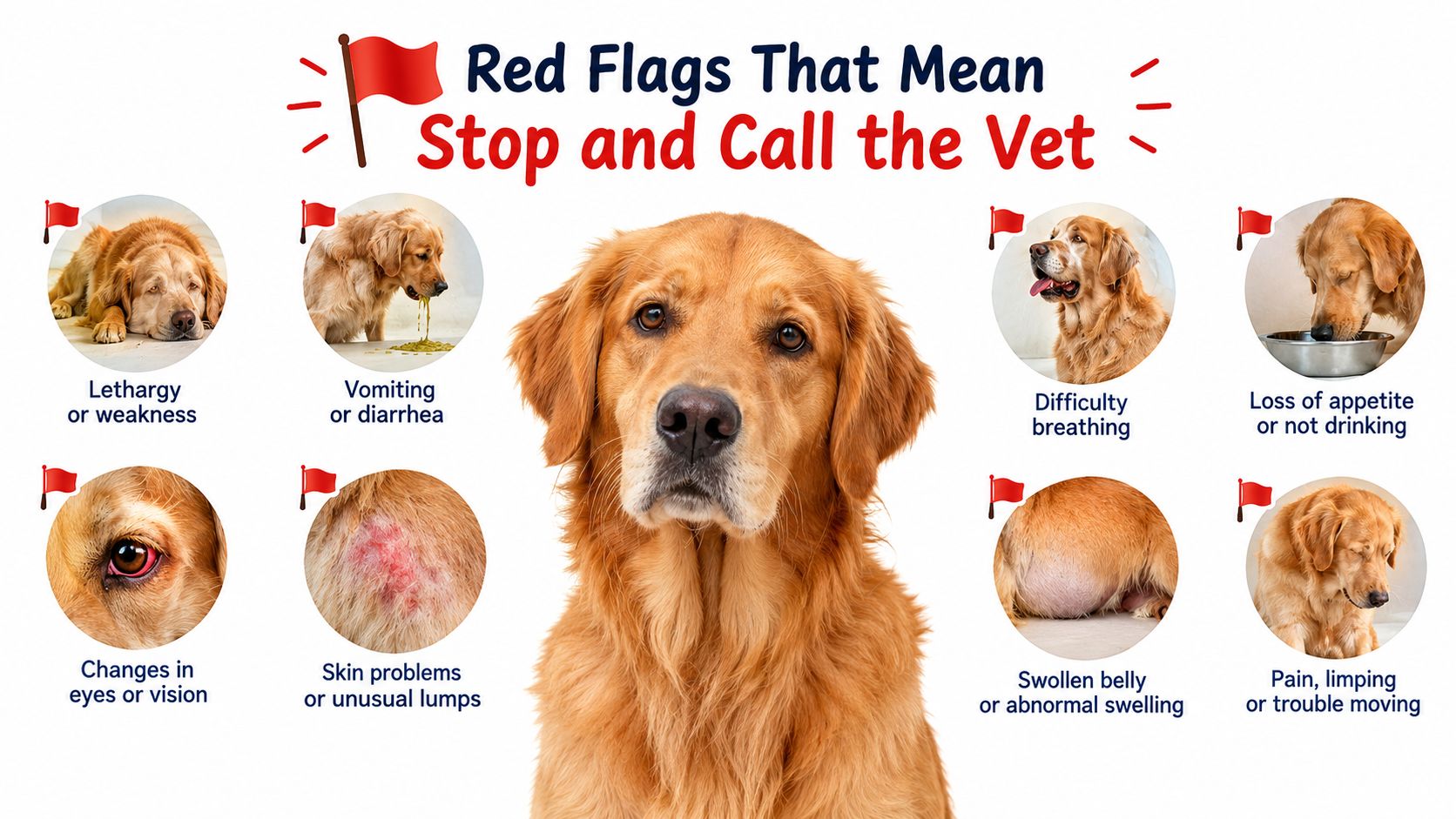
A veterinary visit is also appropriate when the itching is generalized, malodorous, recurrent, associated with the ears, or causing self-trauma. Your veterinarian may need to investigate parasites, perform skin or ear testing, evaluate infection, review prevention history, or consider dietary and environmental triggers. Chronic itch may require prescription therapy rather than repeated OTC applications.
Bandana Rx provides OTC pet-care products as well as prescription veterinary medications, with prescription orders processed after veterinary authorization and shipped to eligible U.S. states. The pharmacy can be part of the next step when your veterinarian has identified an appropriate product and prescribed treatment.
Visit Bandana Rx to review pet-care and medication options that match your veterinarian's recommendations. If your dog's itching is persistent or severe, arrange the veterinary evaluation first, then use the pharmacy to support an accurate, label-guided treatment plan.