


Your dog still greets you at the door, but walks are shorter, naps are longer, and weight has crept up even though meals haven't changed. You might also notice a thinner coat or skin trouble that keeps coming back. Those changes are easy to blame on age, and sometimes that's all they are. Sometimes, though, they're a sign your dog's thyroid isn't making enough hormone, and that's when canine thyroid medicine enters the conversation. The tricky part isn't just the pill itself. It's confirming the diagnosis, giving the dose the same way every day, and timing blood tests so the results mean something.
Table of Contents
- What Is Canine Thyroid Disease
- How Veterinarians Diagnose Hypothyroidism
- Levothyroxine as the Standard Treatment
- Dosing and Administration Best Practices
- Monitoring Treatment and Blood Test Timing
- Managing Side Effects and Concurrent Conditions
- Long-Term Care and Refill Strategies
What Is Canine Thyroid Disease
Think of a middle-aged retriever who used to pull toward the park and now lags behind. Her coat looks dull, she's gained weight on the same food, and she seeks out warm spots to sleep. Her owner assumes she's just slowing down. A veterinarian sees a pattern worth testing, because those signs can fit hypothyroidism, a condition where the thyroid gland produces too little hormone.
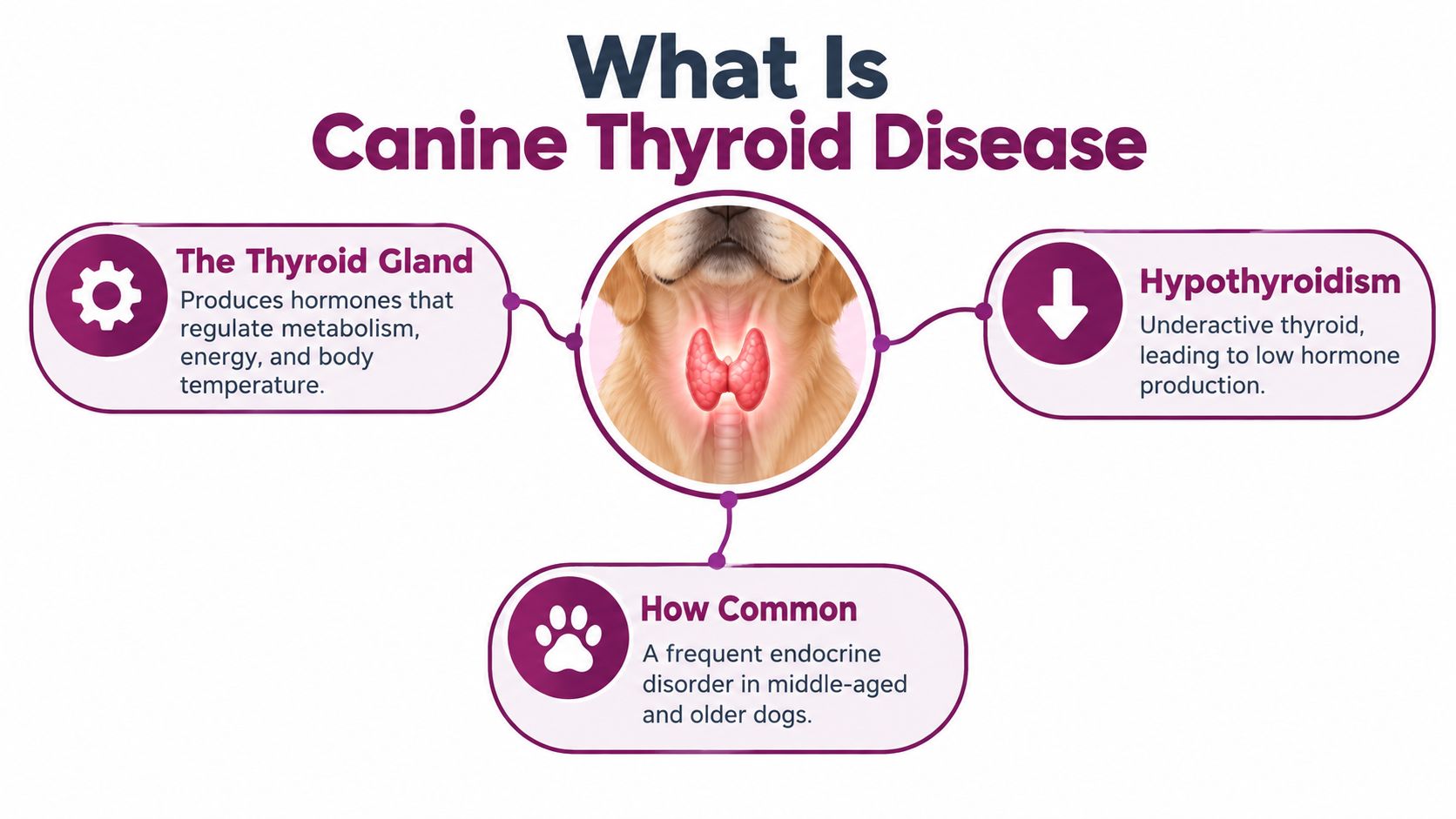
The thyroid sits in the neck and works like a metabolic control center. Its hormones help regulate energy use, body temperature, heart function, skin, and coat health. When production falls, many body systems slow down at once, which is why the signs can look vague at first.
Primary Hypothyroidism and Look-Alike Problems
In primary hypothyroidism, the problem is in the thyroid gland itself, and it can't make enough hormone. That's different from a dog whose thyroid values dip because of another illness or a medication effect. It's also the opposite of hyperthyroidism, where too much hormone is produced, a pattern that's far more typical in cats than dogs.
That distinction matters because lethargy, weight gain, and skin disease have many possible causes. Arthritis can reduce activity. Extra calories can add weight. Allergies can damage skin and coat. Starting thyroid medicine based on signs alone could mean treating a dog who doesn't need hormone replacement while the underlying problem goes unaddressed.
Practical rule: Thyroid medicine follows a diagnosis. It isn't a trial treatment for tiredness or weight gain.
How Common It Is
Canine hypothyroidism is uncommon but clinically important, and it's seen most often in middle-aged or older dogs and in medium and large breeds. Estimates vary by country and study design, with figures summarized at approximately 1.89% of dogs in the United States, 2.7% in Norway, 3.9% in Germany, and 7.2% in Sweden, while a 2024 Journal of Veterinary Internal Medicine study describes overall prevalence as approximately 1%, according to a peer-reviewed report on canine hypothyroidism prevalence. Higher numbers in some studies often reflect dogs already suspected of disease, not the general population.
If weight is part of your dog's picture, your veterinarian may discuss nutrition alongside any diagnosis, and some owners review options such as Hill's Prescription Diet Metabolic Weight Management canned dog food only under veterinary direction. Food alone, though, doesn't diagnose or treat a thyroid disorder.
How Veterinarians Diagnose Hypothyroidism
Owners often expect one blood test and a clear yes or no. Thyroid testing rarely works that neatly, and that's not your veterinarian being indecisive. It's because thyroid values move for reasons other than thyroid disease, so the numbers have to be read alongside your dog's history and examination.
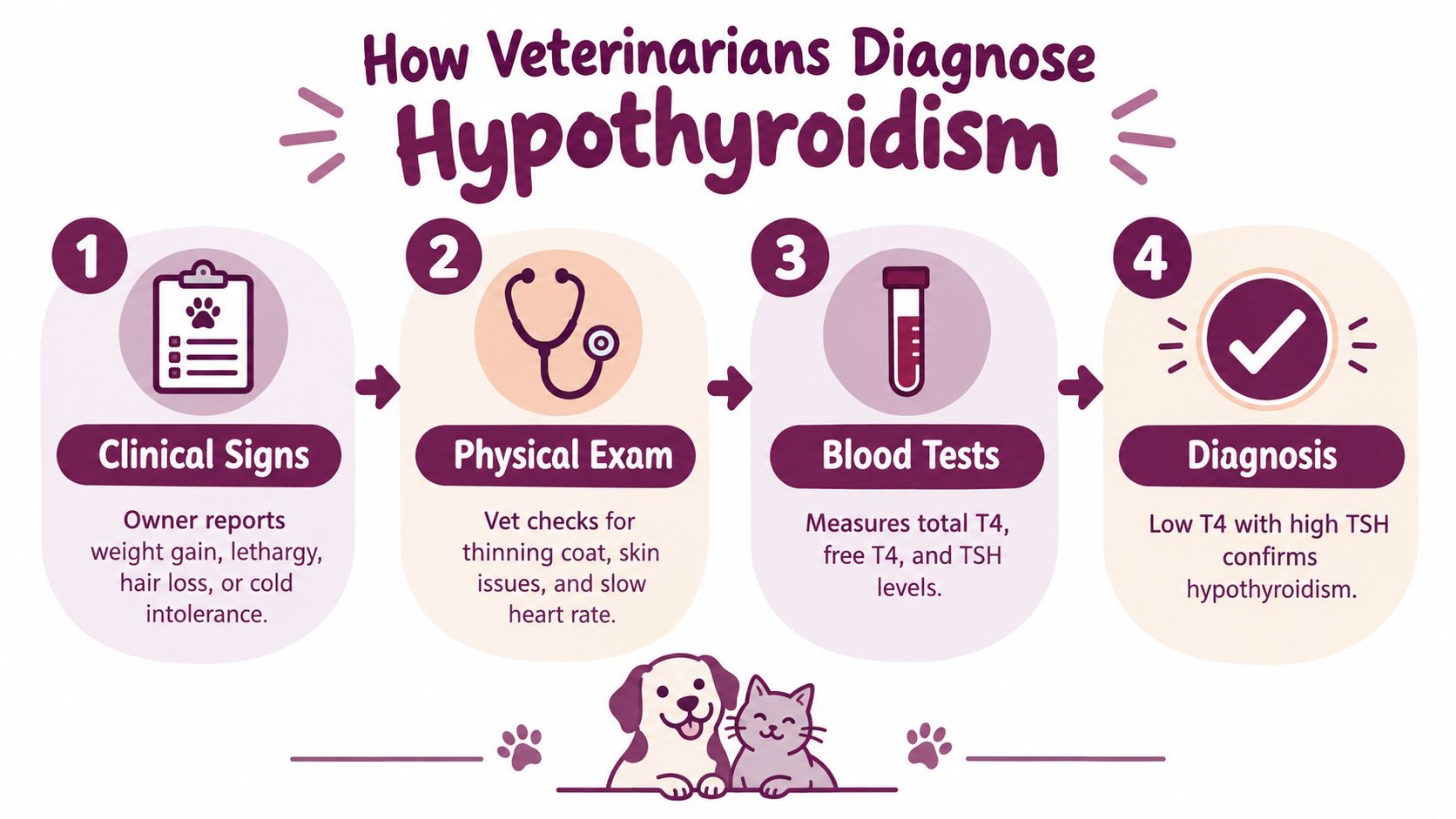
The process usually starts with what you've noticed at home and what the veterinarian finds in the clinic. Weight gain without increased food, low energy, hair loss, thinning coat, recurring skin issues, and sensitivity to cold all raise suspicion. None of them confirms the disease on its own.
What Each Blood Test Tells the Veterinarian
- Total T4: This measures the overall amount of thyroxine circulating in the blood. It's a useful screening and monitoring tool, but illness and some medications can lower it in dogs whose thyroid glands are normal.
- Free T4: This measures the portion of thyroxine not bound to proteins and available to tissues. It can help clarify a borderline or confusing total T4 result.
- TSH: This is the signal from the pituitary gland telling the thyroid to make more hormone. When the thyroid can't respond, that signal often rises, so it adds context to a low T4.
Why One Low Result Isn't Enough
A single low total T4 doesn't prove hypothyroidism. In one clinically evaluated group described in the verified research summarized earlier, most dogs had below-reference total T4, yet some dogs in the evaluated population fell within the reference range, which shows why one value can't stand alone. Your veterinarian weighs clinical signs, breed, age, concurrent illness, and current medications before deciding.
This is also why you may be asked to repeat testing or add another test rather than start medication immediately. It can feel slow when you want your dog to feel better. But a careful workup protects your dog from unnecessary lifelong treatment and protects you from recheck results that are impossible to interpret later.
A diagnosis built on signs plus a full thyroid picture is far more reliable than a prescription built on one low number.
If the combined picture supports primary hypothyroidism, the veterinarian can prescribe replacement therapy with confidence. If it doesn't, you've avoided masking another condition that needs different care.
Levothyroxine as the Standard Treatment
Once hypothyroidism is confirmed, treatment is conceptually simple. Your dog's body isn't making enough thyroxine, so the prescription replaces it. Levothyroxine is a synthetic form of T4. After your dog absorbs it, the body converts T4 peripherally into T3, the more biologically active hormone, as needed.
Think of T4 as the supply your dog draws from and T3 as the form tissues use most actively. Supplying T4 lets the body's normal conversion process do its job, rather than forcing one symptom, such as low energy, to change in isolation. That's why veterinarians judge success by both blood values and how your dog looks and feels.

Why Levothyroxine Is the Drug of Choice
The Merck Veterinary Manual guidance on synthetic levothyroxine as the drug of choice lists a commonly effective regimen of approximately 0.02 mg/kg by mouth every 12 hours, with reassessment after treatment begins. FDA-approved canine products may use a different labeled schedule, so product directions and your veterinarian's instructions take priority over any general description.
Regulatory options have expanded over time, including FDA-approved canine levothyroxine sodium products made specifically for dogs. That matters because dogs aren't small people, and human thyroid tablets shouldn't be substituted for a canine prescription. Strength, dose schedule, and monitoring plan are all selected for your individual dog.
Owners who want to see a specific canine product can review Thyro-Tabs Canine on BandanaRx, but ordering still requires veterinary authorization. The product page doesn't replace the prescription decision.
What Treatment Can and Cannot Do
Levothyroxine doesn't cure the underlying gland problem. It replaces the missing hormone, and treatment is generally continued lifelong for confirmed primary hypothyroidism. As hormone levels become appropriate, your veterinarian looks for improvement in energy, weight trend, skin, and coat alongside laboratory results. Coat and skin changes can take time, so early blood improvement doesn't always mean the coat will look normal right away.
- The goal: Restore hormone availability into an appropriate range for your dog.
- The starting dose: A calculated beginning point, not a guaranteed final dose.
- The adjustment process: Guided by clinical response and timed thyroid testing, not by how a single week at home seemed to go.
Don't change the dose because your dog seems brighter, and don't stop because the coat improves. Those are encouraging signs to report, not instructions to rewrite the prescription yourself.
Dosing and Administration Best Practices
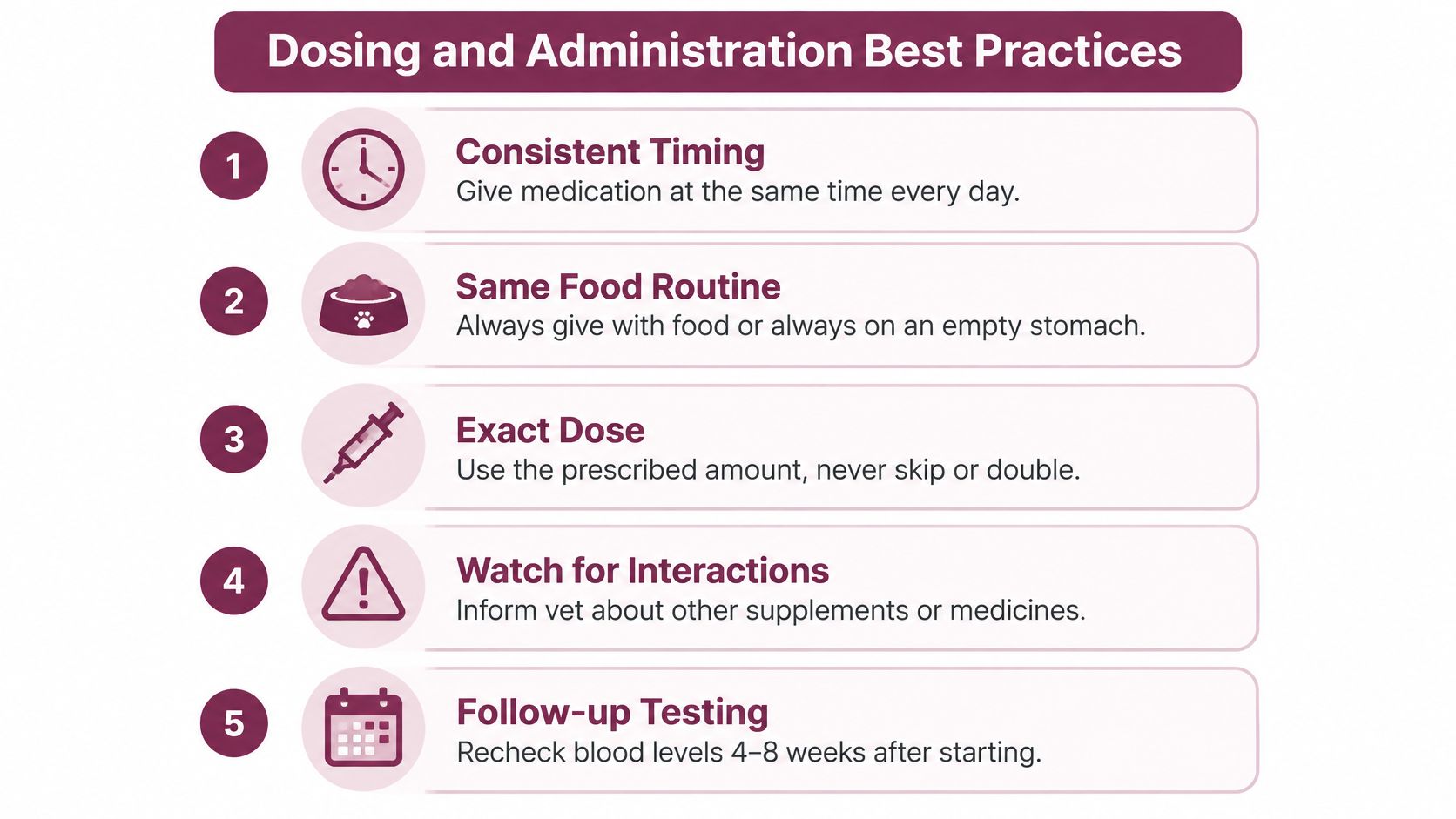
Most day-to-day problems with canine thyroid medicine aren't caused by the tablet. They're caused by small inconsistencies at home. A dose given with breakfast one day, on an empty stomach the next, and forgotten until evening on the third can produce different exposure even though the prescription never changed.
Food changes how levothyroxine is absorbed in dogs. The safe approach is consistency. Give it always with food or always without food, exactly as your veterinarian directs for the prescribed product, and don't alternate based on what's convenient that morning.
Starting Dose and Schedule
For dogs diagnosed with hypothyroidism, an FDA-approved canine product is given orally at an initial total daily dose of 0.1 mg per 10 lb of body weight, equivalent to 0.01 mg/lb or 0.022 mg/kg, given once every 24 hours or divided every 12 hours, as described in the FDA-labeled DailyMed dosing information for canine levothyroxine. Your veterinarian chooses the regimen and adjusts it using clinical response and lab results. The labeled starting dose isn't a universal maintenance dose.
If label directions ever feel unclear, reviewing how to read pet medication labels for dosage, warnings, and storage can help you check the product name, strength, and directions before you give a dose. If anything on the bottle doesn't match what the clinic told you, call before giving it.
Building a Routine That Holds
- Anchor the dose to a daily event: Pair it with a consistent morning or evening routine you rarely skip.
- Use one food rule: Write "with food" or "without food" on your medication note so family members don't improvise.
- Track exceptions: Note a missed, late, or vomited dose instead of trying to remember it at the recheck.
- Ask about missed doses: Don't double the next dose unless your veterinary team specifically tells you to.
- Keep the product consistent: Don't substitute formulations or split tablets differently without asking, since exposure can change.
Administration check: Same dose, same general time, same relationship to food. That repeatability is what makes follow-up bloodwork interpretable.
If pilling is difficult, ask the clinic to demonstrate technique. A calmer, consistent method is safer than hiding the tablet in a large meal one day if your instructions say to give it without food, or skipping doses because administration has become a struggle.
Monitoring Treatment and Blood Test Timing
Here's the part many owners aren't told clearly enough. A thyroid recheck isn't just about getting blood drawn. It's about getting blood drawn at the right time after the pill. A sample collected too early, too late, or before the dose can lead your veterinarian toward a dose change your dog doesn't need.
Post-pill total T4 testing shows how much hormone is circulating after levothyroxine administration. That's different from a pre-pill trough sample, and the two results aren't directly comparable. Mixing them between visits creates apparent ups and downs that may reflect timing, not treatment failure.
The Recheck Timeline
| Stage | Typical Timing | Purpose |
|---|---|---|
| Starting or changing dose | About 4 weeks | Check response and decide whether adjustment is needed |
| Titration period | Monthly until controlled | Refine the dose with clinical signs and lab values |
| Stable long term | Every 6 to 12 months | Confirm needs haven't changed with age or health |
Those intervals come from AAHA guidance recommending testing about four weeks after starting or changing therapy, then adjusting monthly until control is achieved, with testing typically every 6 to 12 months after stabilization. The same guidance notes a post-pill total T4 should generally be collected about 4 to 6 hours after levothyroxine administration.
Reading about the importance of routine vet visits alongside online pharmacy use can help you plan those appointments before a refill is due. Mail-order convenience works best when the lab calendar is planned, not remembered at the last minute.
How to Prepare for a Thyroid Recheck
Call the clinic before the appointment and confirm whether your dog should receive the usual dose that day and at what time. Then work backward. If the blood draw needs to happen 4 to 6 hours after the pill, a morning dose and a midday appointment may fit better than an early appointment.
Bring specific details, not general impressions. Tell the team the exact product and strength, when the last dose was given, whether it was given with food, and whether any doses were missed. Also bring notes on energy, appetite, weight, thirst, coat, and skin. Your veterinarian interprets the number with that context, because a result that looks borderline on paper may make sense once administration details are known.
Don't skip or shift a dose on recheck day unless the clinic instructs you to. And don't adjust the prescription after seeing a result in a patient portal before speaking with the veterinarian. The number is one piece of the decision, not the whole decision.
Managing Side Effects and Concurrent Conditions
When the dose fits your dog, levothyroxine is replacement therapy, not a drug you're expected to merely tolerate. Problems usually signal a mismatch. Too little hormone leaves hypothyroid signs in place. Too much can push your dog toward signs of excess thyroid hormone, called iatrogenic thyrotoxicosis when it's caused by treatment.
Learning to spot both directions helps you call at the right time. You're not diagnosing the cause at home. You're giving your veterinarian useful observations between blood tests.
Signs That Deserve a Call
- Possible under-replacement: Persistent lethargy, continued weight gain, or ongoing skin and coat disease may indicate inadequate dose, poor adherence, administration problems, malabsorption, or even an incorrect original diagnosis.
- Possible over-replacement: Panting, restlessness, increased urination, increased thirst, gastrointestinal upset, or a racing heart can indicate iatrogenic thyrotoxicosis and should prompt veterinary review.
Those sign patterns are described in the FDA information on hypothyroidism in dogs and approved treatments, which also lists a labeled initial total daily dose of approximately 0.022 mg/kg (22 micrograms/kg), reassessment every 4 to 8 weeks during titration, and TT4 measurement 4 to 6 hours after dosing. For a focused owner overview, you can also read about thyroid medication side effects in dogs before your next clinic conversation.
Why Other Health Issues Change the Picture
Concurrent illness, changes in body weight, altered absorption, and other medications can all affect how thyroid results are interpreted or how much hormone your dog needs. A dog who develops gastrointestinal disease, for example, may not absorb a previously suitable dose the same way. A dog who loses significant weight may need reassessment rather than automatic continuation of an old dose.
Keep an updated list of every prescription, over-the-counter product, and supplement your dog receives, and share it at each visit. Don't assume a product is irrelevant because it isn't a thyroid drug. Your veterinarian can decide whether timing separation, closer monitoring, or a dose review is needed.
New restlessness or returning lethargy doesn't automatically mean you should change the dose. It means the pattern needs professional interpretation with timely bloodwork.
Call sooner rather than waiting for a routine recheck if signs are sudden, pronounced, or paired with vomiting, major appetite change, or a noticeably fast heartbeat. Prompt reporting lets the clinic decide whether your dog needs an earlier examination and timed thyroid test.
Long-Term Care and Refill Strategies
Lifelong treatment succeeds when the medical plan and the household logistics support each other. Your dog needs the same medicine, given consistently, with periodic lab review. You need a refill system that doesn't depend on noticing an almost empty bottle on a Sunday night.
Start by putting three dates on one calendar. Note the next thyroid recheck, the date your current supply should run out based on the label directions, and a refill request date that leaves time for veterinary authorization, pharmacy processing, and shipping. Counting tablets is more reliable than guessing how long a bottle usually lasts.
A Refill Routine That Prevents Gaps
- Check supply weekly: Look at remaining tablets and confirm the strength and directions match the current prescription.
- Contact the clinic early: Ask whether updated bloodwork is needed before additional refills can be authorized.
- Keep details current: Tell the clinic and pharmacy about weight changes, new medications, or a changed food routine.
- Don't improvise during delays: Don't borrow another pet's thyroid medicine, use a human product, or stretch doses by skipping days.
- Record the next cycle: When a refill arrives, immediately note the next recheck and reorder reminder.
Prescription authorization isn't a formality. It's how the prescribing veterinarian confirms the product, strength, and dose are still appropriate. If a recheck is overdue, a refill may need to wait until your dog is reassessed, which is another reason to schedule labs before the bottle is nearly empty.
Bandana Rx is a licensed online veterinary pharmacy that provides prescription verification and home delivery for eligible U.S. orders, with tools such as order tracking and scheduled delivery options where available for a product. For a chronic medication, Buy Once can suit a single fill, while AutoShip, when offered for the prescribed product, can help you plan regular replenishment. Don't assume AutoShip is available for every strength or product, and don't let a delivery schedule replace the veterinarian's monitoring schedule.
Store the medicine in its original container and follow the label storage directions. Keep it out of reach of children and other animals to prevent accidental ingestion. If a new bottle looks different, the strength seems changed, or the directions don't match your notes, pause and contact the pharmacy or clinic before giving the first dose from that refill.
Long-term control isn't dramatic. It's a steady loop of consistent dosing, timed testing, honest notes about exceptions, and refills requested early. When that loop holds, your veterinarian gets clean data, your dog gets uninterrupted treatment, and small problems get caught before they become confusing ones.
If your veterinarian has prescribed levothyroxine for your dog, you can explore available canine thyroid medicine options, strengths, and refill choices through Bandana Rx once your prescription details are confirmed. Set up your next refill before the current bottle runs low, keep your thyroid recheck on the same calendar, and contact the pharmacy team if you need help coordinating veterinary authorization for an eligible order.